

Ditch The Ugly Wire Shelves And Try This DIY To Elevate Your Laundry Room
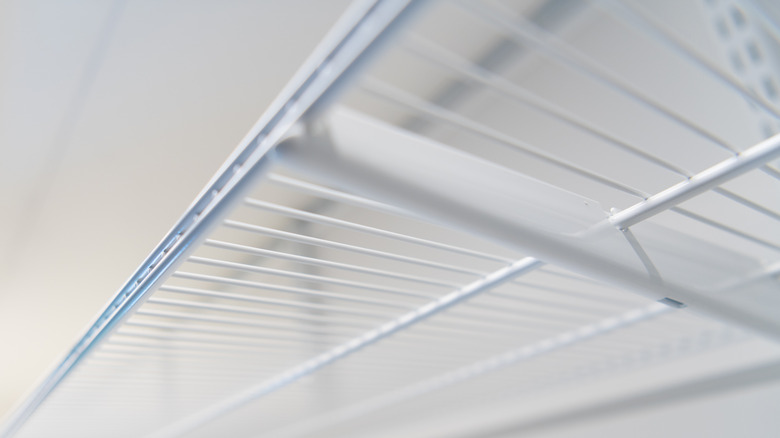
TikToker @atcharlotteshouse was ready to move on from her laundry room's wire closet shelving. The laundry room is one area where you have the license and motivation to make things more functional, even at the expense of stylishness. While you don't get much more functional than wire shelves, they look both cheap and flimsier than they actually are, and they're an understandably common target of DIY renovations and upgrades. @atcharlotteshouse's approach to making new shelves that look like built-in floating shelves is both simple and elegant, and can be done in a weekend afternoon with minimal tools.
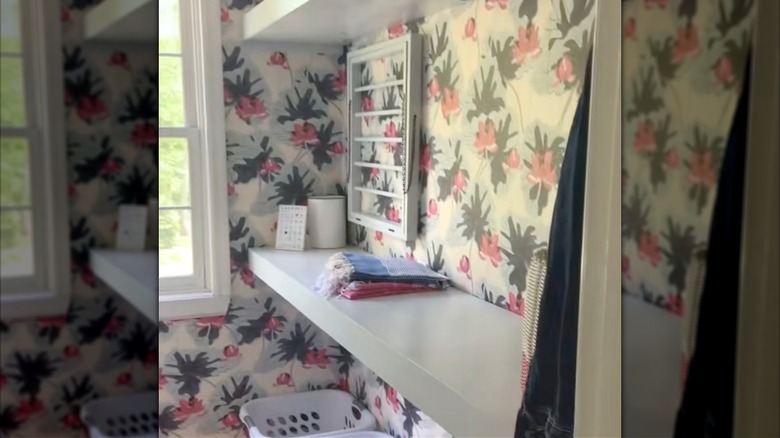
The shelves are beautiful and simple, and this single change might qualify hers as one of the laundry rooms so pretty you might actually enjoy doing laundry. These chunky floating shelves are a welcome correction to all the weird things we've done to support storage, including wire shelving, but also including ugly shelf supports and improperly used L-brackets. A TikTok influencer's laundry room is a world away from my family's laundry room, which in its ideal state would be something like a self-cleaning decontamination chamber, and in its current state is more like a Sisyphean tale of perpetually pushing laundry and cat litter uphill. @atcharlotteshouse's way is better. Might not solve everything, but it looks great trying.
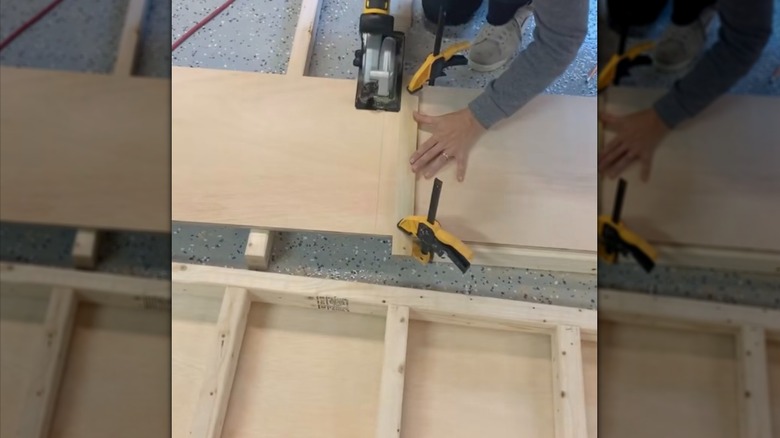
The super-simple build uses 2x3 frames attached to wall studs with heavy duty screws. She broke down some plywood for the shelf tops, bottoms, and fronts, put everything together, then sanded and painted to match her wallpaper. It's a little more time-consuming than approaches like hiding wire shelves by covering them with wood, but certainly nothing daunting.
Choosing the right materials
In some ways, wire shelving is the best material for laundry room shelves — it's waterproof, relatively easy to clean, and is great for ventilation. (Ventilation is important if you are ever going to find damp clothes, dirty or clean, tossed on a shelf. Without airflow, you'll eventually see mold growth on the shelves and have musty-smelling laundry.) But plywood shelves are a good choice for laundry rooms because they're stable and won't warp when exposed to moisture and humidity, and because it's easy to finish. Melamine is another good choice; while it can be painted, it's relatively more difficult. Melamine comes in various widths, but you can get it in 4x8 panels and break it down just like you would plywood. It's only a little cheaper than a sheet of half-inch sanded plywood, so that's worth considering.
Sanded plywood (you can get it pre-primed as well) is the way I'd go. Some brands tend to chip badly when cut, so take care to tape your cuts and make them good-side-down. This is especially important if you're not going to use any trim, though caulk might cover it well enough. If it were something I planned to stain, I'd probably opt for birch plywood, which has a great-looking veneer and doesn't cost that much more. I used a lot of it in my house (even painted) because I found a deal at a liquidator, and it's incredibly stable and forgiving. But stain alone might be a poor choice for a humid laundry room.
Putting everything together
With this approach, you'll have exposed edges to deal with. The way @atcharlotteshouse explains her process, she probably used edge banding on the front pieces of her "floating" shelves, but it's not visible in the video if she did. It would add complexity in cutting and measuring, but it might be worthwhile to miter the corners at 45 degrees, like you would a faux exposed beam. Burnish the corners (gently for plywood), paint, and you might never notice the seams at all.
She uses brads and finish screws for the visible work, and GRK or Spax washer head screws — probably the strongest screws you can buy at your local big box home improvement store — for the structural stuff. This class of screws can be twice the price of the construction screws I use for everything, and, frankly, they're overkill for laundry room shelving. Also note that washer head screws are pan-heads and sit proud of the surface you're screwing them into. This gives extra holding power and is great for attaching the shelf to the wall studs, but it might get in the way anywhere the shelf is supposed to butt against a wall or be covered with plywood. Our primer on the different types of screws is an invaluable reference for unpuzzling all the options.
@atcharlotteshouse DIY laundry room shelves to replace the builder grade wire ones. #learnontiktok #buildlikeagirl #diyorganization #laundryroommakeover #laundryroom
These are gloriously overbuilt shelves. And shelves should be overbuilt, because whoever is stacking stuff on them in the future won't necessarily know their capacity, only that they look super-heavy-duty. Putting two screws in each stud would make these shelves strong enough to stand on, and probably to dance on. But don't, just in case.