

What To Do If You Find Invasive Japanese Honeysuckle In Your Yard
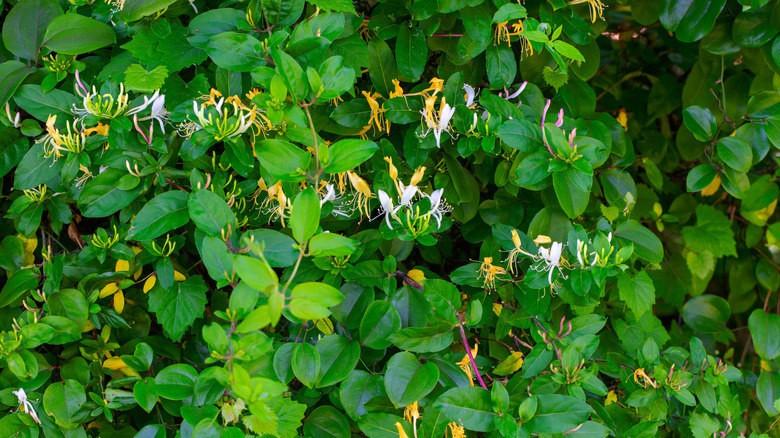
Birds love it, bees love it, and plenty of yards are full of this sweet-smelling woody vine. But Japanese honeysuckle (Lonicera japonica) is no friend to your garden, and is a threat to any other plants and trees you may have blooming. Left alone, this aggressive climber will take over your yard and allow no other species to thrive. It is one of those invasive garden plants to avoid in setting up new landscaping, and if you inherited this problem plant, it is enough of a menace that you'll want to take steps to remove it. Unfortunately, removing this invasive is no small feat, and takes a multifaceted approach that involves pulling, cutting, and applying herbicide.
A native of Asia, Japanese honeysuckle was brought over to the U.S. in the early 1800s and planted as an ornamental and for erosion control. Over the years, this vine proved problematic, escaping into sensitive natural areas and smothering everything in its path. Now it is considered invasive throughout the United States, with a large presence in the American Southeast, but also significant pockets in the West.
Japanese honeysuckle is distinguishable from hummingbird-favorite native trumpet honeysuckle (Lonicera sempervirens) by its flared yellow or white flowers and large, black berries, as opposed to the native's more pink, tubular flowers and smaller, reddish fruit. Unlike trumpet honeysuckle, Japanese honeysuckle takes over by growing thickly up in tree canopies and shading out other species below, and directly kills other plants by strangling them with its tough, woody vines.
How to remove Japanese honeysuckle and keep it from returning
For younger plants that pop up in your yard, you can hand pull them out by the roots, which is easiest when the soil is damp in the fall. Do not just mow back the honeysuckle, or you will cause an even bigger invasion of this plant, which re-sprouts happily from mowed or grazed areas.
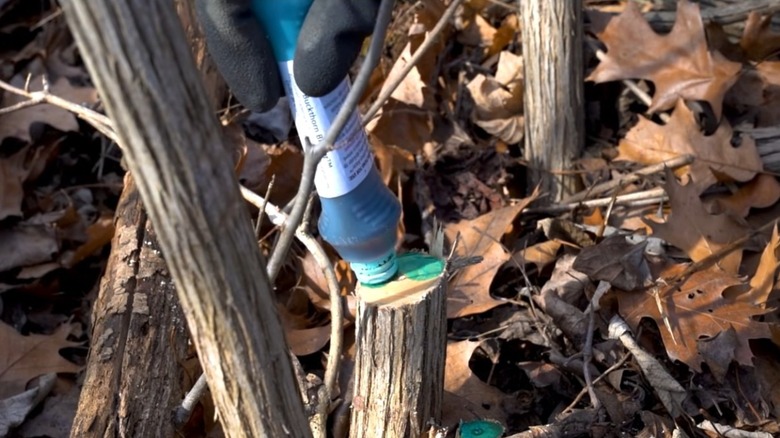
While it is always best to try and find a safe and natural way to control weeds in the garden, for large Japanese honeysuckle plants, you'll need to use an herbicide to be effective in your removal. You will first need loppers or a hand saw to cut the stems back to a few inches high; then, you can paint or spray the cuts with an herbicide, as demonstrated by CincyNature in this YouTube video. Glyphosate (Roundup or Rodeo) is the recommended herbicide to kill Japanese honeysuckle. The Missouri Department of Conservation recommends applying this chemical in the fall after the plant has become dormant, but before the first freeze. Make sure you are wearing gloves and safety glasses if you are using an herbicide.
It may take a few years and multiple treatments to fully eradicate Japanese honeysuckle if you have a large invasion. Once removed, you can replant the area with plants native to your state that won't be in danger of getting out of control in your garden.