

Keep Grass And Weeds Out Of Your Flower Beds With One Gorgeous Garden Addition
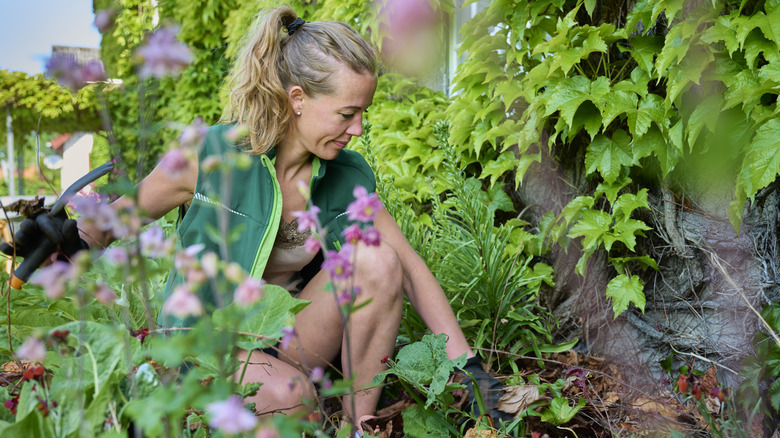
If you've been planning a gorgeous spring flower bed, the last thing you want is weeds popping up around your flowers. You can remove them by hand or put down a layer of mulch, but there's another option that's both effective and beautiful. Ground cover plants can help suppress weeds and grass, and fill in gaps in between your plants. Many of them add aesthetic value to your garden as well. No matter your experience level or garden set-up, there's bound to be a ground cover plant that works for your flower bed.
Ground covers are plants that grow low to the ground and spread out to cover a space. They typically form dense carpets, which prevent weeds or opportunistic grass from getting the light, water, and space they need to grow. This can become a problem if you're trying to grow other plants from seeds in your garden, as the ground cover may also overwhelm them. However, if your plants are all established and already taller than your ground cover will be, and you chose your ground cover with care, then there shouldn't be any problems.
In addition to keeping weeds out of your flower beds, many popular ground covers have flowers of their own, some of which can attract hummingbirds and butterflies. However, there are some gorgeous ground covers that you should avoid. Since ground covers tend to spread, some non-native ground cover plants can become invasive. Creeping Jenny (Lysimachia nummularia), wintercreeper (Euonymus fortunei), and periwinkle (Vinca major and Vinca minor) are all known for being stunning, low-maintenance ground covers, but they're also invasive in the U.S. Instead, focus on native beauties like creeping phlox (Phlox subulata), which is native to the east coast, and baby blue eyes (Nemophila menziesii), which is native to the west.
Choosing the best ground cover for your flower beds
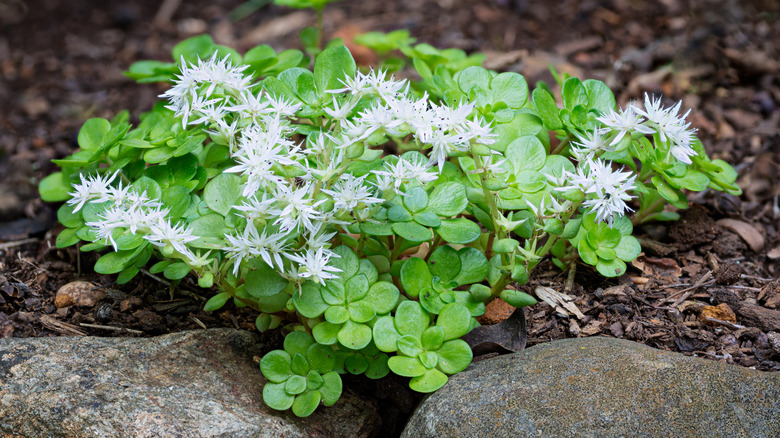
In order to be both gorgeous and effective, your ground cover needs to be in good health. Not every ground cover plant will be a good fit for your garden, so it's important to choose carefully. After all, you won't want a weak ground cover that looks unappealing and can't stop weeds from growing! Start by looking at the conditions in your flower bed. Consider how much sun it gets, what the soil is like, and what hardiness zone you're in. If you have multiple flower beds that are quite different from each other, such as one in full sun and one in deep shape, then you may need more than one ground cover plant.
While any healthy ground cover can repel weeds, you should consider what would pair well with your flower beds aesthetically as well. For example, both wild stonecrop (Sedum ternatum) and heartleaf foamflower (Tiarella cordifolia) are hardy in zones 3 through 8, can keep weeds from sprouting, and enjoy shady gardens, but you might prefer one over the other. If your flower beds are already full of large, showy flowers, then something simple like wild stonecrop's small white flowers might form a nice backdrop without becoming distracting. If your garden could use a little height and visual interest, something more like heartleaf foamflower, with its taller flower spikes, may be a better fit. For sunny gardens, consider plants like bearberry (Arctostaphylos uva-ursi), which is hardy in zones 3 through 7, or geraniums (Geranium maculatum), which is a low-maintenance ground cover that attracts butterflies and is hardy in zones 3 through 11.