

The Quick And Easy Way To Get Rid Of Moss Growing In Cracks
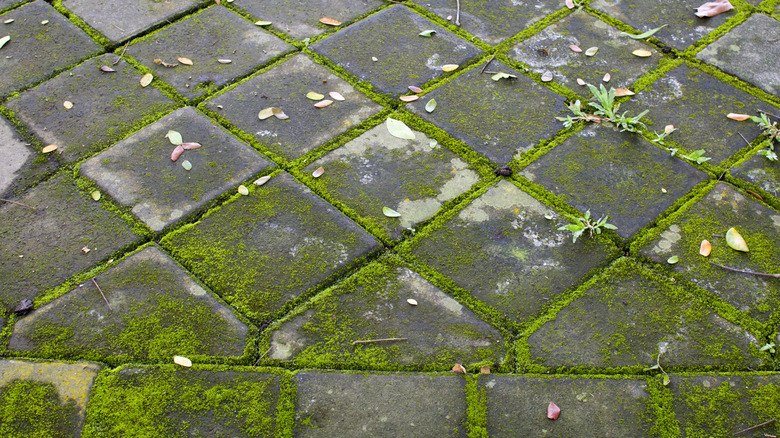
Sometimes the growth of moss along your sidewalk adds to the charm of an outdoor space, bringing a green patina that fits with an English cottage garden or rustic vibe. But if you prefer neat and tidy-looking hard surfaces, moss can look a bit messy — not to mention it can become a slippery hazard on rainy or icy days. For that reason, you may want to get rid of it. Instead of the tedious work of digging it out of all those cracks and crevices, or applying a chemical fungicide that may not be ideal for plants or pets, consider a simpler solution that takes only a little bit of time and effort: a pressure washer.
Pressure washers work by blasting a powerful stream of water against a surface, removing dirt and debris with relative ease. All you need is a hose to supply the water to your pressure washer and a power source. There are a ton of different pressure washers out there to buy or even rent, and finding the right one for your needs depends on how big a space — and how big a moss problem — you have, as well as what type of hardscape material needs cleaning. For big jobs, a heavy-duty pressure washer powered by a gas engine may be needed. But for more delicate surfaces or smaller spaces, a more compact and lightweight pressure washer with an electric motor is all you need.
Pressure wash with care to preserve your sidewalk
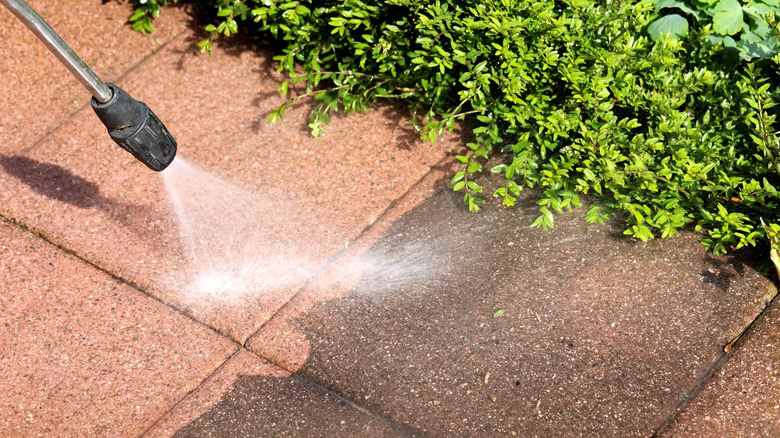
You need to be thoughtful about choosing a pressure washer, paying attention to how much water pressure, measured in pounds per square inch (PSI), you will need. Too much PSI can damage your hard surface or accidentally remove not only moss but also the sand or grout in between pavers. While large areas of solid concrete, such as driveways, can handle being cleaned by a high-PSI pressure washer (2,500+), smaller sidewalks need a lighter touch to avoid damage. Concrete pavers can be effectively cleaned at a PSI of 1,500 to 2,000. Older brick may need an even softer touch, more like 800 to 1,200 PSI. Look at the PSI rating of any pressure washer you buy or rent, and make sure it is adjustable to your needs.
The type of spray nozzle you use with your pressure washer to remove moss is also important. Pressure washers often come with different nozzles providing a variety of spray types, from a fan-shaped spray good for removing surface grime to a more focused, 0-degree spray that gets into the cracks, making it helpful for moss. Experts recommend using a 25- or 40-degree nozzle on mossy pavers. Consumer Reports recommends never using a 0-degree nozzle, as its spray can not only damage surfaces, but also pose a real safety hazard.
Whichever nozzle you use, be sure to hold the sprayer at least 12 inches above the surface and keep it moving so you don't gouge or damage one spot with all that powerful water. And before attacking your moss, be sure to secure any loose pavers, or you might cause more damage.