

This One Kitchen Upgrade Can Make Your Whole Space Feel Open And Airy

Newer home builds have shifted toward airy layouts. However, older houses tend to have more closed concepts with partitioned kitchen and living areas. In my thirteen years as an interior designer, I'm finding that more families feel a bit of separation isn't necessarily a bad thing, but rather a welcome change to the blurred boundaries in open concept homes. That being said, this shift back toward more delineated spaces hardly means homeowners want to be completely cut off from other main rooms. So, striking a middle ground during a refresh or renovation is essential for achieving the right balance. One option, which has been on an upward trend in recent years, is incorporating a pass-through window between the kitchen and living room. This creates a connection and flow between spaces without knocking out all of the walls. It's also a great alternative to an open concept floor plan that still provides functionality.
Now, these are not your oddly small pass-through windows of yesteryear, which were common in midcentury homes. You know the ones I mean: the awkward, undersized holes in the wall that do very little for the aesthetics or functionality of either room. No, I'm talking about the architecturally-significant pass-through windows. These are transforming today's more closed concept floor plans into spacious-feeling interiors connected with intentionality and visual interest. You may want to socialize with family or guests, keep an eye on the screen while preparing game-day snacks, or let natural light permeate from one space to the next. A kitchen pass-through window can help dramatically transform your home, as long as you go about it the right way so it doesn't look dated.
A kitchen pass-through window can elevate the look and function of your home
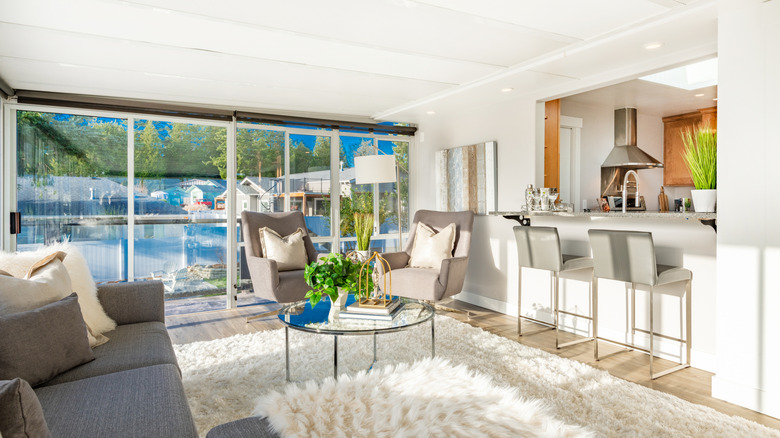
A pass-through window between the kitchen and living room has many benefits. A cutout of the drywall lets in light and opens sightlines. This crucial connection between rooms gives the home a feeling of airiness, spaciousness, and visual cohesion between spaces. The kitchen to living room bridge also allows for better socialization, communication, and a way for parents to keep an eye on younger children.
However, since this design feature is also not a full commitment to a totally open concept floor plan, it allows both spaces to maintain some individual identities and privacy, which helps to keep the floor plan defined and cozy. After so much time spent at home together during the pandemic, I've noticed that many people have a newfound appreciation of a more closed concept home as an alternative to overwhelming open concept floor plans. A pass-through window is the best of both worlds. It's a happy medium between the two ideas that allows free-flowing conversation and functionality while still maintaining a sense of delineation.
Lastly, a pass-through window is an opportunity to create a design focal point in your space. It naturally catches the eye due to its prominent size and central position in both rooms. But this is also exactly where a poorly-planned pass-through window could fall flat, looking like a dated relic of a home built in the latter half of the last century. So let's talk about how to create a wow moment instead of an underwhelming flop.
Updated pass-through windows are all about scale and architectural details
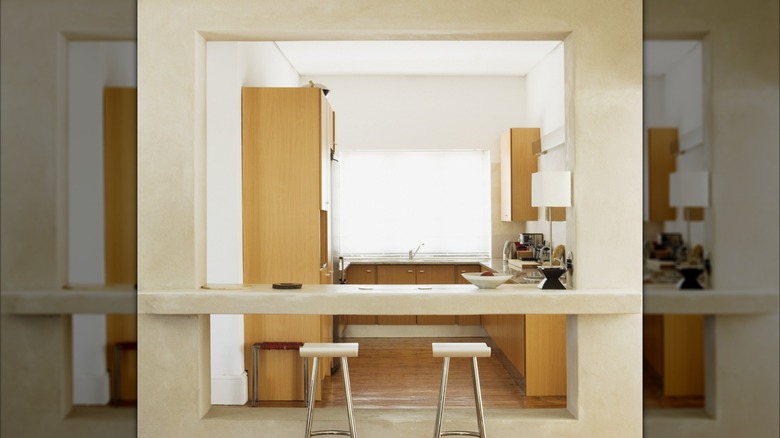
To avoid a dated pass-through window, pay close attention to scale. Anything too narrow or short will feel unimpactful and pointless. If you have to duck to look through it, such as a window with upper cabinets above, it's an absolute no-go for me. Today's most inspiring pass-through windows commit to a significant size to truly bridge the spaces. If you can take it close or all the way to the ceiling, fantastic. This will make the ceilings seem higher and the room more spacious. If you're slightly confined by height, consider creating a wider window, perhaps with an arched top or something architecturally unique to elevate the visual.
In addition to a functional, beautiful size, treat the pass-through window as an important architectural component of your home. A countertop can strengthen the connection to the kitchen. This could be a raised breakfast bar or an extension of the kitchen counters that flows into the living space, like a peninsula. Better yet, rather than a floating countertop extension, ground it with a base or legs on the living room side to make it feel more purposeful.
Lastly, create a statement by giving your pass-through window architectural interest. Add custom trim to both sides so it feels intentional. Alternatively, flank the window with bookshelves or glass panels to give it a meaningful design presence. The more you integrate and highlight the connection between the spaces, the more elevated and modernized it will feel. And that will help you avoid the undersized, almost non-functional pass-through windows of years past.