

This Vintage Glassware Is The One Thing To Always Look For At Thrift Stores
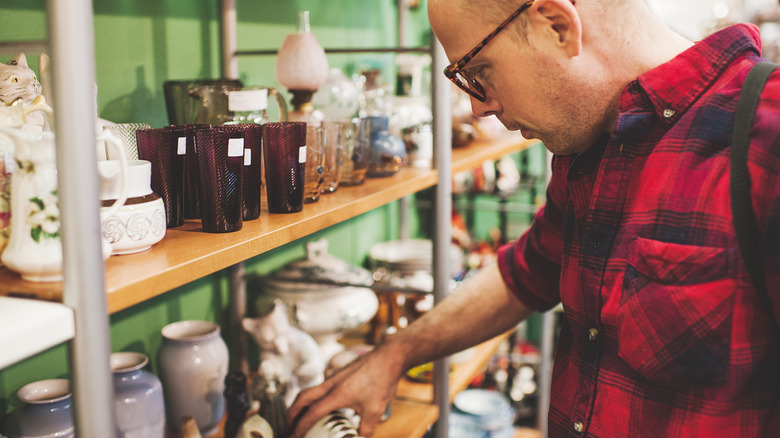
While you might be dreaming of a trip to Venice, complete with gondoliers navigating crowded canals and tolling bells ringing out above Saint Mark's Square, the vintage glassware shelves at your local thrift store can offer just as much of la dolce vita. Eagle-eyed thrifters are starting to spot pieces of Murano glass that are worth a fortune at auction. Made on the eponymous island in the northern part of the Venetian lagoon, Murano glass is made from a unique mixture of silica, soda, lime, and potassium by craftspeople whose glassmaking heritage dates to the Renaissance. But beyond these artisanal qualities, the highly collectible glassware is often further elevated by the inclusion of real 24 karat gold, sterling silver, and other minerals added in thin layers to achieve brilliant colors and designs during the blowing process. Today, lucky buyers have reportedly paid thrift store prices for Murano glass pieces that have ended up selling for thousands.
Even Katherine Hepburn wasn't immune to spotting a brightly colored piece of Murano glass and falling madly in love. The red goblet in the classic film "Summertime" has been widely noted as the start of an American infatuation with these colored glassware finds. "Everybody's grandmother went to Venice and bought some. Then, they put it all away to be used on some special occasion and so nothing ever got broken. That's why there is so much around," New York designer and collector Marjorie Reed Gordon explained in an interview with Martha Stewart.
Murano glass is valuable if you know how to spot authentic pieces
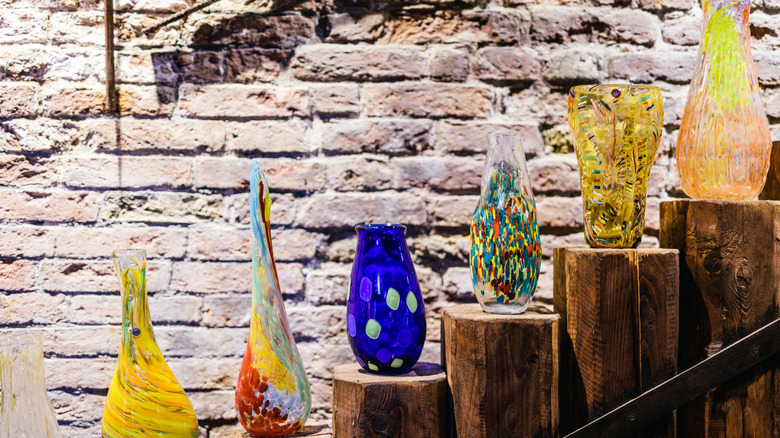
Unlike the distinctive patterns and shapes that make it relatively easy to spot valuable vintage Pyrex items you should never overlook at the thrift store, finding authentic Murano glass requires a little more know-how. Like champagne, although many imitations abound, the real thing comes only from the region bearing its name. Murano glass is made by hand, so one of the first ways you'll know you've found a counterfeit on the thrift store shelves is if the piece looks too perfect. Instead, little irregularities, imperfect textures, and even tiny bubbles in the glass are all good signs.
While heft can be a positive sign for thrift store and estate sale finds like copper and crystal, finding a heavier piece isn't a good sign when it comes to Murano glass. Since it's made using thin layers, valuable vintage glassware pieces will be lighter weight than they appear. Even if you find a strikingly colorful piece full of metallic flecks, if it feels dense and heavy, it's probably a Murano counterfeit.
The best way to recognize real Murano glass is to look for a label of authenticity, signature or maker's mark, or a punt mark (also called a pontil) on the base. This will be a small tip or indentation where the glassblower released the creation from a metal rod. You should be suspicious of perfectly smooth glasses or matching sets since this indicates mass production instead of handcrafted origin. However, if you find an authentic piece of Murano glass at the thrift store for just a few dollars, it could be well worth the investment since collectible pieces can sell for thousands of dollars.