

No More Sticky Kitchen Cabinets: This Finish Is The Best Defense Against Grease
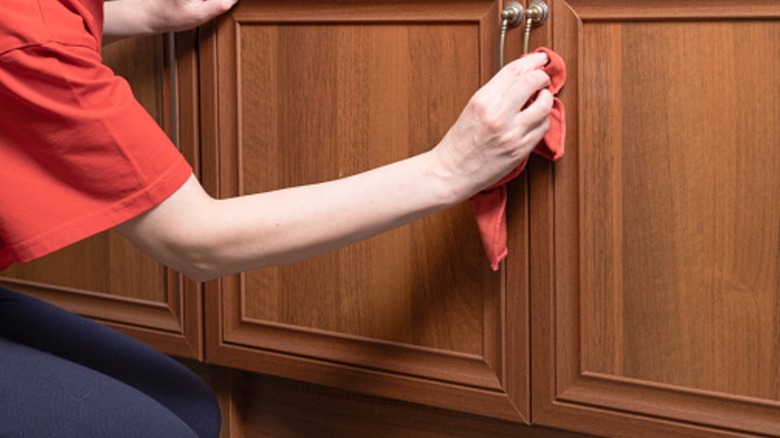
Unless you like to microwave all your food, grease in the kitchen is hard to avoid, and that's bad for your cabinets. Grease flies around the room whenever you cook with oil on the stove — even if you turn on the range hood — and you spread it yourself whenever you touch anything with greasy fingers. Wood cabinets need a tough finish to resist this onslaught and make them easier to clean.
Of the many types of wood finishes available, the one applied at the factory is usually catalyzed lacquer. It's noxious, flammable, and dries very quickly, so it isn't the easiest finish to apply, but luckily, there's another highly durable finish that's much more suitable for DIYers : two-part polyurethane, also known as 2K poly.
This two-component product consists of primary finish and a catalyst that, once added to the finish, initiates a cross-link reaction that produces a super-hard surface resistant to damage or staining from grease splatters. One popular brand is Renner, which offers 2K polys like 688 and 851 as both clear and pigmented topcoats. The finishes come in different glossiness levels, so you can choose the best sheen for your kitchen cabinets. The products are pricey, typically costing over $100 per gallon for just the topcoat (the catalyst that enhances its durability costs extra). But they give you a surface comparable to a factory-applied catalytic lacquer with all the advantages of water-based finishes, including easy cleanup, low VOCs, and manageable drying times.
2K poly offers an epoxy-like finish that easily sheds grease
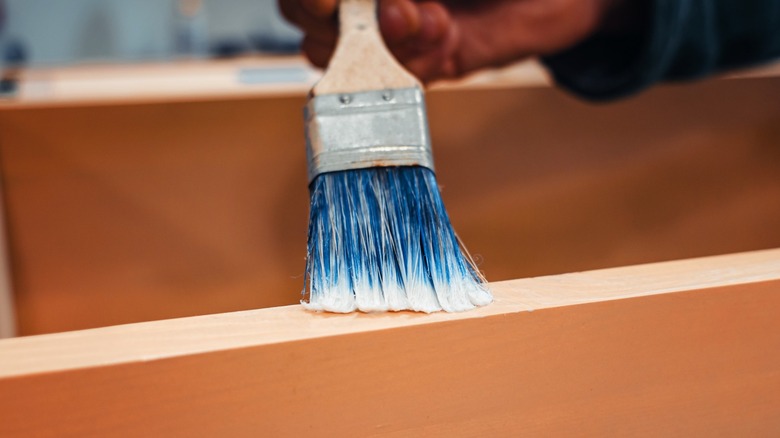
When choosing a stunning paint color for kitchen cabinets or an appropriate clear finish, there's always a decision whether to go for a water- or solvent-based product. In the past, if you wanted the most durable finish in a hurry, you would always go for a fast-drying solvent-based product like catalyzed lacquer, but the chemistry of water-based finishes has improved to the point that this is no longer true. In Europe, waterborne 2K systems have largely become the preferred finish option.
Conventional one-part water-based polyurethane produces a very hard surface, and adding a catalyst turbocharges the mixture to make the surface even harder and more resistant to chemicals. In fact, the final result approaches an epoxy finish. You could apply 2K poly with a brush or roller, but spraying gives the best results. That gets messy when finishing kitchen cabinets, so a good strategy is to remove the cabinet doors, take them outside to spray them, and brush or roll the rest of the cabinet (the part you can't take outside). A crucial note: The catalyst in 2K poly products may contain high concentrations of isocyanates, which can cause face and skin irritation or respiratory problems if directly inhaled. Always read and follow the safety precautions on the container and wear appropriate protective gear.
Another important caution to keep in mind is that, once mixed, 2K poly begins to harden in the container. The amount of time you have to use it before it becomes too stiff to spread is known as the pot life, and for Renner 851, that's only about five hours. That means it's important to mix only as much of the product as you're able to use in this time.