

Neither Concrete Nor Gravel: The Eco-Friendly Driveway Material Gaining Popularity
Concrete and gravel driveways and roads have been around for hundreds of years, and while they are durable, they come with their own set of maintenance challenges. Concrete driveways are high quality, but are very expensive, while gravel driveways are prone to weed growth. An eco-friendly alternative that is gaining popularity is recycled asphalt pavement (RAP). It is exactly what it sounds like: old asphalt pavement, from driveways and roadways, that has been dug up and processed (recycled) into a new product. This new product, which is neither concrete nor gravel, has qualities you'll find in both gravel and asphalt driveways. Its cost savings may be even better than a do it yourself asphalt driveway.
It turns out that asphalt is one of the most commonly recycled materials, and that process is very successful. A ton of RAP replaces a ton of newly made asphalt. RAP requires less energy to make than new asphalt. As a result, it is less expensive per square foot than new asphalt (20- to 30% savings); estimates range from $6.20- to $8.75 per square foot for RAP, but around $7- to $13 for new. However, when compared to gravel, it is considerably more expensive ($1.80 per square foot for gravel). With its blended characteristics, many find RAP to be a durable and thrifty driveway option — more so than the many types of gravel driveways.
Pros and cons of recycled asphalt pavement
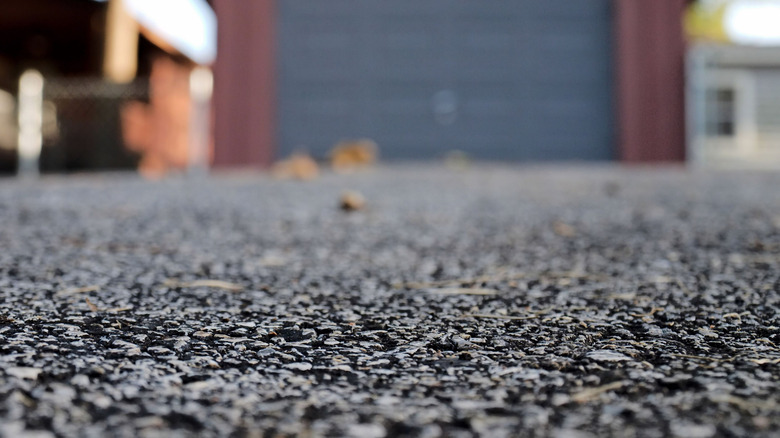
So, what are the upsides of RAP? Starting with a view from 50,000 feet, it is an ecologically sound choice when compared to installing new asphalt. It requires less energy to manufacture, and its carbon footprint is much smaller. By using RAP, the raw ingredients of asphalt are left in the ground, which creates less environmental disturbance. Recycled asphalt makes a durable, relatively low-maintenance, long-lasting surface that sheds water, tolerates snow shoveling and plowing, and is less prone to weeds. And as we've discussed, it is less expensive than a traditional asphalt or concrete application.
Aspects of a RAP installation that some find to be a negative start with its appearance. It will not have the uniform black color of a traditional asphalt application. Its color will be lighter in general and will change from one area to another. Some folks like the look; others not so much. Like gravel, it will show turn and tire marks. It can also develop depressions that will need to be filled from time to time, raking loose aggregate from one place to another. With the fact that recycled asphalt is continuing to gain popularity, it seems logical that the pros are generally outweighing the cons. If you are considering planning a driveway on your property, recycled asphalt pavement is one option you may wish to consider.