

4 "Timeless" Design Trends That Are Actually Making Your Home Look Dated
Barn doors are timeless, they said. Barns have had 'em for centuries; they've stood the test of time. But of course, they weren't timeless in homes, unless you live in a barn or a rural wedding venue. Many design fads are misconstrued as timeless. We've identified a few trends that are called timeless, but when done wrong can make your home look dated: long-standing trends like subway tile and matching furniture; recent trends like modern farmhouse and all-gray interiors.
If this seems confusing, it's only because we sometimes use words that do not mean what we think they mean. The quality of being "dated," for example, requires that the trend be strongly associated with a former period of wide acceptance in the recent past, probably in living memory. Some trends must go through a period of feeling dated before they can have a resurgence. So being dated isn't a quality a thing has, it's a category we impose on it.
Timelessness is a line we draw for ourselves, or that our cultures draw for us, that proclaims, "We will always appreciate and not disparage these particular things." It's a fragile concept when applied to decor, so we usually use it to cover broader design categories, like quality and materials (particularly wood and natural stone). Timelessness is sometimes described as the "holy grail" of interior design. Perhaps that means it's protected by a taunting Frenchman, but if it means the pinnacle of design, it's not quite right. The pinnacle of interior design is a curated, personal space that you love.
Store-bought modern farmhouse
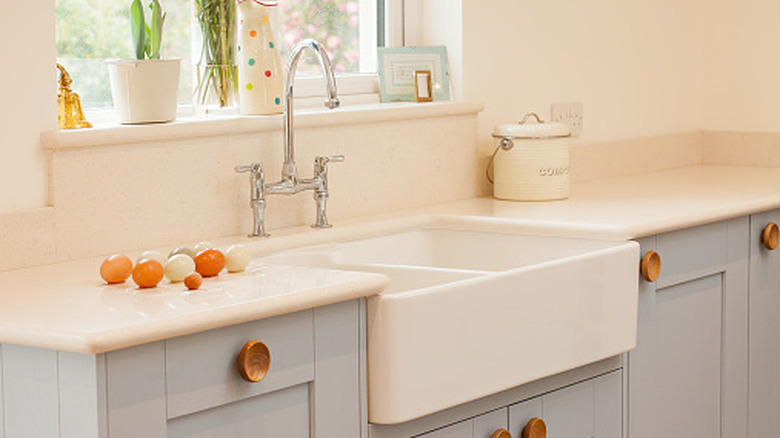
Any style that approaches ubiquity is in danger of being called "dated" within a few years ... or a few hours. This is the position modern farmhouse style finds itself in. "There are some design elements like exposed beams, wood paneling, and wide-open spaces that will never go out of style. Then there are some other ubiquitous items that many top designers say they would kindly ask you to remove immediately," says design editor Laura Kostelny in Country Living.
You can't simply apply the modern farmhouse aesthetic with a composite farm sink and some artificially distressed basswood shiplap. The very term "modern farmhouse" is something of a hedge against overspecification, but the house-flip modern farmhouse elements popularized on HGTV imply that you can get there with a few cartoonish bits of decor. If you try this, your visitors will start looking around for Magnolia paint colors and big clocks on easels.
This is the eyerolling ennui you feel when you encounter a design element for the thousandth time and the twelfth year running in a magazine or a big box store display. But an authentic modern farmhouse is above this fray. Even if everyone's tired of seeing the same gingham cafe curtains and porcelain farmhouse sinks, the immediate and inevitable reaction to walking into a beautifully appointed modern farmhouse-style home is still pleasure. Just aim for the truly timeless aspects of this style: soft, Old World color schemes, natural materials, antique accents, and design cues taken straight from European country houses.
Subway tile
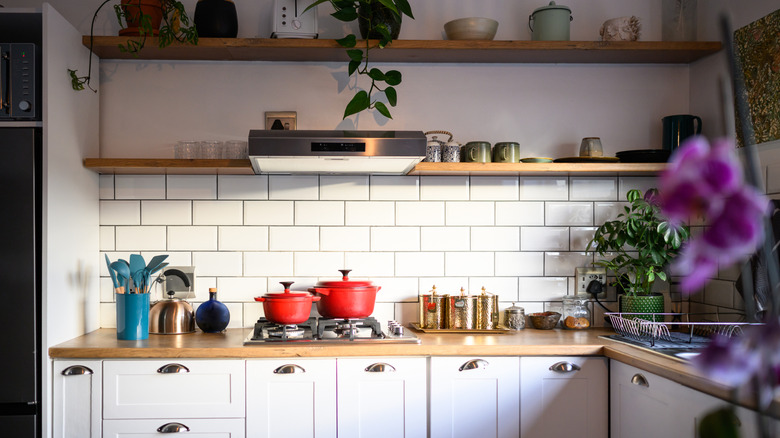
As with shiplap, the omnipresence of subway tile has momentarily contributed to its feeling dated. According to Good Housekeeping, it was once most contractors' go-to, and while it's still fairly common, designer Golara Ghasemi thinks the look veers into "basic." Subway Tile had a fascinating evolution from below to above ground, emerging from an early twentieth-century effort to make subways brighter and more hygienic. It gradually became popular for home interiors.
The tile morphed into the longer 3-by-12 format and a half-dozen other sizes, laid in increasingly extravagant patterns like herringbone or chevron. You can get subway tiles in any manner of cutting-edge colors and patterns, but the classic cool, sterile white, cream, or gray tiles are still prevalent in new builds. According to real estate agent Max Stokes, "Subway tile had its moment; it's now feeling a bit too builder grade for many" (per Forbes). Their simplicity, beauty, and suitability for purpose make them an easy-to-reach-for material for many building a practical kitchen or bathroom, but Nova Tile and Stone recommend aiming for a less conventional design in order to stay trendy with these tiles: lean into rich, glossy hues or arrange them in an unconventional pattern.
Gray drenching
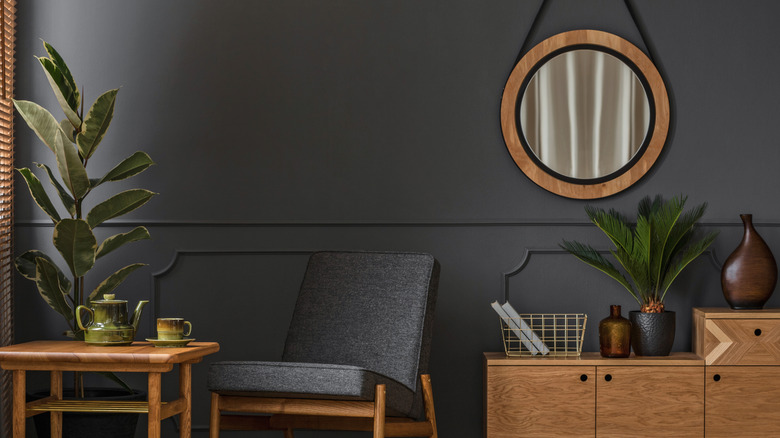
While gray is often referred to as white's moodier cousin, too much of a good thing can make this neutral feel like a fading trend. Some designers have grown so overwhelmed by or overtired with gray that they aren't just opposed to gray drenching, but to any gray finish of any sort. Designer Kylie Mawdsley (who has gray cabinets in her kitchen) has a very strong reaction against any use of gray that isn't motivated by strong biases and preferences. Her logic? Gray isn't getting any more popular. By the time you list your home, the world won't be any closer to loving gray. Gray will make your home look dated compared to newer, trendier homes on the market."
Designer Nicole Fisher notes, "Homes are shifting away from looking 'correct' and toward feeling lived-in and expressive" (per Yahoo! Shopping). Gray is not totally out the door, but when you apply this color, you should do so with other splashes of color and with personality, eclecticism, and variety in mind. On the ubiquitous 'greige' trend, Nina Lichtenstein agrees: "[It] had a long run, covering walls, flooring, and cabinetry, but [it] can leave a room feeling cold and impersonal" (per Homes & Gardens). So, if you're choosing a gray wall with gray furniture but want to keep your space timeless, consider throwing in some rich, ruby-colored drapes, a jewel-toned braided rug, or a colorful tone for your doors and moldings.
All matching furniture
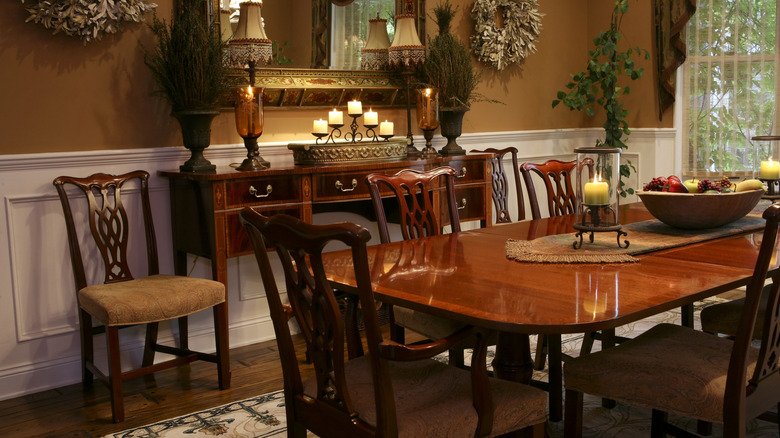
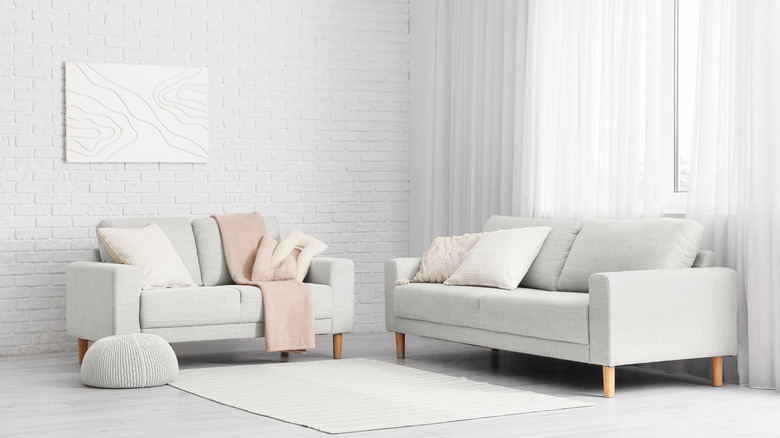
Overly matchy furniture can be a sign that your home design aesthetic is outdated. But just as the proper use of gray is a matter of degree, so it is with matching furniture as well. Yes, a coordinated set of furniture can help an otherwise eclectic room become cohesive, but in a more traditional space, it can come off as boring. Instead, interior designer Rachel Peck recommends, "Be intentional with mixing, and make sure every piece gets you excited. Intention leads to timeless design" (per Real Simple). It's not all about cohesion, but rather, individuality and expression.
"Unlike high-street trends that impose uniformity, creating a home with mismatched pieces adds depth and individuality," says Tom Rutt, of Tom Rutt Studio (per Homes & Gardens). Some DIY decorators think that timelessness means rewriting the same trends over and over, but many designers disagree, emphasizing that individuality is key, as long as your room looks balanced and your choices are refined by one well-thought-out vision. In the right room, you don't even notice that the furniture matches, but in the wrong room, you don't notice much else. It's a matter of balance. Curation and personalization can rescue matching pieces, so long as they're not overwhelming, like ornate, dark cherry dining room suites — which most designers agree are decidedly old-fashioned.