

Exactly What To Do If You Discover A Rabbit's Nest In Your Yard
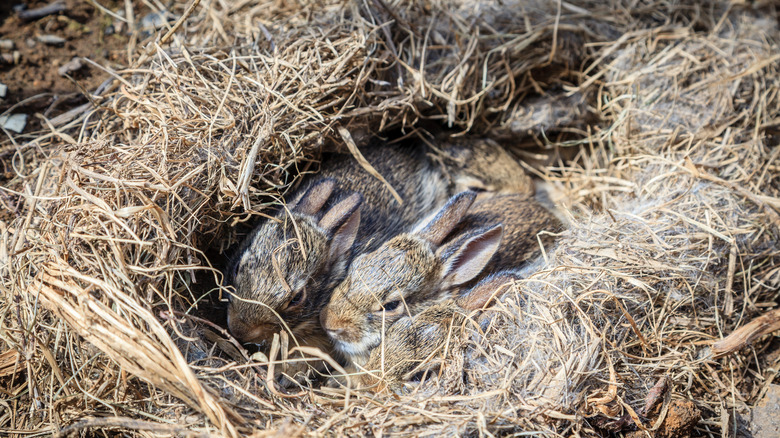
It's surprisingly easy to find yourself staring at a nest of baby rabbits, even in your own yard. The nests are typically poorly concealed, and mother rabbits are notorious for making bad decisions about nest location when trying to navigate humans and their pets. The best thing to do is almost always to do absolutely nothing.
Of course, empathetic people have a completely understandable reluctance to do nothing in a situation that seems to require intervention, especially to save the lives of baby bunnies. Have you seen baby bunnies? Come on. But caring for wild animals like rabbits is illegal throughout the United States unless you're a licensed wildlife rehabilitator. States take these decisions out of your hands for good reasons, one of which is that the need for intervention is usually not as clear as it might seem.
Rabbits can roam from their nests when they're as young as 2 weeks old, and fully independent young rabbits are tiny. So, while it might seem like you've found an orphaned rabbit, odds are that it's just doing its thing. And note that mother rabbits only nurse once or twice a day and don't stay in the nest with their young. In fact, they carefully avoid even being in the nest area except at feeding times. If helping a rabbit — even a clearly injured one — involves having to chase it, just back away and leave it alone. Rabbits panicked from being pursued frequently die from capture myopathy, so chasing it will only harm its odds of survival.
Move your lawn mower, not the nest

Understanding why you should do nothing to help a nest of baby rabbits is tough. Aside from the risk of capture myopathy, some seemingly helpful actions can be harmful as well. For example, leaving food or water for a nest of rabbits or a mother can attract predators — the opposite of what you were trying to accomplish.
There are, however, a few cases in which you should intervene on behalf of a nest of baby rabbits. If the nest is in an area that you have to mow, leave a 10-foot radius of un-mowed grass around the nest. If necessary, upend a lattice-style plastic laundry basked over the nest while you're mowing to keep the nest location in view.
This precaution is necessary because rabbits are among the very few mammals with no ability to relocate their young. They are very specific and particular about nest locations in most regards, and experts agree that a mother returning to a missing nest either won't search for it, won't be able to find it, or won't understand that it is hers. This isn't because of the presence of human scent, so it's better to attempt to rebuild a damaged nest and leave it where it is than move it. In any event, moving the nest will almost certainly result in the death of any baby rabbits within.
Is the nest at risk from pets?

Pets are another common problem for rabbit nests. Both dogs and cats are an extreme danger to baby rabbits. If you have an active rabbit nest on your property, supervise and leash dogs for a few weeks until the nest is empty.
Pet cats should stay indoors or in patios whenever possible. Feral cats are basically an uncontrollable danger to baby rabbits, but house cats will kill something about every other time they're allowed outside, and they tend to torment their prey because they aren't actually hungry. Per a research paper on nature communications journal, cats kill 7.6 to 26.3 billion mammals and birds each year, occasionally eliminating local populations and even destroying ecosystems. And cats themselves are almost always in danger when outdoors, so it's best to keep them inside if possible. Be a good rabbit neighbor and share this information with any of your neighbors that have cats too.
Finally, you can use a laundry basket (again) to protect a nest against pets. Put it over the nest upside down and cut a 3- to 4-inch hole at ground level on two sides so the mother has access. Place a heavy rock (but not so heavy that it'll crush the basket) on top to further deter pets. To prevent a nest from being reused in a bad location, destroy empty nests after the young leave.
When to seek professional help

There are a few circumstances in which you should seek the help or guidance of a licensed wildlife rehabilitator because of a rabbit nest's location. But to understand how rare any intervention should be, consider the fact that over 90 percent of orphaned rabbits will not survive a week and even expert care rarely keeps baby rabbits alive.
A truly abandoned nest is basically the only reason a rehabilitator should agree to interfere with a nest, and might not even consider it unless you've taken the necessary steps to prove the problem is real. The most common way to see if a mother is actively returning to her nest is to create a loose grid of yarn, twine, or small twigs over the nest. If the twigs haven't been disturbed for 24 hours, this indicates the mother might not be nursing the babies. Check the condition of the baby rabbits within. Pinch their skin lightly to see if it "tents" or springs back to its normal location. Failure to spring back can indicate extreme dehydration. Contact a licensed rehabilitator and explain the situation, noting whether the rabbits are warm and if they have their eyes open, and they will determine if the situation calls for professional wildlife removal.
Preventing wild rabbits from nesting on your property

Eastern cottontails nest in spring and summer, typically March through September. To keep rabbits out of your yard and deter them from nesting in a particular location during that period, there are basically two options: fence them out, or deter them with some sensory information they find unpleasant or alarming.
Done properly, fencing is nearly foolproof... but it isn't easy to do and can be quite expensive if you're protecting a large area. A low, fine fence made of wire like chicken wire or hardware cloth should be buried at least 8 inches deep to prevent rabbits from crossing underneath the fence. That's a lot of digging, and your HOA might not appreciate the appearance of your fence anyway.
The HOA, if you have one, is also unlikely to praise the various deterrents used to keep rabbits away, such as reflective scare tape, foil balloons, pinwheels (often used to keep moles away), and even beach balls. Empty glass bottles buried with their necks exposed make a whistling sound in wind that might deter rabbits, and should make mowing quite an adventure. A sufficiently sensitive motion-sensing sprinkler might also help. Some critters are afraid of owl decoys, but results with rabbits seem inconsistent. Chemical repellants have a reputation for not working well against rabbits. Finally, some experts encourage removing a rabbit's escape cover (sort of the opposite of leaving that 10-foot radius around a nest), but this can have negative effects on other species. In any event, do not use any deterrents around an active nest, as it can result in scaring away a nursing mother.