

How To Level An Uneven Lawn Without Renting Expensive Equipment
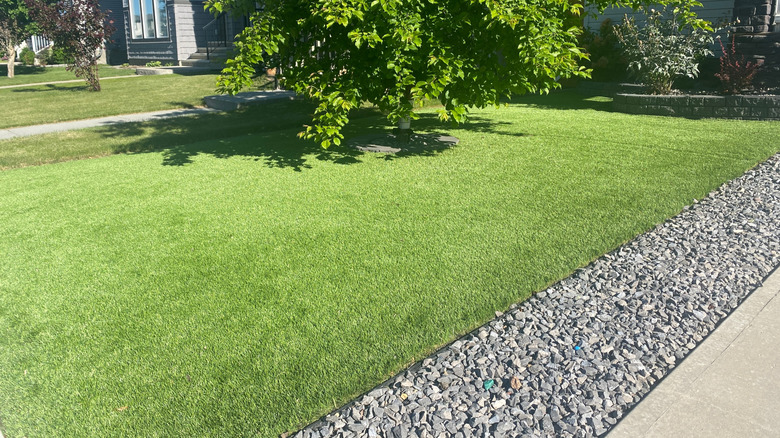
For those who enjoy spending time in their yard, an uneven, bumpy lawn can be irritating. Even if you go through great pains to take care of your grass, over time it can become uneven for a variety of reasons, ranging from heavy rain to burrowing pests. Even improper mowing practices can cause it. Regardless of the cause, you can level an uneven lawn without renting expensive equipment. In fact, many of the tools you need to level your lawn are likely already in your shed — or they should be.
To that end, the first step to leveling an uneven lawn is to gather up the necessary tools and supplies. Again, most of these are essential lawn and garden tools you likely already have on hand, such as a spade or shovel, rake, water hose or section of PVC pipe, and level. You will also want to have a wheelbarrow or 5-gallon bucket handy. One item that is less common, at least for those who haven't dealt with an unlevel lawn before, is either a lawn leveling rake or a landscaping rake. Neither of these items is overly expensive to add to your tool assortment, although for small areas, you can make do with a stiff push broom instead. Finally, you need to have either a hand tamps or a lawn roller.
Of course, in addition to tools, you need material to put in those low spots. For that, grab some topdressing comprised of topsoil, sand, and compost. While the sand is optional, it can help improve drainage, which is often one of the underlying causes of an unlevel lawn. A basic topdressing uses 40% of topsoil and sand, along with 20% compost.
Using basic tools to level an uneven lawn

Using basic tools to level an uneven lawn isn't that complicated. However, it does take a little bit of work, time, and planning. Part of that planning process is choosing the right time to do the leveling. It is usually best to level your lawn in either spring or early fall, when temperatures are not excessively hot, the grass is still growing, and the atmosphere has a decent level of moisture. Additionally, you don't want to attempt it when your lawn is waterlogged from a heavy rain event, nor when it is excessively dry. While planning, you will also need to look around your yard and locate all the low spots. Then, make a sketch showing these spots so you can reference it later while filling and leveling.
Once you've decided on the day and time, begin by mowing your lawn and dethatching, if necessary. Then, create your topdressing mix in a wheelbarrow or bucket. For smaller low spots, simply fill the area with the topdressing, then tamp and level with a rake or push broom. Laying a PVC pipe or garden hose along the edge of the low spot can serve as a visual guide to ensure you adjust the area to the right level.
For larger or deeper areas, you will need to first remove the sod. A flat spade or shovel can be used to cut both along the edges and beneath the sod. Once it has been removed, fill the low area with the topdressing mix, then compact and level it. Next, replace the sod you removed and water the areas thoroughly.