

The Downside To Growing Snake Plants That No One Considers

Snake plants (Dracaena trifasciata) are arguably one of the most popular types of houseplants due to their interesting-looking foliage and overall low maintenance. Caring for a snake plant is relatively straightforward. That doesn't mean snake plants don't have their downsides, though. For one, these plants are slow growers, and they also do not care for too much water or bright light. They're also not very pet-friendly thanks to their toxic saponins. While technically hardy in zones 10 through 12, snake plants are also considered invasive when grown outdoors. There are even some lesser-known downsides to these plants, including the possibility of permanent leaf damage. Snake plant leaf damage is preventable, but treatment success largely depends on the variety you have.
According to the Penn State Extension, there are at least 70 known snake plant species, with Iowa State naming them the most popular houseplant. While all types have interesting leaves that are skinny, long, upright, and snake-like, there's some variability with their exact shape, height, and color. No matter what the variety, all snake plant species can be vulnerable to leaf damage when exposed to too much direct light or cold temperatures.
Excessive fertilizer is another common cause of permanent harm. Some telling signs of this type of damage include brown spots or browning of the leaf tips. While other snake plant issues, such as yellow or wrinkled leaves, can be remedied by adjusting water intake and light exposure, browning is a surefire sign that the affected leaves cannot be saved. Single-leaved species, such as 'Shark Fin' or 'Whale Fin' (Dracaena masoniana), are especially at risk.
Preventing and treating snake plant leaf damage
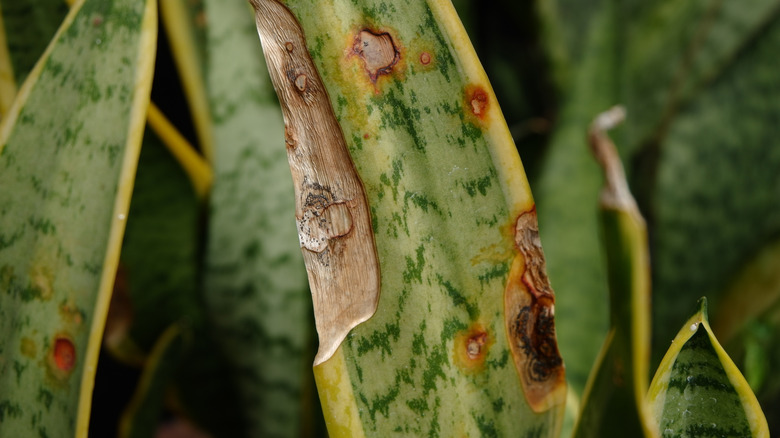
Despite the risk of leaf damage in snake plants, there are some steps you can take to prevent it. First, make sure to place your snake plant in a spot indoors that only receives a maximum of 2 to 6 hours of direct light. Snake plants do not need a lot of sunlight to thrive, and excessive amounts will burn their leaves. It's also paramount that a snake plant is never placed in a spot that dips below 50 degrees Fahrenheit. Finally, do not over-fertilize your snake plant, as too much can lead to leaf damage. As a rule of thumb, Iowa State University Extension and Outreach recommends using either a quarter or half strength of an all-purpose fertilizer during the spring only.
If you do spot some leaf damage on your snake plant, you don't necessarily need to panic just yet. For species that have multiple leaves, you simply need to cut away the damaged ones and let the healthy foliage be. Be sure you cut each damaged leaf down to the soil, rather than just the tips. Pruning them in this way helps to ensure that new (and hopefully healthy) leaves will replace the damaged ones. It's even possible to turn snake plant leaves into a whole new plant. Unfortunately, you may find yourself in a tougher spot if you're growing single-leaved snake plant varieties with browning leaves. At that point, you may not be able to save them and may need to start over with a new one.