

Why Energy Experts Recommend Running Ceiling Fans In Winter
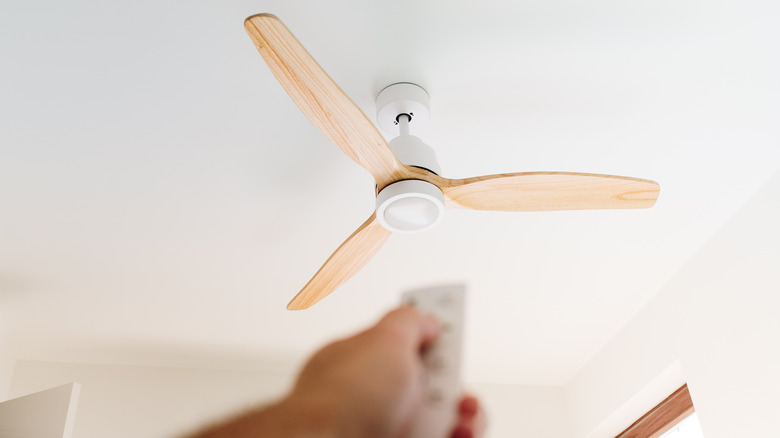
Ceiling fans are the unsung heroes of air circulation and personal temperature control. According to a 2024 survey by 360 Research Reports, "nearly 94 million households use ceiling fans" in the U.S. alone. And while surely all 94 million of those families know a ceiling fan help keep you cooler in summer, not everyone knows you can also use them to help warm you up in winter. This might sound counterintuitive, considering the job of a ceiling fan is to create a draft. But there's actually a setting on your ceiling fan designed for cooler months that reverses the direction of the airflow, helping to make the room warmer.
All it takes to benefit from this winter heating tip is the flip of a switch. By toggling the switch to reverse the spin of the fan to clockwise, you switch the fan from pushing cool air down to pushing the warm air at the ceiling, dispersing it into the room. This reversed airflow helps keep you cozy all season long, and it helps support your HVAC system when you make adjustments in conjunction with ceiling fan use. In other words, this "hot" tip can actually save you a chunk of change on your utility bills. Check out the science behind how a ceiling fan helps make your room feel warmer, how to change your fan's settings for cold seasons, and the best practices for staying toasty while also saving money on your winter heating bills.
The science behind using a ceiling fan to make your room feel warmer

The science behind this clever ceiling fan trick is all in the direction of air flow. Switching the fan to spin clockwise creates an updraft that pulls the cool air upwards. As it rises toward the fan, the warmer air that had stagnated at the ceiling gets pushed outward, down the walls, back to the ground, and then around again. As the warm air recirculates, the room can start to feel cozier.
It's worth noting, though, that even though the fan creates an updraft that distributes warmer air, it doesn't actually heat a room. The idea is that the recirculated warm air helps you feel more comfortable without actually changing the temperature in the space, similar to the way windchill makes you feel colder without changing the outdoor temperature. Basically, it's a perception thing rather than a method of actual heating.
From here, energy experts suggest that since your room feels warmer thanks to the ceiling fan, you can make adjustments at the thermostat accordingly, dropping your home's overall temperature by a few degrees. This reduction means the heater doesn't have to work quite as hard, lowering the load on your HVAC system and therefore extending the lifespan. It also helps reduce the total on your heating bill, saving you up to 15% per month for flipping one little switch on your fan.
Reversing your ceiling fan and best practices for winter months
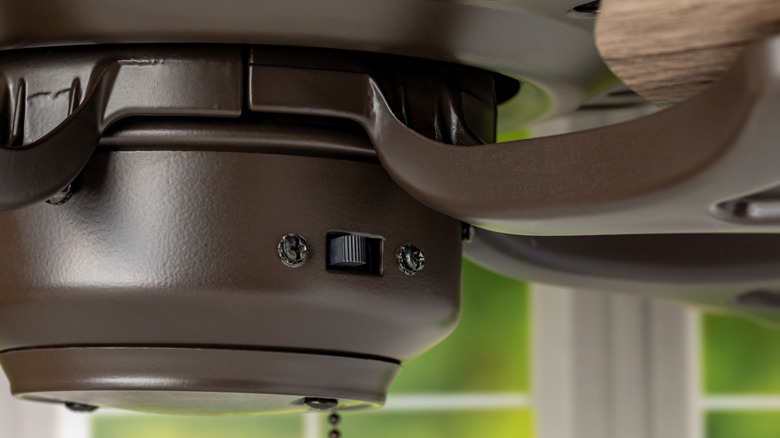
To take advantage of this heat circulation feature, simply turn the fan off and locate the ceiling fan's motor direction switch, typically located on the body of the fan. Toggle the switch to reverse your fan's direction, causing it to rotate clockwise in winter mode. It may be a horizontal switch, which typically needs to be toggled to the right, or a vertical switch, which should be toggled in the upper position. Alternatively, some fans may have a reverse button on their remote for easy switching. Older fans may not have a switch, but you might be able to manually tilt the blade direction to change airflow.
Run the fan on a low setting in the winter to avoid creating a draft. Also, unlike your home's heater that runs constantly, you should only turn on the ceiling fan when you are actually in the room. A fan requires your presence to perceive the change, so it's not worth wasting electricity to run it when you aren't there. Finally, as mentioned above, the only way to see a financial benefit and reduce HVAC load is to actually adjust your thermostat. Dropping your home's overall temperature is what will actually save you a few bucks on utility bills. Your ceiling fans simply help make up the perceived difference by making you feel warmer in a slightly cooler room.