

'No Demo Reno' Star Jenn Todryk's Trick Makes Popcorn Ceiling Removal A Breeze

We may receive a commission on purchases made from links.
You have to really dislike your ceiling to do what homeowners do just to remove popcorn ceiling texture. They'll occasionally replace the drywall completely, cover it with a new layer, or sometimes sand it off with specialized equipment that helps with the resulting mess. Jenn Todryk, star of HGTV's "No Reno Demo," has a method that often works and makes the process easy ... though not quick or mess-free, by any means.
"Unfortunately, popcorn ceilings are one of those things that just age your home the minute you walk into it. It is the sad truth," Todryk told Dallas' D Magazine in 2023. In the final episode of her show's second season, Todryk helped remove the popcorn texture from her client's ceilings. "[When] removing popcorn ceilings, you need a paint rig — essentially a paint sprayer — but we've put water in it. You're spraying up on the ceiling, you're letting it moisten so it detaches itself from the drywall, and then you simply scrape it off," she explained (via Discovery+).
A popular technique in the 1970s and '80s, "popcorn ceilings" describes a couple of the most common types of ceiling texture, added to hide imperfections like unevenness, seams, and nail pops, and to reduce noise by absorbing some frequencies and diffusing others. But today, popcorn ceilings are considered outdated. They also make rooms darker and difficult to clean, repair, or paint. These textures were either hand-applied with trowels, brushes, and other tools, or they were sprayed on in combination with materials to add dimension like polystyrene and vermiculite ... and sometimes asbestos.
How to use Todryk's wet-and-scrape method
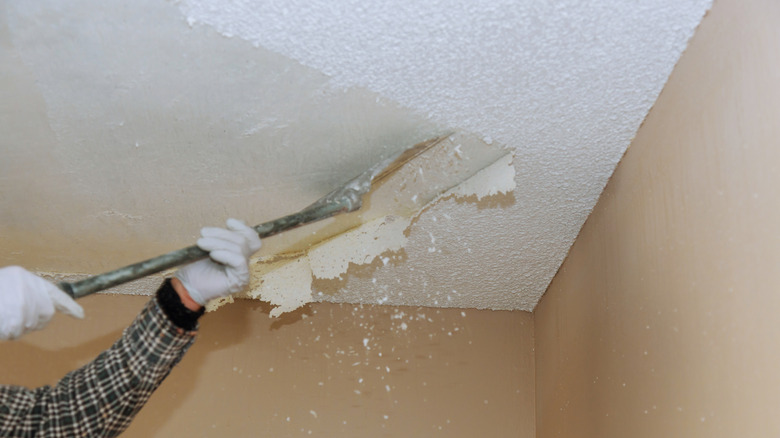
The wet-and-scrape method of removing popcorn ceilings works because water penetrates and softens the joint compound that the texture is typically made of, making it easy to scrape away. Back in Season 2 of "No Demo Reno," Jenn Todryk used a paint sprayer to apply the water, but simple tank sprayers like you'd use in a garden are also common. Use warm water and allow it to soak in for 10 to 15 minutes before scraping. Use a wide, not-overly-sharp tool like a drywall mud knife and work in small sections to make sure the joint compound stays moist. Take care to use enough water to penetrate the ceiling texture, but not so much as to damage the drywall. Hold your scraper as flat to the ceiling surface as possible to avoid digging into and damaging your drywall.
"[It] makes a huge, huge mess," Todryk warned in the episode. She was particularly concerned about the impact on flooring. "You're going to want to cover, cover, cover. Because, again, while it's easy, it's super messy." Cover furniture as well, though it's probably more sensible to remove everything you can from the room before getting started to make access and cleanup easier. If you're not thrilled about working on a ladder, consider a scraper that accepts an extension pole, like this Level5 16-inch Offset Knife, available on Amazon for $35.09. You can simplify cleanup by using a wet/dry vacuum with a tool like the Popeeze Ceiling Scraper ($44.99 on Amazon). If you still have misgivings, consider covering your popcorn ceiling without any mess using lightweight decorative tiles.
What to do when the wet-and-scrape method won't work (or isn't safe)
Jenn Todryk's wet-and-scrape method is easy, to be sure, but chaos can find its way into any process. The two major problems you'll likely encounter with popcorn ceiling removal involve two of the most feared substances in all of home construction: asbestos and paint. In this case, paint turns out to be the worst of the two by a mile because removing a painted popcorn ceiling is an incredibly labor-intensive process for a very simple reason: Some paints will seal the texture against water, making it impossible to soften, and therefore making the wet-and-scrape approach a non-starter.
This ceiling texture, for reasons that seem increasingly paltry, was popular in the '70s and '80s. Asbestos was banned in 1978, but existing material stocks were used until the early 1980s. That means that for most of the time popcorn ceilings were popular, they might have contained a potentially hazardous material. If you suspect your popcorn ceilings might date from this era, you should have them tested by a lab accredited by the National Voluntary Laboratory Accreditation Program (NVLAP). A directory of these labs is available here.
If your ceiling texture does contain asbestos, learning to love it might be the most sensible approach. Disturbing the texture can create a problem where one didn't exist before since materials in good, stable condition aren't usually a threat. If you do decide to go the asbestos-abatement route, you can do the detailed, painstaking work yourself or hire a certified professional (or, more likely, a team of professionals) to do it.