

What Those Ugly Radiator Covers Along Your Walls Are Really Designed To Do
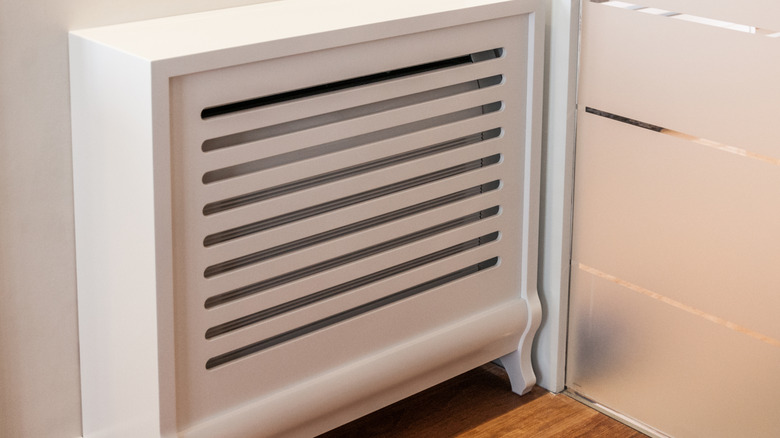
They say beauty is in the eye of the beholder, but sometimes ugly is in the living room of the beholder. Because of differences in taste (some beholders are better than others), differences in budget, and differences in the ever-moving target of fashion, some radiator covers won't be to everyone's taste. And maybe that's okay, if the radiator cover does what it's designed to do. And what it's designed to do is, unsurprisingly, to cover the radiator ... and, as a result, to look better and burn people less often than the bare radiator.
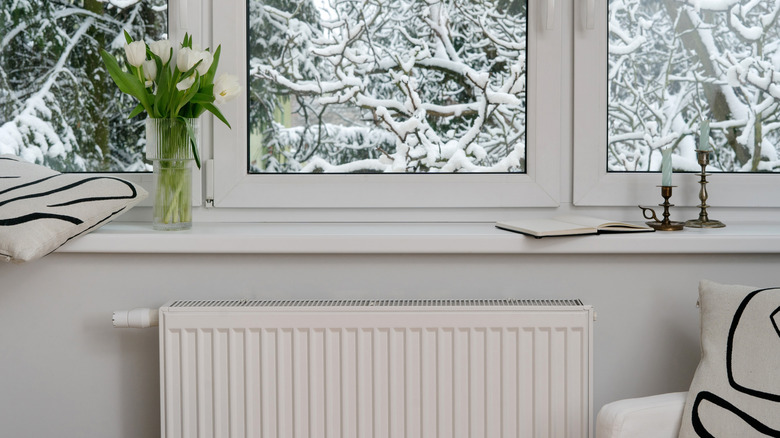
The classic column radiator — the thing you picture when you imagine, say, a New York apartment in the 1940s — is a purely utilitarian object designed to disperse heat by radiation and convection into and around a room. Covers are meant to improve the radiator's aesthetics. There are newer and more fashionable radiator designs, but that just circles back around to the eye-of-the-beholder problem.
There are other purposes touted by makers and sellers of radiator covers. The standard-issue cover can provide additional storage or counter space, protect the radiator itself from damage, protect nearby objects from the effects of constant heat cycling, and help keep the radiator clean, thereby eliminating one of the causes of home radiator odors. A clean radiator is more energy efficient, which is particularly important when you're using a cover, because they also have a bad habit of making your radiators heat less well. As a result, many covers are designed in a way meant to improve their heat-distributing characteristics.
Designing with radiator covers and considering alternatives
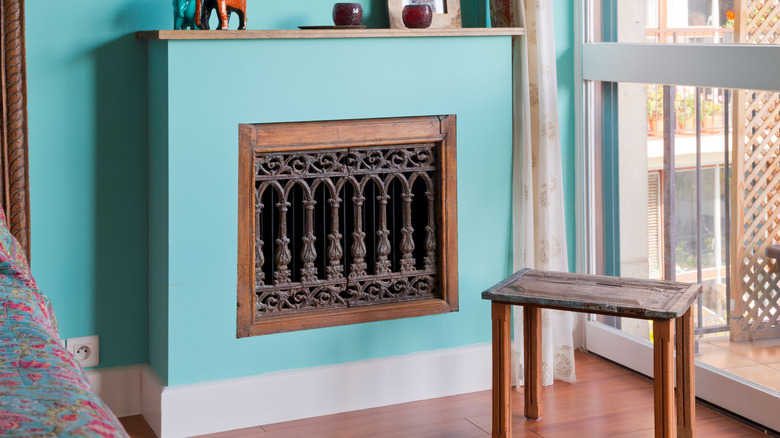
The metal grates, wooden slats, and other openings, and other elements that help release and direct heat also largely define a cover's style. If these gaps, panels, screens, drawers, and shelves are arranged in a way that is in keeping with your home's style, you've avoided the ugly (assuming you like your home's style). Otherwise, you'll find yourself wishing for a radiator cover that does its various jobs while not looking out-of-place or simply unattractive.
There's an amazing variety of radiator covers on the market, from vinyl "wraps" to elaborate wood models that create the impression of a midcentury console table. There are vertically slatted models that look like the ubiquitous acoustic paneling and ones that make your radiator look like a crib has crashed through your wall. Horizontal-slat models can evoke Scandi or sauna. In a narrow space, wall-to-wall models are sometimes constructed to look like built-ins, and there are window seats, bookshelves, and countless other snazzy and clever radiator cover ideas.
Safety issues around your home radiator are mostly a concern with children or in small spaces like bathrooms. Otherwise, you have the option of leaving your radiator uncovered and decorating around it. This usually involves painting it to match the wall and using wall decorations to create a composition that works in your space with elements like shelves, art, a mirror, or anything else you can style suitably. Consider mimicking your radiator's shape characteristics with similar, simple pottery and other objects. Use heat-tolerant structures and objects that don't need to be handled, and avoid large elements that will block the movement of heat.
Coping with the efficiency trade-off
However retailers might downplay it, radiator covers reduce the amount of heat that flows through your room. Many consider it an acceptable trade-off for improvements in interior design, and this is nothing new. There's a reason that traditional HVAC ductwork is concealed in walls and ceilings, even though exposed ductwork is more energy efficient. Basic research conducted at Liverpool John Moores University showed that a wood cover can lead to almost a 40% heat loss. ("Loss" isn't quite the right word; the heat is actually being trapped inside the cover by the insulative properties of wood.) That might be more trade-off than you want to make, so it's good to know what to look for in an energy-efficient radiator cover.
One way to mitigate this inefficiency is through the choice of materials for your radiator cover. The same study showed that radiators with magnetically applied wraps produce more heat (between 13 to 20% more) than radiators with traditional wood covers ... but, of course, less than a bare radiator. The result might have actually been even more impressive, but interpretation is limited by the way temperatures were measured. Metal covers in general block less heat, and metal can also be used internally to control how heat moves.
Some covers incorporate reflective surfaces designed to direct heat, thereby improving efficiency, in part by reducing heat loss to insulative materials like wood. Look for designs with these reflective panels, in addition to openings on all sides (the more openness, the more heat passes through). Some designs, especially those with top shelves, can also help direct heat convection deeper into the room.