

Erin Napier's Unique Kitchen Backsplash Idea (That Isn't Cliché Tile)

It probably wouldn't occur to most suburbanites or city folk (or to most designers) but someone like HGTV's Erin Napier knows when to let a kitchen wall be a backsplash. Replacing the standard cookie-cutter tile backsplash with a classic beadboard alternative doesn't come up a lot, yet when it does, it usually involves a kitchen that needs a little texture and a way to keep some of its historical character. The approach is one of the more surprising things you can do in a modern renovation, and it looks absolutely natural.
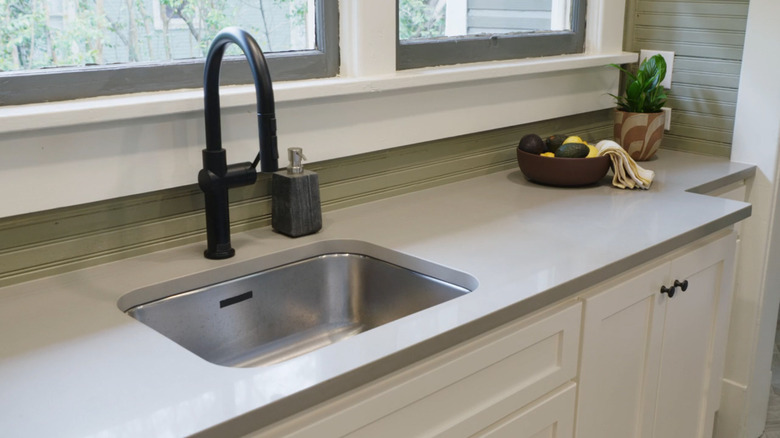
The beadboard backsplash appeared twice in Season 6 of Napier's show, "Home Town." In Episode 7, Napier was completely overhauling a home's kitchen and wanted to preserve some sense of history against the onslaught of "new construction" vibes. So her team painted the existing beadboard sage-gray and the new cabinets blue-gray, and the resulting look was spectacular ... and inexpensive. "For [client] Luke and this house and the investment he's gonna have in it, this isn't his forever house," Napier explained. "He's a young guy, and he's gonna be moving on. I think not spending money on a backsplash and doing this instead was the right thing."
In the premiere of the same season, the "Home Town" team also left the kitchen beadboard intact. "I really like it. I think the texture is great," Napier said midway through the reno. And in Episode 1 of the next season, Napier ditched the tile backsplash trend for her own staycation getaway house and instead installed V-groove board, a close cousin of beadboard that she also used for at least one other home.
Two (or is it two hundred?) types of beadboard
Let's step back and quickly look at what beadboard is. Traditional beadboard was a wood plank that featured a groove to conceal joints between the boards (by combining the milled groove with the groove of the joint). Some varieties were butted against each other, while others were shiplapped. Later beadboard was typically tongue-and-groove. Double- and triple-beaded boards introduced additional pairs of grooves in each board for a more dense pattern that's represented on most beadboard panels made today. V-groove is similar but includes bevels where the boards meet (rather than a second groove), so it has no bead, the raised semi-circular bit between grooves. The two are closely related, and V-groove and beadboard were sometimes milled on opposite sides of the same board. It's not uncommon for the terms to be used interchangeably. The variety means you can find a style to match your kitchen's design, with tight traditional beadboard working well in cottage or rustic arrangements and spaced-out V-groove designs offering a more modern backsplash.
Beadboard is most commonly used as a wall covering, usually vertical wainscoting. Traditional planks sometimes require additional backing. But it's now easy to find sheets of MDF beadboard that span wall studs just as drywall does, so additional support isn't always necessary.
You can, of course, still buy beadboard planks. In fact, the variety of beadboard sizes, thicknesses, and materials is impressive ... birch, pine, and maple plywood, MDF, HDF, PVC, pine, basswood, and polystyrene sheets and planks. Beadboard is a generally durable kitchen backsplash option, and materials like moisture-resistant MDF or PVC add to its resilience against humidity and splashes. Wood will work, but it may need extra sealing and preparation to prevent warping and damage.
Is a beadboard backsplash a bad idea?
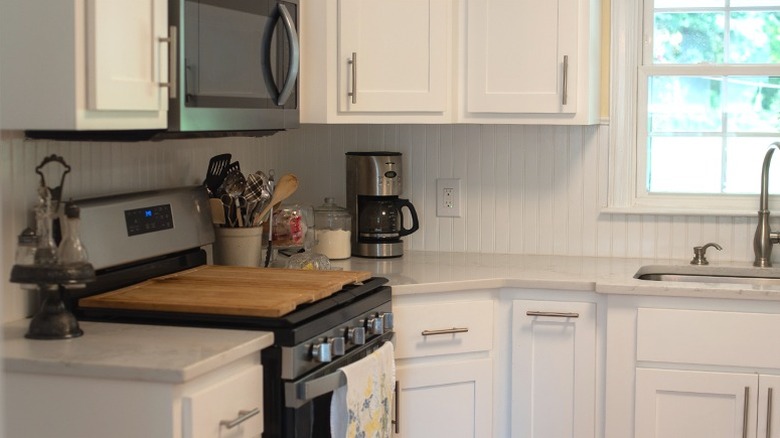
You probably won't find beadboard promoted as a backsplash, even though it's one of the most budget-friendly kitchen backsplash ideas. Tile backsplashes aren't required, of course, and you don't necessarily need a backsplash at all. They became popular in the 1930s and 1940s as stubby little vertical extensions of the countertop. As kitchen design became more influenced by fashion, they gradually grew and became more ornamental, more expensive, and more expansive, eventually consuming half the wall. Strictly speaking, what Erin Napier installed in the examples above wasn't a backsplash; she simply left the beadboard walls intact. But once you get a look at it, you might want to install beadboard over your current tile.
Beadboard was originally used as an inexpensive wall-covering option, including in kitchens. When it's installed on an entire wall, traditional plank beadboard has the beads running horizontally. It is possible to run 4-by-8 beadboard paneling horizontally, but you may deal with fairly obvious seams — unless you're covering them with battens, as is often done with wainscoting. Aesthetically, vertical beads for the backsplash can make the ceiling seem higher, while horizontal beads will make the kitchen feel wider.
Backsplashes are commonly described as a way to keep food and water off the wall behind sinks and stoves, though it seems more likely that original stubby backsplashes were to keep detritus from cooking, washing, and food prep from falling behind things where they would be difficult to clean. If you want to use beadboard but are concerned about splashes, you can find paint (usually made for bathrooms) that is moisture- and bacteria-resistant and entirely washable. Look for semi- and high-gloss sheens for the easiest cleanup.