

The Valuable Vintage Kitchen Item You Should Never Overlook At An Estate Sale
We may receive a commission on purchases made from links.
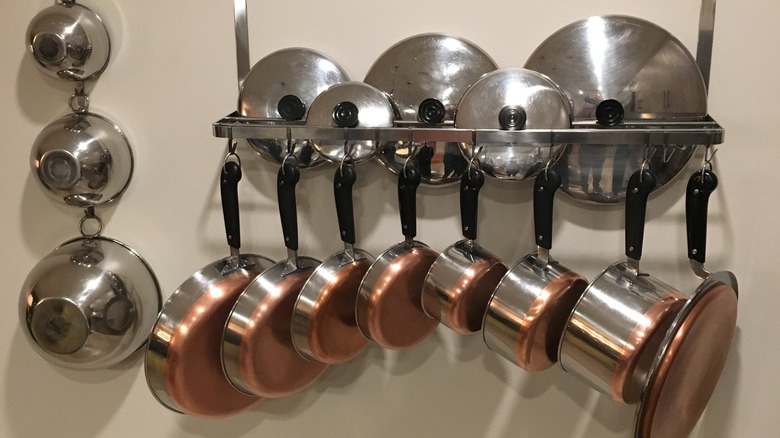
If the distinctive look of Revere Ware's copper-bottom pots and pans feels familiar to you, it's probably because someone in your family owned a set. Or, conceivably, everyone in your family owned a set. The popular, high-quality cookware, introduced in 1939, skyrocketed in popularity after WWII and became a household name. While sales declined in the 1960s, Revere Ware's golden age saw a surge in the brand's popularity, and these much-sought-after pots and pans kept their value in secondary markets such as estate sales.
While pure copper cookware once existed and is considered something of a "holy grail" vintage find for secondhand shoppers, copper in cookware can be dangerous if ingested. Revere Ware's iconic cookware was stainless steel electroplated on the bottom with a thick layer of copper, a new and unique technique that produced superior heat distribution and better cooking. Largely because it's good stuff, not because you simply want to show off your copper cookware collection, it has retained its value.
We looked at dozens of Revere Ware listings on two popular online outlets for vintage goods, eBay and Etsy, and found some encouraging and surprising results. A single item (skillet, saucepan, or stock pot) with or without a lid made prior to the 1968 manufacturing changes that reduced the cookware's quality averaged $44.21 ... far more than you're likely to pay at a thrift store or even an estate sale. Inexplicably, pots and pans made after 1968 averaged $71.55. The sets we encountered were mixed from pre- and post-1968 items, but described as "vintage" ... a risky situation for anyone who doesn't know how to identify the older, more valuable pieces, which have thicker bottoms with more copper.
How to identify a vintage Revere Ware piece
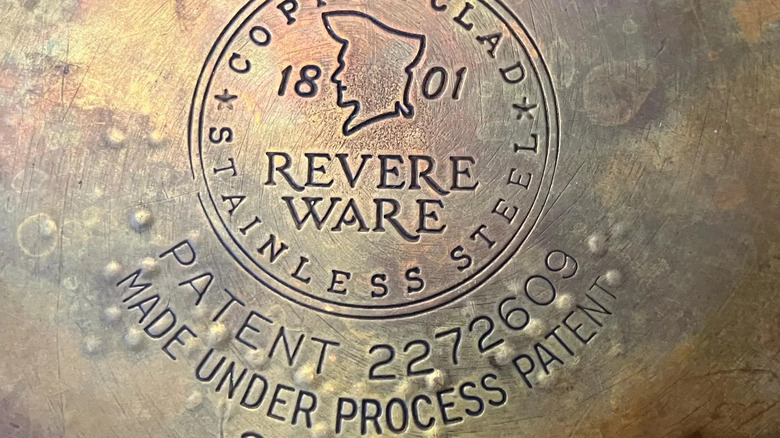
Revere Ware made a lot of products over the decades, but the series 1400 copper-bottom pots and pans are what you should be on the lookout for ... and it's the pre-1968 cookware that matters. Fortunately, it's relatively easy to determine whether a particular piece is from the thick or thin era by just looking at the brand stamp on the bottom. This is usually a logo in combination with other elements, like the place of manufacture. Revere Ware made between 1946 and 1968 was stamped with a mark that featured a logo with a left-facing Revere silhouette with a two-line circle around it, as well as a patent reference. The circle and patent references weren't included after 1968.
Because the brand stamp (sometimes referred to as hallmarks or maker's marks) can wear away from the bottom of a well-used pan, this can cause confusion. There are some other clues, but this minutia is almost bottomless, so it's hard to keep it all in mind. One ambiguity that can be confounding, especially when looking at photos online, is the presence of two-lined ovals on the stamps of both pre- and post-1968 cookware. We've spotted double ovals on cookware made in China, as well as double ovals within a larger single circle. Because overseas manufacturing all occurred after 1968, anything from Korea, Thailand, China, or Indonesia is of a later vintage. But note that we've also spotted double ovals from Revere's Riverside, California, facility, which closed in 1962. So, double-lined curves on a worn pan bottom aren't conclusive unless you can make out the exact shape; your best bet is to look for that patent mark.