

Fast Growing, Cold Hardy, And Colorful: This Fruit Tree Is A Must-Have For Your Yard
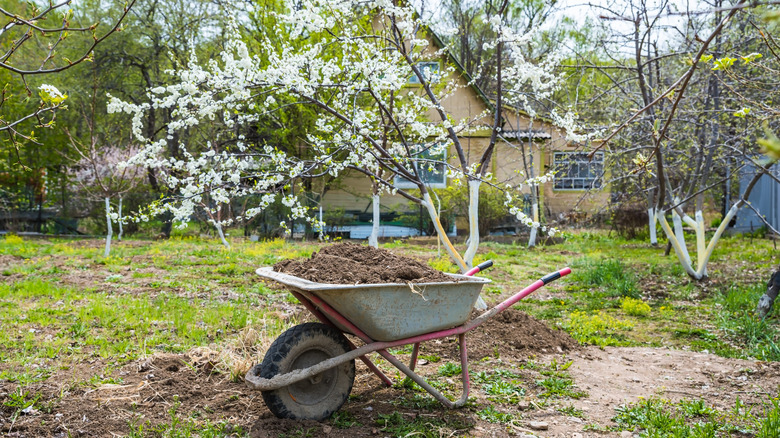
Fruit grown in your very own yard is as fresh as it gets. Plus, many fruit trees support local pollinators with their flowers. If you live somewhere with long and frigid winters, your growing season may be too short for fruit that needs lots of mild weather to develop properly. In this situation, search for fruit trees that tolerate chilly conditions. Exploring lesser-known options can be especially fruitful — and not just in the figurative sense. One is mulberry (Morus spp.), a fast-growing tree with sweet, colorful fruits that look like blackberries. Fortunately, it doesn't share blackberry bushes' least endearing qualities: thorns that scratch your arms as you harvest the fruit and a reputation for taking over flower gardens, play areas, and other off-limits spots in their attempts to form colonies.
Mulberry trees are relatively easy to cultivate, but some species are more cold-hardy than others. For instance, the coldest weather Himalayan mulberry trees (Morus macroura) can handle is found in USDA hardiness zone 7, which includes most of Kentucky and Virginia. Meanwhile, red mulberry trees (Morus rubra) are hardy in zones 4 through 9, so they can manage the deep freezes of Maine's northernmost tip.
A mulberry may be a good fit for your yard if you're looking to boost its aesthetic appeal or attract birds without a feeder. This tree will add visual interest to your landscape with white or pink flowers in the spring and vibrant yellow leaves in the fall. Its branches often twist into interesting shapes, too. Many mulberry caretakers also appreciate the tree's large canopy, which has an attractive, rounded shape that provides a wealth of summertime shade.
Mulberry varieties to consider for your yard
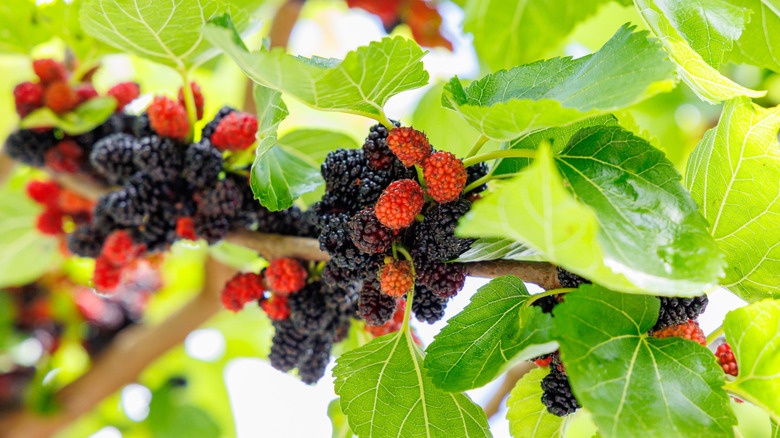
If you're seeking a fast-growing, cold-hardy mulberry tree for a home landscape, start your search with cultivars and hybrids of red mulberry (Morus rubra). In addition to tolerating temperatures as chilly as minus 33 degrees Fahrenheit, they're native to the eastern U.S. Native plants are a smart choice for your yard because they've evolved to thrive in your area's weather, soil, and other growing conditions. As a result, they often require less water, fertilizer, and pesticide use. They also support biodiversity in ways that non-native species do not.
One reliable choice for many yards is 'Illinois Everbearing' (Morus alba x rubra). This red mulberry hybrid makes big, sweet berries that are a favorite among gardeners with sophisticated palates. It's also a marvelous match for impatient gardeners, gaining 3 to 5 feet per year when planted in ideal conditions. This mulberry variety has a knack for thriving in colder conditions than many of its relatives, so it's often recommended as far north as zone 3, a range that includes northern Minnesota and much of Alaska. It offers ripe berries week after week in the summer and early fall. While some mulberry varieties exceed 60 feet in height, 'Illinois Everbearing' is likely to be a manageable 30 feet.
If you live in the southwestern part of the U.S., you have another native variety to consider, too: Texas mulberry (Morus celtidifolia). This tree is happiest in zones 5 through 9 and likes to form multiple trunks, often developing a shrub-like appearance. It also grows quickly, typically reaching heights of 15 to 20 feet. Plus, it sports pretty, heart-shaped leaves with toothed margins.
Other important considerations for mulberry trees
It's okay if you don't choose a native mulberry for your yard, but make sure to plant a variety that's allowed in your state. During the colonial era, white mulberry (Morus alba) was introduced to the U.S. to feed silkworms for a silk industry that didn't fully materialize. Since then, this species has been classified as invasive in more than a dozen states. White mulberry shouldn't be planted in Georgia, Indiana, Kentucky, Maine, Maryland, Michigan, Ohio, Pennsylvania, Rhode Island, South Carolina, Virginia, West Virginia, or Wisconsin.
Also, select your mulberry tree's planting site with care. You'll need to consider falling berries, which can leave stains on sidewalks, clothing, and more. Some mulberry growers place berry-catching tarps beneath the trees to make harvesting easier and keep the juice from dyeing nearby fences and patios.
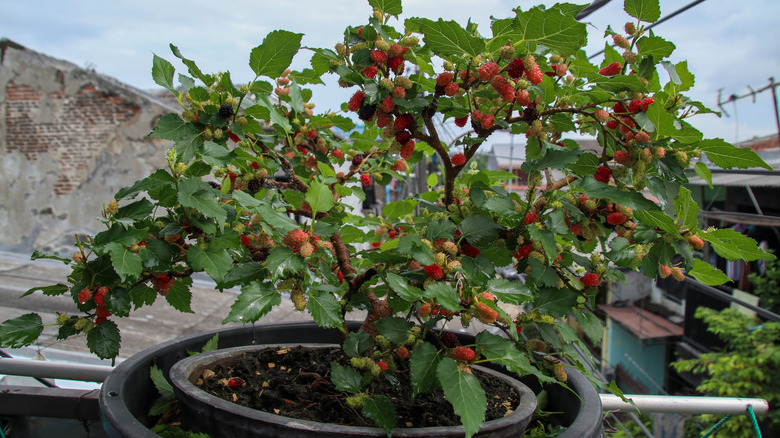
Finally, consider the tree's root system when choosing a planting location. Mulberries can create foundation problems for houses if their roots get too close, so put at least 15 feet between buildings and new trees, more if you're growing an especially tall type. Or, choose a petite variety — say, the 'Dwarf Everbearing' cultivar of black mulberry (Morus nigra) — and grow it in an oversized pot. Though many black mulberry trees are hardy in zones 5 through 10, you may need to wrap 'Dwarf Everbearing' in frost cloth to help it survive winter in zones 5 and 6. Or, just bring it indoors for the season if its container is light enough to move. This mobility is also helpful if you want to prevent patio stains or give the tree more sunlight to encourage berry formation.