

If You Put Vicks VapoRub In Your Toilet, Here's What Will Happen
There's nothing wrong with a good, even surprising off-label product use. Getting inventive to solve a problem sometimes requires thinking outside of the box, and can result in huge wins like baking soda's shift from cooking to cleaning and Play-Doh's reinvention — which transmogrified it from a wallpaper cleaner to a creative toy. So when we started reading about people using Vick's VapoRub to remove toilet stains, we thought it was worth asking an expert about this slightly kooky trick.
When Hunker spoke exclusively with Carly Castro, founder of Clean With Carly and owner of FreshLee Cleaning Co., about VapoRubbing away your toilet woes, she suggested the hack wouldn't pass the sniff test. "I thankfully have not seen this trend circulating, and I'm glad, because it's quite silly," Castro said, adding that silly-sounding hacks are usually exactly that. "I spend a lot of time helping viewers and clients fix problems that started after following cleaning hacks they saw online," she said.
The real problem with the VapoRub hack isn't really the silliness, of course. Every kid knows that silly toilet jokes are great fun. The trouble is that Vick's VapoRub leaves a residue that can be counterproductive. "That residue can also make the task harder than it needs to be. Toilet bowl cleaners are designed to cling to the surface so they can work properly, and the oily film left behind by Vick's prevents that. You end up scrubbing harder just to remove both the stain and the residue," Castra said.
Some tricks give clean joke a new meaning
The toilet is one of those places — along with dishwashers, surgery suites, and a few others — where "at least it looks clean" is not good enough. Expert, business owner, and Cleantokker Carly Castro told Hunker in an exclusive interview that some common toilet-cleaning strategies might only get you to "looks clean" for a little while, including the idea of using Vick's VapoRub. "While it might loosen some surface grime, it's not actually going to remove hard water or rust stains. It simply isn't formulated to do that," she said.
More traditional cleaners only fare a little better, in Castro's estimation. Bleach, for example, is usually just a temporary fix. She explained, "When it comes to bleach, it may temporarily lighten the appearance of a stain, but it does not actually remove hard water or rust buildup. That's why those stains tend to reappear so quickly." And even dedicated toilet cleaners struggle when it comes to certain types of stains. "While there are acidic toilet bowl cleaners on the market and they do work well, not a single one ever fully removed severe hard water or rust stains for me," Castro said. And that's why she favors mechanical removal of stains, usually using a tool that you might associate more with toilette than with toilets.
You will just lava the real toilet-cleaning hack
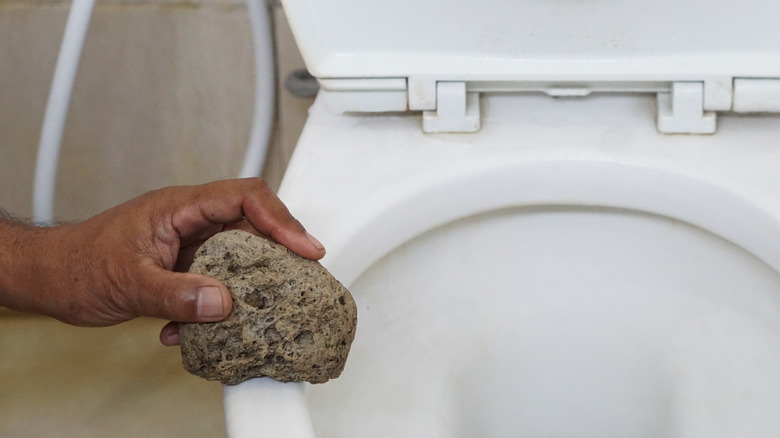
So what's this secret tool for scrubbing away tough toilet stains, revealed to Hunker in an exclusive conversation with Clean With Carly founder Carly Castro? It turns out to be something most of us think of when we think about exfoliation. Castro gave us a little verbal drum roll before the big reveal. "The safest way to remove toilet stains might also sound the scariest to some people, but it's actually quite simple when done correctly. A pumice stone is my go-to," she said.
Pumice is a volcanic rock formed when lava cools rapidly. It's widely used in everything from construction to cosmetics to cleaning. Because pumice stones are so abrasive, they might not be the first thing you think of when looking for a better way to scrub a porcelain toilet bowl. But cleaning toilets with pumice stones is easy, inexpensive, and nontoxic, and is a method that Castro swears by. "A pumice stone physically breaks down and removes the build up itself. It addresses the root cause of the staining, which makes it a more effective and longer lasting solution," she explained. And, in fact, pumice stones are useful throughout the bathroom, helping with everything from getting spray foam off your skin to removing rust and stains from a shower floor.
Using a pumice stone to tame wild toilets

As with using pumice stones for skin care, you have to be careful when first learning how to use one as you try to get your toilet back to its original bright white state. In an exclusive conversation with Hunker, cleaning expert Carly Castro extolled the virtues of the simple abrasive. "Used properly, it safely removes hard water stains and rust build up," Castro said. "I've seen some wild toilets over the years, and a pumice stone has never failed me."
How does one safely take on those wild toilets? It turns out that the way to clean a toilet with a pumice stone safely is the same as for cleaning delicate things with a Magic Eraser, even when you shouldn't: Lubricate the works with water. Castro said, "The key is keeping both the stone and toilet surface wet at all times to prevent scratching. You can dip the pumice stone into the toilet water between scrubbing, or keep a spray bottle filled with water nearby and continuously spray the surface as you work."
It also turns out that keeping things wet is also how you use pumice stones for exfoliation, but don't get the impression that you can use a pumice stone meant for your face in your toilet. (Or vice versa ... remember the part about dipping the stone in the toilet?) "Make sure you're using the correct type of pumice stone. A pumice stone made for cleaning works very differently than the ones sold in the beauty aisle, and using the wrong kind can damage surfaces," she said. Including, presumably, your face.