

Don't Waste Your Money: The Best Type Of Firewood For A Long Burn Time & High Heat

When investing in firewood to heat your home, the name of the game is getting a type that's going to give you an efficient, clean, long-lasting, consistently hot burn. If you were just lighting a short fire for the purposes of aesthetics and enjoyment, the wood species would matter less than when buying in bulk to supply your wood stove or fireplace with fuel for the winter months. And considering that you could go through four to six cords of wood to heat a 2000-square-foot home in a cold climate and pay an average cost of $250 to $500 per firewood cord, it's essential to choose the best kind.
And what exactly is the best wood type for your fireplace or wood stove? The short answer is that most dense, seasoned hardwoods will do the trick. The longer answer is that because of its high heat value, consistent output, and long burn time, seasoned oak will give you the most bang for your buck with a wood that burns longer, hotter, and more reliably than many alternative widely available species.
While a cord of approximately 600 to 800 logs of already seasoned oak may cost more upfront (though you can buy green wood for less and season it yourself), it's efficient and more cost effective in the long run to heat your home versus a species that burns more quickly. The secret to oak's success as firewood after its long seasoning period lies all in the density of its interior structure, so let's break down exactly how long oak should be seasoned for the best burn and why it's the ideal wood for a long-lasting, hot fire.
Seasoned oak's dense structure creates a long-lasting, high-heat fire
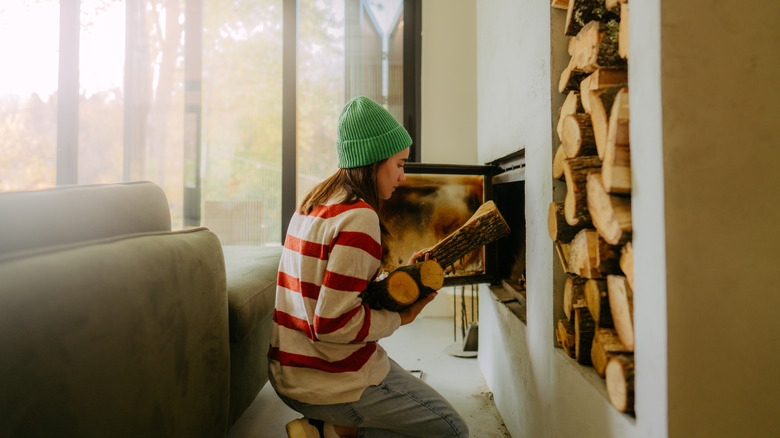
There are two factors that play into the success of firewood: dryness and density. The first essential piece of the puzzle is that any wood must be dried out properly to yield the best burning results. Freshly chopped wood typically has a moisture level of about 50%. However, seasoning wood means drying it out over a long period of time to reduce the water content to under 20%, ideally closer to 15% when possible. For hardwoods, this means one to two years of seasoning time before it's ready to be burned. Oak is on the longer end of that spectrum because its compacted structure means it dries out slowly. To ensure firewood is seasoned enough for use, it should feel lightweight, be lighter in color (tan or gray) with darker ends and visible cracks, peeling bark, and a sharp, hollow cracking noise when you hit two pieces together (rather than a dull thud).
Secondly, what makes seasoned oak such a solid choice for firewood is its density. Its interior structure results in a high heat, which gives consistent fire ideal for fireplaces or wood stoves. It can be challenging to get the dense logs lit initially, but once they're ignited, the result is a steadfast, hours-long fire. This reduces the need for reloading your wood stove during overnight burns. Additionally, due to its lower levels of sap or pitch when compared to softwoods, seasoned oak burns cleaner with minimal smoke and popping. Suitable firewood alternatives for a long, hot burn are other properly seasoned hardwoods like hickory, maple, ash, and beech, which can be mixed with faster-burning species as needed for kindling.