

The Sleek Backsplash Trend That's Replacing Basic Tile In Many Kitchens
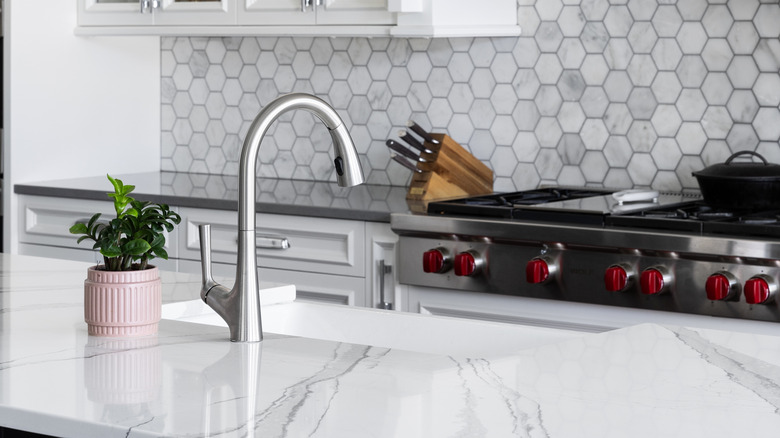
Backsplashes. You could be staring at numerous tiles trying to pick something for your kitchen remodel and find yourself at a loss. There are so many kitchen backsplash ideas and inspirations that it can be hard to make up your mind on what matches your color scheme or the style you're trying to achieve. What's more, you might be afraid you'll make a choice that makes your kitchen look too busy, adds too many colors, or includes tiles you end up hating a month later. The pressure to make the right design decision is real.
Luckily, there's a 2026 kitchen trend that can ease your path forward and create a more harmonized and streamlined appearance: backsplashes made from solid sheets of marble, quartz, or granite. If you're already installing a new countertop, instead of choosing a coordinating tile, just take that one material and continue it up the wall. This trend, which some are referring to as a "countersplash," gives the whole room a smooth, uninterrupted flow that feels more polished and high-end.
People love it partly because there are no little grout seams to scrub. You just have one continuous surface that wipes clean in seconds. It also creates a sense of unity, tying the counters and walls together in a way that feels intentional and modern. When you use a striking piece of stone, its natural swirls and patterns become a showpiece, turning the kitchen backdrop into something closer to art than architecture.
Key things to consider when installing a countersplash

When you're planning a countersplash, one of the first decisions you'll make is how thick you want that slab to be. Different stones come in different standard sizes, but most fall somewhere between just under an inch to a little over an inch. You can usually ask for a specific thickness if you have a preference, but it helps to think through how the edge will look once it's mounted on the wall.
A super-thin piece is lighter and easier for installers to secure, but it can sometimes look a bit too fragile when seen from the side. A chunkier edge, on the other hand, can give the whole kitchen a richer, more intentional feel. When you're unsure, matching the depth of your counters is a simple rule that always looks polished.
Cost is another major factor, and countersplashes cost more than classic tile, with prices varying quite a bit based on the stone you choose and how much wall space you're covering. Quartz and marble tend to land on the pricier end and commonly sit around the higher ranges at roughly $90 per square foot, while granite usually comes in lower at $50 to $75 per square foot, with premium varieties pushing the total up. Want an alternative? Joanna Gaines prefers quartzite as another option for a seamless backsplash. Many homeowners see it as money well spent due to the decreased maintenance needs.