

Why Are Solo Basement Toilets In Old Homes Called Pittsburgh Potties? Here's Their Real Purpose

Standing proud yet alone, a toilet sitting in an unfinished basement was once a common sight in houses across America. Stand-alone basement toilets do still exist, sometimes placed in a corner or inside a long wall, or, even more awkwardly, right in the middle of the basement. You may even have heard these toilets referred to as "Pittsburgh potties," prompting you to wonder — just what is the deal with them? Why are they called that? Were they early versions of basement bathrooms, or something else entirely?
Well, the "Pittsburgh potty" nickname came about because these toilets were commonly found in working-class neighborhoods in Pittsburgh. Perhaps because they're so strange and solitary, myths soon emerged to explain these enigmatic thrones; one suggested that Pittsburgh's miners and steelworkers would come home, shed their soiled clothing in the basement — and do their other business, as well. Meanwhie, other theories have suggested that these were "dad" toilets, providing isolation for fathers that, in this case, would certainly be beneficial for all concerned parties. The truth, however, is a little more complicated than that.
Stand-alone basement toilets were a solution to sewage issues
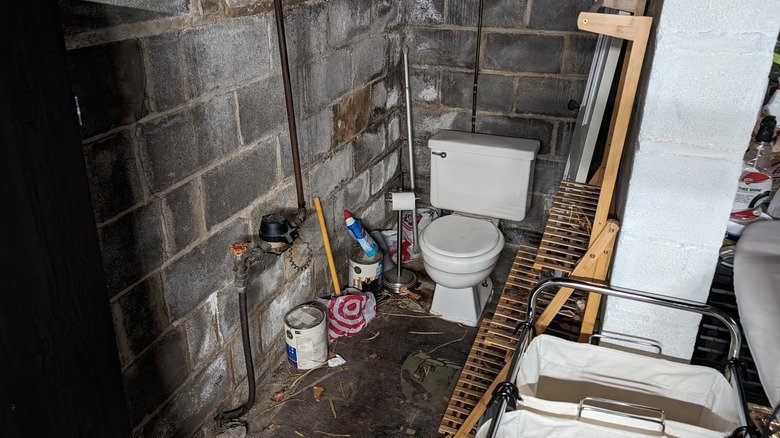
In the early 20th century, interior plumbing was just beginning to become more common. These were early days for the sewer systems needed to support interior toilets, however. This meant that the sewers themselves were often inadequate or would become overwhelmed as more and more homes were connected to them. When this happened, the sewers would become backed up, often spilling into the homes themselves — and this backup always occurred at the lowest hookup in the house.
If that hookup happened to be a toilet in an unfinished basement, the results would be much less destructive than if it was located in, say, a second-floor bathroom. And that's the reason for those oddly placed toilets in the basements of so many early 20th century houses. Cleaning the mess from a cement slab in the basement, while still gross, was a much better option; it would literally ruin the types of small, modern bathrooms you get today. Notably, this was true in more places than just Pittsburgh, which is why Pittsburgh potties can often be found in homes across other towns and cities, too.
Over the years, sewers were improved, basements were finished, and walls were built around these solitary toilets. Their true purpose was mostly forgotten as a result, leading to myths like that of the Pittsburgh potty. Nowadays, of course, a toilet placed in a basement is more likely to be a design choice than a grim necessity.