

Easily Melt Snow And Ice On Your Driveway With Two Ordinary Household Staples
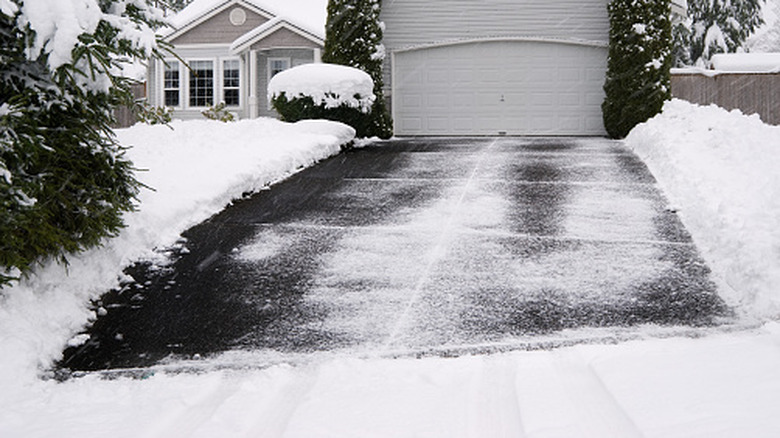
In regions with long, icy winters, homeowners quickly learn what works and what doesn't when it comes to clearing snow and ice from walkways. While the numerous types of ice-melting salts work wonders, there are two ordinary, ice-melting household staples that work really well as an alternative if you find yourself with no salt on hand.
If you've got rubbing alcohol and dish soap in your cabinets, you can mix an ice melt together that will more than make up for the salt you forgot to buy or the fact that you don't have time to shovel completely before you go to work. The alcohol and dish soap will need to be diluted in water in order for the melt to be most effective. A good ratio to follow is a quarter cup of rubbing alcohol to a half a gallon of hot water to a few drops of dish soap.
The mixture will need to be scaled based on the size of the area you need to tackle. Short walkways or stairs are probably best suited to this method. You would need a lot of the mixture to use for your entire driveway. You could also bottle it up in a spray bottle and use it to get ice off of frozen locks or iced-up windows of your car. Just be sure the water isn't still super hot for that last application, as the rapid temperature changes could crack the glass of your window.
How rubbing alcohol and dish soap help melt ice
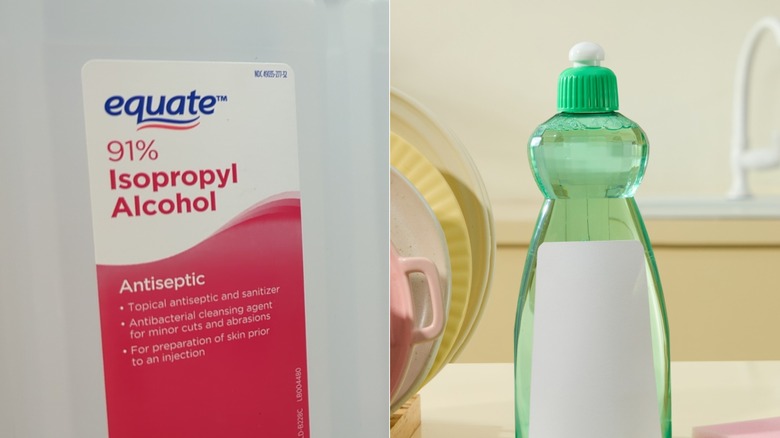
Getting the hang of making homemade ice melts is really going to help you gain a sense of confidence in how to approach winter weather. In the case of this particular mixture, it is important to understand exactly how the ingredients work together to melt away ice and snow. Rubbing alcohol is the key element here, as it has a lower freezing point than water. As such, when it is diluted, it lowers the overall freezing point of the snow and ice, which will, in turn, dissolve the ice to the point where it can be easily removed with a shovel.
Dish soap is surprisingly useful in an ice melt for one reason: it can help break down the surface tension of the water, allowing the rubbing alcohol to be mixed in more easily and for the overall mixture to be more easily spread across a surface. You'll just need to be careful when walking, as it can make the application a little slippery.
Again, always be careful to remove this as soon as it has finished melting the ice. If you just leave it in place, it could potentially ice over if the temperatures reach into the negatives. That's because, while pure rubbing alcohol has a freezing point of minus 128 degrees Fahrenheit, the more you dilute it, the higher its freezing point becomes.