

3 Easy Drilling Hacks For Perfect Accuracy Every Time

How hard is it to drill a hole where you want it and at a proper angle? Sometimes, the most straightforward tasks can go sideways on you and ruin a much more complicated assemblage of work. As a professional woodworker, it is a bit embarrassing how many times the simple stuff has caused me a problem. That's why you'll often find that people who have worked in a wood shop for a long time have a host of small gizmos (we call them jigs) to help us work smarter and more accurately across a variety of tasks, whether we need to drill pocket holes or get straight cuts with a saw. Here are three drilling hacks that DIYers everywhere can put to use to create their own jigs for more accuracy and consistency. These drilling blocks are easy to make out of spare wood (such as 2-by-4 pieces) and simple to use.
The basic idea of woodworking jigs is to take the human factor out of the equation. In this case, we are using a predrilled guide in a block of scrap wood to properly orient a drill bit as it starts to form a hole. While it is not always critical, sometimes it is important that a hole be exactly 90 degrees to the wooden surface, like when you're drilling into narrow material. Without some guide, you will be able to get close to 90 degrees, but it's unlikely you will be spot on. It's the same idea when you are drilling holes at angles other than 90 degrees, such as when you might need to attach a table leg at a 15-degree angle.
Making a simple drilling jig from a wood block
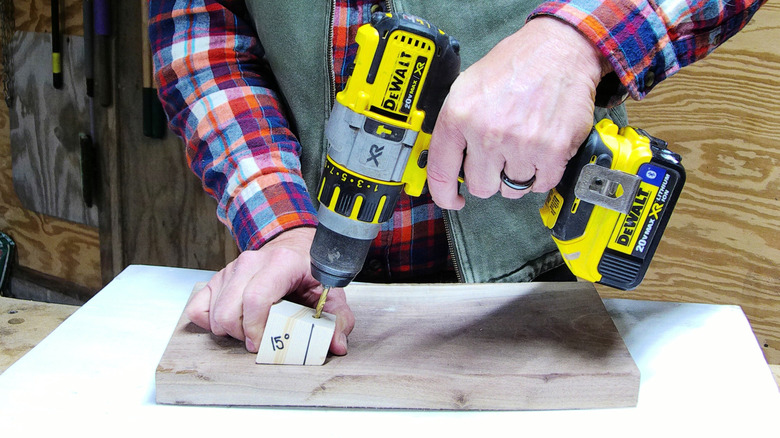
I can almost hear some of you thinking, "If it's tricky to drill straight, perpendicular holes at exactly 90 degrees into my project, how will I do it into the drilling block?" Great question. First off, you may indeed drill an inaccurate hole into the block. You could just throw that block away and your woodworking project will still be fine. Make your mistakes when you're only risking scrap wood and not hours of work that you may have invested in your project. If you have a drill press, you can accurately bore a hole into the block at 90 degrees and then take the block to the project.
The drill block will only work for one diameter. A block with a ¼-inch diameter hole will not guide a 1/16-inch diameter drill bit with enough accuracy, so you'll need to make one for the different drill bit sizes you plan to use. Another consideration is the block should be small enough that it won't get in the way in use but be large enough for you to hold securely. It can be made of nearly any species of wood, whatever you have lying around your shop.
For the second hack, you may wonder how you make a drilling block with an exact angle. Here's how I do it. I start by drilling my block like I would for a 90-degree guide. If that goes well (the hole is a true 90 degrees), I use a saw to cut the bottom of the block to the angle I need. Now, the hole I bored is at my desired angle, and drilling a perfect pilot hole for my project is a lot easier. Mark the block so you'll remember the angle.
Stop block depth control
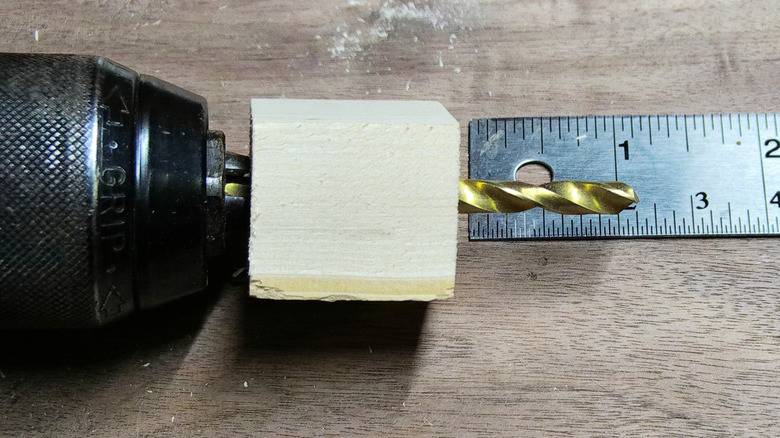
When you are doing woodworking, the holes you bore not only need to be formed at an accurate angle and a prescribed diameter, but most of them need to stop at a specific depth, if only to not drill through and leave an exposed hole where you don't want it. I use stop blocks on my drill bits to control the depth. There are depth stops that you could buy to put on your bits, and I have a few of them, but they don't work any better than this shop-made solution. As you see in the photo above, I made the stop block so that 1 ⅛ inches of the bit extends past the block. That is the absolute limit of how deep I am able to drill with this set up. Simple and sweet.
Clever DIYers that you are, you've probably been wondering about those other guide blocks we discussed earlier. What if they prevent you from boring your holes deep enough? Yep, that happens. But the good news is that you've already got an accurately placed and angled hole started. You can take the guide block off the drill bit and carefully extend the depth of the hole without it, using the existing hole to direct the rest of the operation.