

If You See These Colors Painted On Trees, Pay Attention — Here's What They Mean
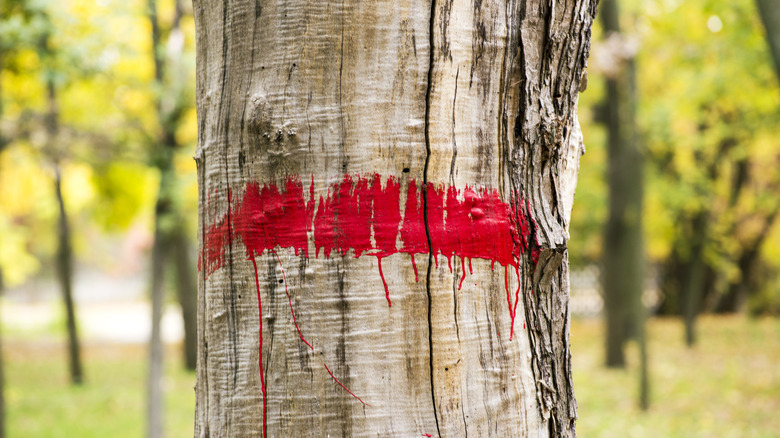
If you have ever been hiking, there is a good chance that you have run into some sort of paint markings on trees. But while certain colors are often used to guide you along a designated path, paint on trees does not always mean "follow me." In fact, color coding is used to communicate property lines, trees that are designated for harvesting, the presence of a protected animal species, and more. The trouble is that these paint codes seem to vary from state to state, so it's not quite as simple as identifying a singular answer, and some may even be specific to the preferences of the landowner. That said, there is a good amount of crossover, so you can usually get an idea of what the trees (or those that marked them) might be trying to convey. For instance, a red line on a tree lets you know that you've hit the boundary of where timber harvesting is being done. So, what do all the other paint colors and marks on tree trunks mean?
As a forewarning, when in doubt, it's best to use caution when in the presence of marked trees, as you do not want to get in trouble by trespassing or, even worse, accidentally cut down a tree that was being protected for one reason or another. If you aren't sure about what a marking means, it's best to do some research to see if there are specific guidelines for your state or general location. On the other hand, if you are looking for a quick and cheap way to mark your own property line, paint markings may be a good option for you to consider. Now, let's decipher the messages these paints are conveying.
Purple: Do not pass go, do not owe $200 (or whatever you might accrue in fines)
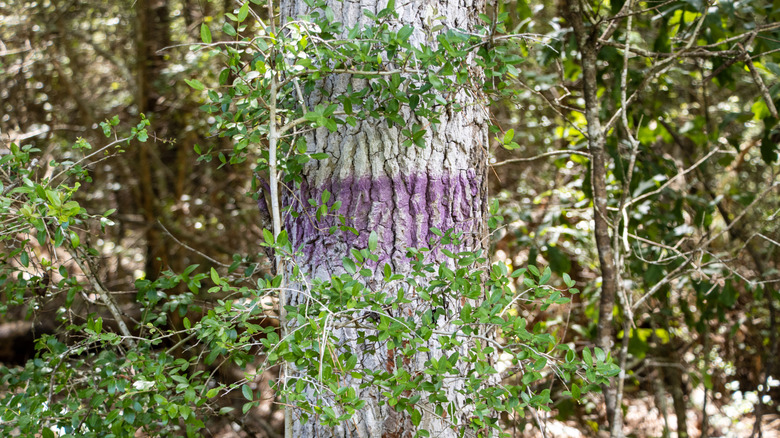
If you see a tree painted purple, you won't want to ignore it. Purple is one of the most universal tree-marking colors, and it is most commonly used to mark the border of private property. Not only is it intended to communicate that you have reached private property, but it is also generally meant as an official and legally recognized "no trespassing" notice. In most counties in Pennsylvania, for example, this can be used in place of no trespassing signs, and it holds the same weight as the signs in the court of law when up to standard.
In this case, there are specific demands that must be met: Vertical purple lines must be at least 8 inches long and 1 inch wide, and the bottom of the mark must be between 3 and 5 feet from the ground, with each mark no more than 100 feet apart. This information can be found on the Pennsylvania Game Commission website. Please check your own state's websites to see if there are different regulations where you live.
Yellow and Orange X marks the spot for harvesting
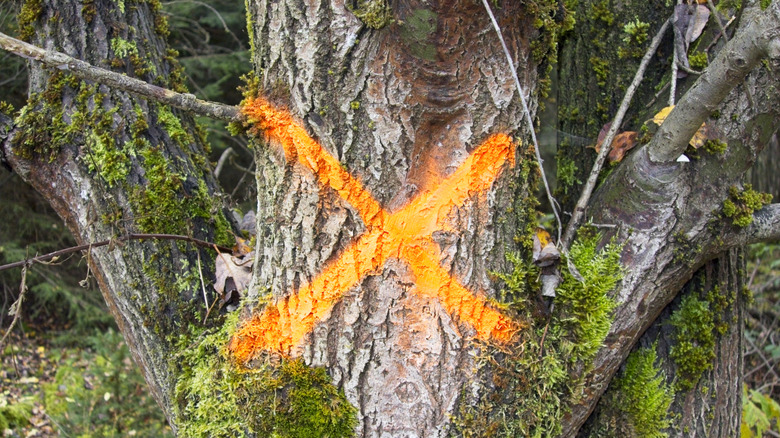
Yellow and orange paint are most commonly used interchangeably, but both are generally a sign of a tree that has been marked for harvesting. When this is the case, the paint is also usually in an "X" formation, though it may also be in the form of a slash. There are some varying opinions as to the meaning of these markings, but while they can both signify a tree that is set for removal, there is also the possibility that the presence of an "X" in place of a slash is used specifically to show the border of government-owned property. That said, other sources noted that orange paint was specifically used to mark trees that were chosen for cutting.
Regardless, the best thing you can do if you run into a tree with an "X" – no matter the color- is to go back from whence you came. Usually, this is meant as a sign to bar entry to what is most likely government property. Should you have a tree that you need to get rid of on your property, there's no need to mark it if you are doing it yourself, but just be sure that you know how to safely remove a tree on your own before you start.
A slew of meanings for blue
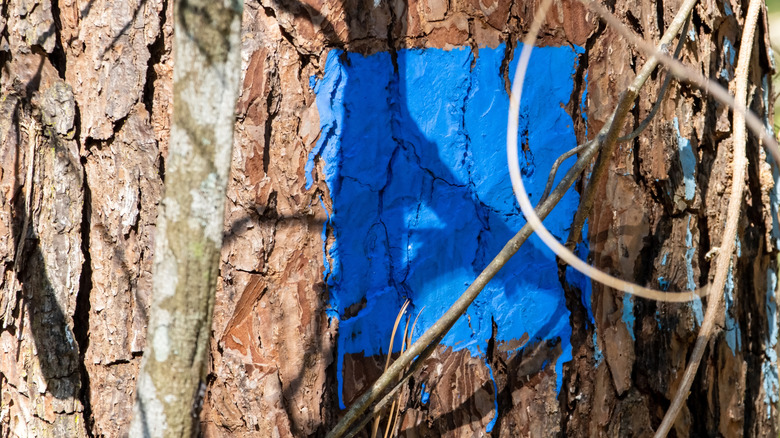
Okay, once again we are back at another option that could mean that it is marked for removal, or a border of a property line. However, some states — like Arkansas — may have some more niche meanings. In this case, the Arkansas Game and Fish Commission has determined that blue paint will be used to mark the removal of specific trees in an effort of habitat renovation. This specific use originated in 2021 to restore the area as a prime waterfowl hunting location by opening up previously closed tree canopies to allow for the Red Oak — a preferred tree of local waterfowl—to receive the space for sunlight to reach the forest floor, which is necessary for Red Oaks to grow successfully.
Another divergence is in the Deschutes National Forest, where blue is used for marking trees that are set to be removed, while orange marks the boundaries and trees that are not supposed to be cut. Most commonly, however, blue paint is in fact used to mark a property boundary. If you aren't sure, though, it's best to err on the side of caution, so steer clear if you are questioning its meaning.
A circle in white protects animal rights
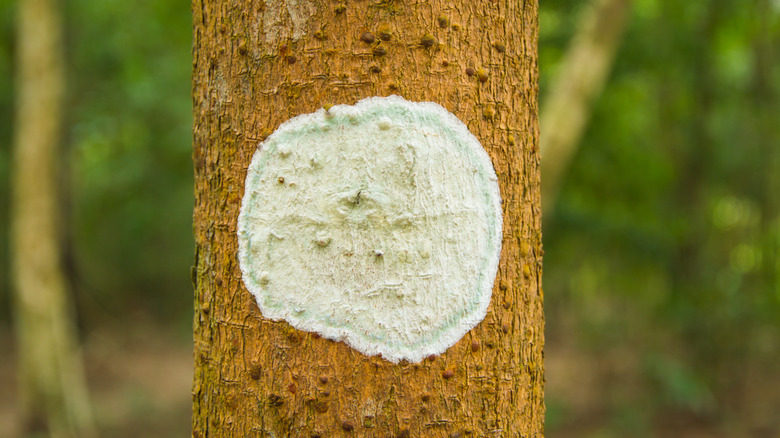
If you see a white circle on a tree, that's your sign to back up and walk away. Now it's not you that is in any danger, but rather an inhabitant of the tree that may not be too happy with a peeping tom staring down their home. These white circles most often indicate that a tree is home to an endangered or protected animal — most likely a bird.
This symbol is pretty consistent across the U.S. and it's important to note that this is not just intended as a sign for loggers or other possible tree cutters to avoid cutting that specific tree, but it also implies that you should keep your distance and prevent disturbances (including cutting neighboring trees) in order to give the animal the best chance to both survive and thrive in the area. Though this marking can be used to notify passerby of any endangered animal, the red-cockaded woodpecker is federally protected, and the white circles are used to identify their nesting trees.