

Why You May Want To Think Twice Before Buying Basic Hardware Items At Home Depot

It's fair to say Home Depot has changed the face — and shelves — of the hardware business. Between 1990 (a year after Home Depot became the world's largest home improvement store) and 2024, almost 5,000 smaller hardware stores disappeared from the retail landscape. Home Depot quickly evolved from 60,000-square-foot stores with 25,000 products — impressive for the time — to 128,000-square-foot behemoths sporting 35,000 different products. And, along the way, the stores lost their way when it came to stocking what had once been hardware store staples, which are now arguably among the items you should avoid buying from Home Depot.
Along the way, Home Depot increasingly focused its stock on DIY home improvement market, as did its major competitors. But not all competitors; Ace Hardware has consistently outperformed Home Depot in customer satisfaction surveys, and one reason is a broader inventory focus, and often a bit more depth in areas like small hardware items. This has created a reputation for Ace as a supplier of a much better hardware selection, somehow fitting 25,000-30,000 products in stores with an average size of 7,000-10,000 square feet.
Those who frequent older Ace Hardware stores know they're often full of hardware that might be obscure to the home renovator, but is indispensable to the farmer or the electronics hobbyist or the auto mechanic. In a very real way, Home Depot underserves its hardware customers by both having too much stuff and too little.
It's hard to find what you need at Home Depot

In spite of their large inventories, big-box hardware stores like Home Depot are often considered the wrong choice by tradespeople who might be looking for a very specific fastener or fitting, a substitution strategy, or advice in general. This is often chalked up to the lack of knowledgeable, personalized attention you get at Home Depot as opposed to, say, Ace Hardware or a small independent hardware store. We checked inventory at local Home Depot (as well as Lowes and Ace Hardware) stores for nine fairly common hardware items to figure out how useful the website is for locating such hardware, and how much stock the stores actually have. In three of nine searches, the Home Depot website turned up no correct matches, in stock or otherwise. This seems to indicate a deficiency in the search mechanism .. the same search that Home Depot's employees use in-store. The personal contact and more knowledgeable staff at smaller stores like Ace Hardware mean you're more likely to get help beyond a sympathetic shrug when the item can't be immediately found.
A DIYer seeking help with something, particularly something outside of the home improvement domain, might have trouble locating a small hardware item in a three-acre store. Consider the lowly expansion nut. The specialty fasteners have relatively few DIY home improvement uses, so if you ask for a vibration-dampening, watertight fastener, you might not get much help from home improvement-focused staff in a sea of "universal" replacement parts and tiny, highly specialized pieces that all look the same from 10 inches away.
Home Depot doesn't have enough options
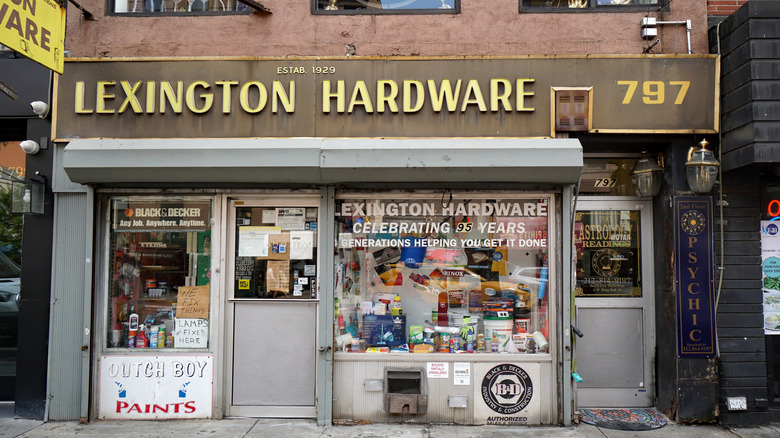
Home Depot once had trouble keeping items in stock. In a real way, Home Depot moved from having products out of stock because of its popularity to a company that has products out of stock on purpose. When we checked our local inventory, the problem came into focus. When the Home Depot website managed to locate an item, the local inventory was often paltry. For example, the local store carried a total of three expansion nuts, in only one size. That odds of that being sufficient for a product that's often used in multiples to mount things to other things in a waterproof fashion seem poor. Similarly, the store stocked a total of 10 knurled nuts in all sizes, and only one size of flange nut. This sort of hardware is de-emphasized as an option to take up valuable shelf space. Incorrect inventory counts make the problem worse, and it's a fairly common complaint from Home Depot customers for small- and big-ticket items alike.
While Home Depot orders inventory based on regional stats, smaller hardware stores, on the other hand, are more responsive to local needs. And while Home Depot stores cater most carefully to contractors and homeowners with relatively big jobs to do, your neighborhood Ace Hardware or independent store is more likely to be able to help customers navigating, for example, a store's endless variety of screw types or piles of various types of nails. They're often your best bet for common hardware items that might be too off-beat or fiddly for big-box stores like Home Depot to occupy themselves with.