

Get Your Washing Machine's Rubber Gasket Squeaky Clean With One Household Staple
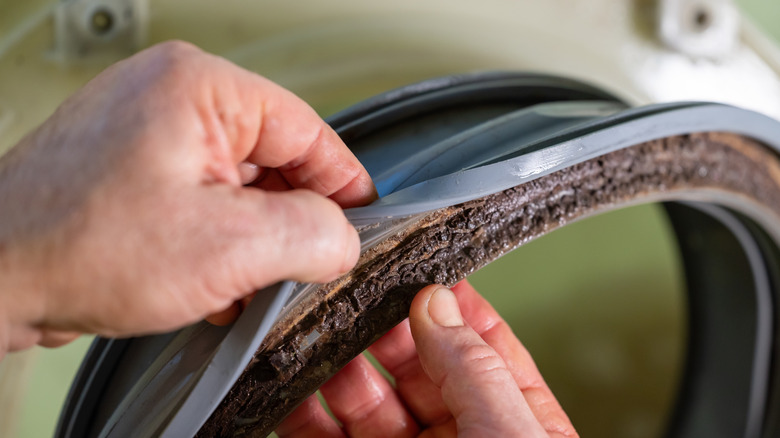
When your washing machine is smelling a little musty, moldy, or even just a little off, it's often due to a leaky or dirty rubber seal, also known as a gasket. That gasket on the door of your washing machine is what prevents water from leaking out during the wash cycle. It's also a key area where dirt, grime, mildew, and mold can accumulate. Look at it this way: you are putting dirty things into an enclosed space and adding water. If the washing process doesn't get rid of them, they can easily accumulate in any cracks or gaps in the door's rubber seal. But all it takes is a little hydrogen peroxide, white vinegar, or bleach and some cleaning implements to keep that rubber seal clean in order to prevent worse problems.
Things can get much worse indeed. If you have identified black mold accumulating in your gasket, you've got a potentially serious health problem on your hands. Black mold, especially Stachybotrys chartarum, can produce toxins that can be extremely dangerous. Even if it's not black mold, dirt or detergent buildup in those spaces can harden and create cracks in the rubber seal. If that happens, no amount of cleaning can restore it to its original condition. Fail to replace the damaged gasket, and you're running the risk of discovering water spills in front of or under your machine. A poorly sealed washing machine can even lead to your machine not functioning well, or leave your clothes smelling like the grime or mold trapped in the seal. Heading off these situations is pretty easy, but it involves staying on top of the potential problem by regularly cleaning the seals in your machine.
How to clean your washing machine's rubber gasket
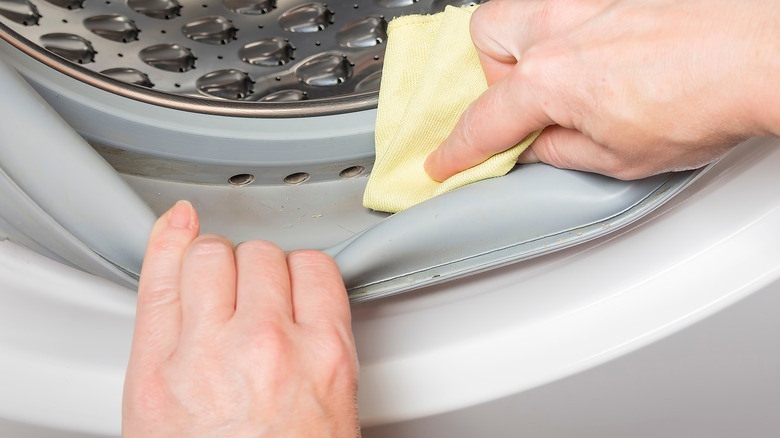
Inspect your gasket first to identify any cracks in the rubber. The rubber should feel supple, not stiff. If you find cracks, you'll need to replace the gasket. Otherwise, head to your cleaning supply cabinet and get out either your bottle of white vinegar, 3% hydrogen peroxide, or bleach, but no more than one of them. Do not mix any of these three chemicals together, as that can produce dangerous fumes that can lead to health problems.
The appliance manufacturer Hoover recommends mixing together a solution of 1 cup bleach and 1 cup baking soda, and running it in your machine, while many experts advise using white vinegar for light, regular cleaning, but the smell of both of those can be off-putting. Hydrogen peroxide has only a faint scent, produces no fumes, and degrades easily in the environment. It's often used to bring a shine back to a grimy shower and as a general disinfectant. While undiluted hydrogen peroxide is dangerous and even explosive, the brown bottle of hydrogen peroxide in your cabinet is usually a highly diluted 3% solution that is powerful yet safe for domestic use.
Add 2 cups warm water and ¼ cup hydrogen peroxide to a spray bottle. To add a little grit to your cleaning solution, you can also add a ¼ cup of baking soda. Let the baking soda dissolve before using. Spray the solution around the entirety of your gasket, then scrub it with an old toothbrush or soft scrub brush – nothing so stiff that it damages the gasket. Rinse the cleaning solution off the gasket with a clean, wet cloth. Repeat if necessary until the surface is completely clean, then dry the seal completely, including inside the folds of the gasket. Leave the washer door open to let it air out.