

5 Genius Tennis Ball Hacks All Homeowners Should Know About
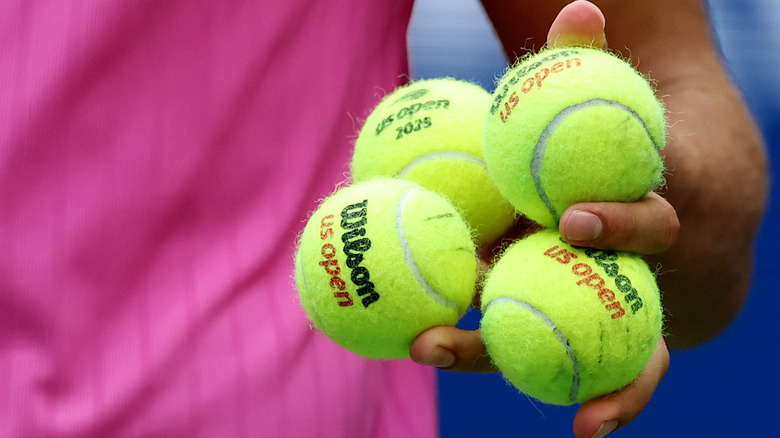
Sometimes, in our haste to use pool noodles and aluminum foil to accomplish every feat of humanity, we neglect one of the most useful, flexible, ubiquitous, hackable, and fuzzy objects around: The tennis ball. And odds are you have some abandoned ones in your home, either because your dog gave up on chasing them or you gave up on playing tennis. Thankfully, there are so many tennis ball hacks out there to repurpose them that it can be hard to pick only a few. There are dryer hacks and even this genius swimming pool trick.
Several unique qualities of tennis balls make them so suitable for non-tennis, non-dog uses. Properly cut, they can hold onto things, and four of our hacks make use of this feature. They're also a bit softer than... well, than hammers, to name just one. This makes them suitable for, say, repeatedly driving your car into one without damaging anything.
Speaking of not damaging anything, here's an important tip for anyone planning to cut a tennis ball for one of these, or any other, hacks. Use a sharp utility knife and cut away from the hand holding the ball, so that if the knife slips, it won't have the opportunity to cut you. And reconsider using a folding utility knife when dealing with bouncy things; the last thing you want is a knife blade bouncing across your knuckles.
Display cards with cuteness
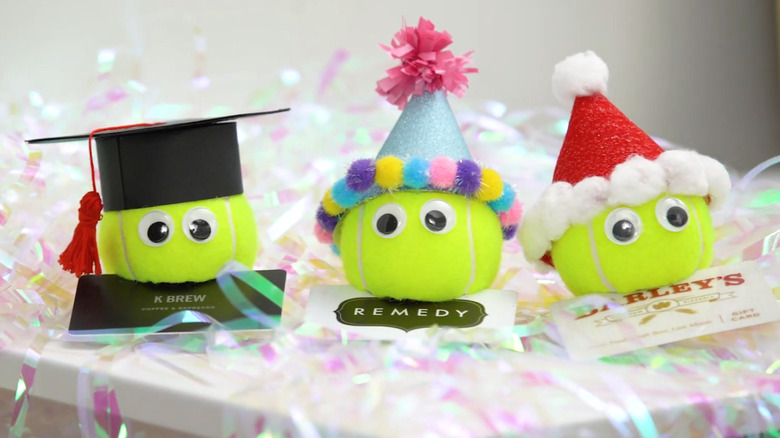
One quality of tennis balls that tempts us to do crafts with them isn't all that impressive: They're round. As simple as it sounds, this is the magic behind a bunch of cute hacks, which usually involve a ball head, knife-cut mouth, and either googly or drawn-on eyes. The result is inevitably adorable. And even when you look at it practically, the possibilities of things to do with this adorable hack are nearly endless. The "mouth" of the tennis ball face is quite good at holding onto things, and it's almost impossible not to add little faces to create a themed presentation for, say, gift cards. They're also good for holding mail and keys, and just about anything else that will fit.
You could also use them to hide cash and valuables, but in that case, you might want to forgo the cute face; no sense in calling attention to what you're hiding. For hiding things, it's probably best to keep the tennis balls looking like tennis balls, unless there's a rash of tennis-ball-seeking burglaries in your area. We've seen at least one crafter suspend a tennis ball from the ceiling, put googly eyes on it, then hide cash in it. This could just be giving burglars an unnecessary advantage.
Make a nifty parking stop
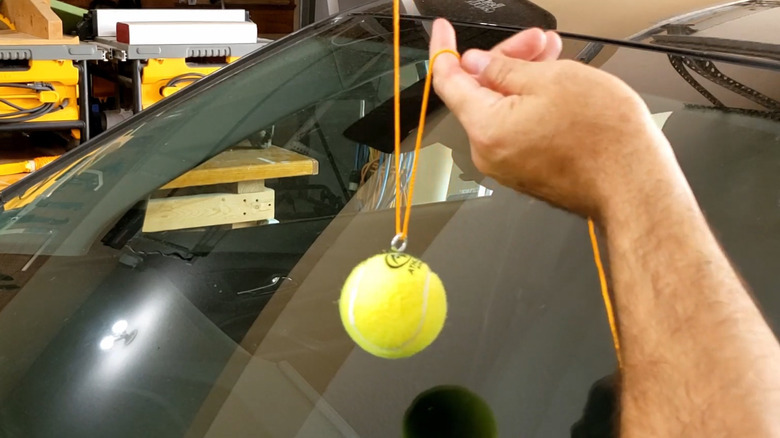
You've probably seen this parking stop hack by now: A tennis ball hanging from a string that lets you know how far forward you should move your car when parking it in a tight garage space. It's a time-honored way to ace your parking. While this one's been around for a while, there are a couple of less common improvements to it that we thought were worth mentioning.
The first is to make the ball retractable. This version takes the standard setup — a ball hanging from a string — and routes the string in a way that lets you pull the ball up when you don't want it getting in the way. Hang the tennis ball with a string from an eye screw at the correct position on your ceiling, then drag the two ends of the string towards a garage door arm. Attach two rubber bands to a carabiner hooked to a hole on the door arm, then fasten the string to the bands. Now, with the tennis ball in place, experiment with opening and closing the door until you have the ball positioned correctly on your windshield. And by "positioned correctly", we mean it shouldn't be in the center of your windshield, but somewhere around the top driver's side corner of the windshield. This will help you properly position the car both front-to-back and side-to-side in your garage.
Protect your padlocks
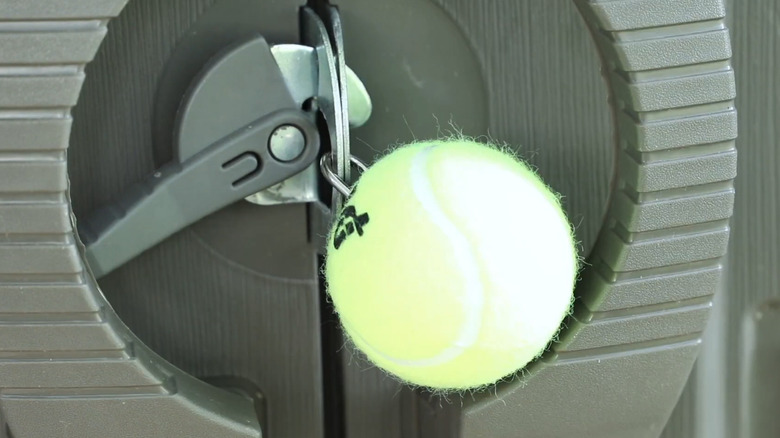
Tennis balls are fairly waterproof, which is one reason they're dog-compatible. They hold their shape even when damaged, so when you cut a slit in a ball, it should still close fairly tightly and keep some amount of precipitation out of the interior. This property becomes very useful when it comes to weatherproofing padlocks.
If you live in an area that ever gets a good, hard freeze with any amount of rain, snow, or ice, you've probably had a padlock freeze up on you. Now imagine how frustrating that'll be if it's the padlock to your shed where you keep the snow shovel. But if you cut slits in tennis balls and slip them over your padlocks, you'll keep most of the wetness out ... and that's the part that fouls things up when the temperature drops below freezing. Of course, a little spritz of WD-40, graphite, or a silicone-based lubricant would help prevent your padlock from freezing, but you probably don't need the tennis ball at all if you have any of those handy.
This doesn't just work in cold weather. Even a high-quality outdoor padlock left in the weather long enough will start to gather some rust and corrosion on its internal parts, and will eventually become very difficult to open. The tennis ball trick can help you put off this struggle for some time.
Turn a hammer into a mallet
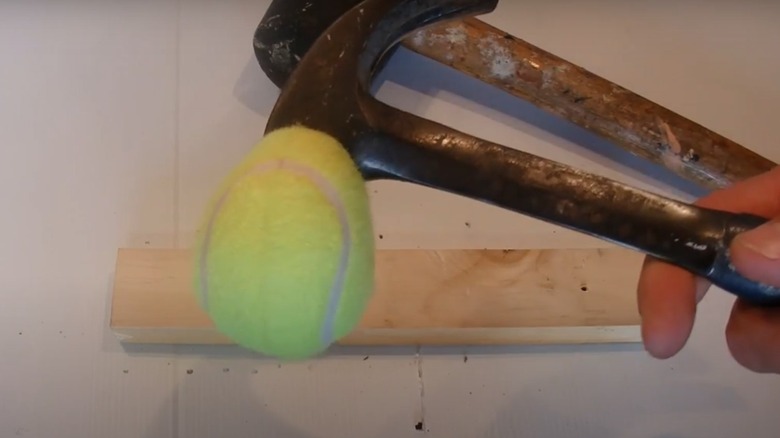
This idea only seems trivial if you've never damaged anything, including yourself, with a hammer. In fact, hammers are designed explicitly for damaging things, even if it's just the wood you're driving a nail into. If, instead, you want to knock on things without damaging them, the right tool for the job is often a mallet. Don't have a mallet? If you have a hammer and a tennis ball, you can have a mallet in mere seconds.
It's easy to convert a hammer into a very bad mallet by just cutting an X in a tennis ball and slipping it over the head of the hammer. The trick to making this hack truly useful is to cut the tennis ball enough so that the hammer head fully enters the ball and touches the side opposite the cut. Otherwise, you have a very cushiony mallet that doesn't carry a lot of force since most of your energy gets absorbed by the ball. And that shock absorption is valuable — it's one of the main reasons for using a rubber mallet — but you do need enough force to accomplish whatever you're trying to do.
Craft an unexpected jar opener
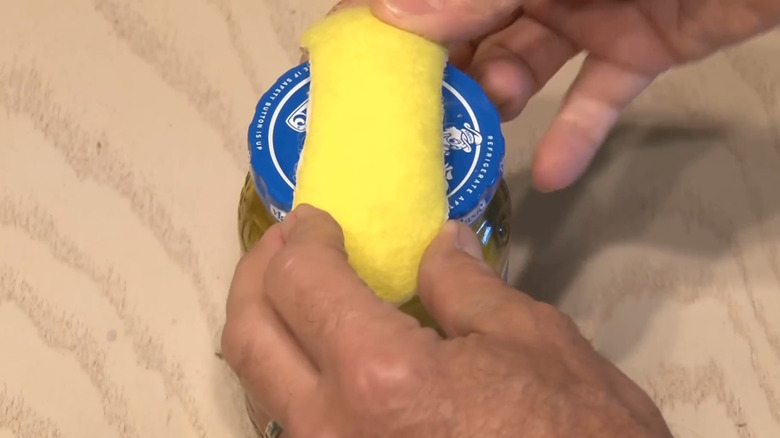
There are a few ways to open a stubborn jar — increasing your leverage, improving your grip, or breaking the jar's vacuum seal. And, of course, there are a lot of hacks making use of each of these methods, so it's needless to say that one of them involves a tennis ball. In this hack, you're cutting the ball in half and using the inner rubber bit to grip the jar lids.
Tennis balls are made by joining two hemispheres of rubber, covering them with felt, then smoothing and pressurizing them. So, your first guess is probably to cut the ball in half by simply slicing it down the barely visible joint between hemispheres. But if you cut along the visible felt seam, you end up with a more useful shape that can handle larger jar lids better than a ball cut exactly in half.
Cutting a tennis ball along its felt seam leaves you with two rubber-backed felt shapes, described in geometry as a stadium (though we like the alternative term discorectangle). This is a rectangle with a semicircle at each end, like the shape of a flattened capsule. The elongated rectangle can handle larger jar lids by virtue of having more length than width, while a round ball cut in half will always have equal length and width.