

Think Twice Before Planting These 5 Trees — They're Banned In Several US States
Imagine this embarrassing scenario: There's a knock on your front door. You open the door to encounter not your all-too-friendly internet salesperson but two serious-looking officials with clipboards and tablets. "Good morning," they say, "we're with the government and we're here to seize your tree. You've planted an invasive species that's banned in our state. Arborists are on their way, and you will be billed for the removal."
It might not go exactly like this, but believe it or not, it's not far from the truth. In many states, some widely planted trees have become a public menace. Many trees were planted in the United States with the good intention of growing them as shade trees. Many are fruit trees you should rethink growing, even if they are food for humans or wildlife. Still others were meant as ornamental delights sold in garden centers, only to have them outcompete native species and take over entire regions.
No region of the country is immune to tree invaders: Wisconsin bans the sawtooth oak (Quercus acutissima) while many parts of Florida prohibit the aptly named devil tree (Alstonia macrophylla). If your tree is on the USDA's Federal Noxious Weed list, federal officials also have the right to destroy your tree, but not every state bans trees. Contact your state's cooperative extension service to see what's prohibited in your state.
Don't plant Norway maples
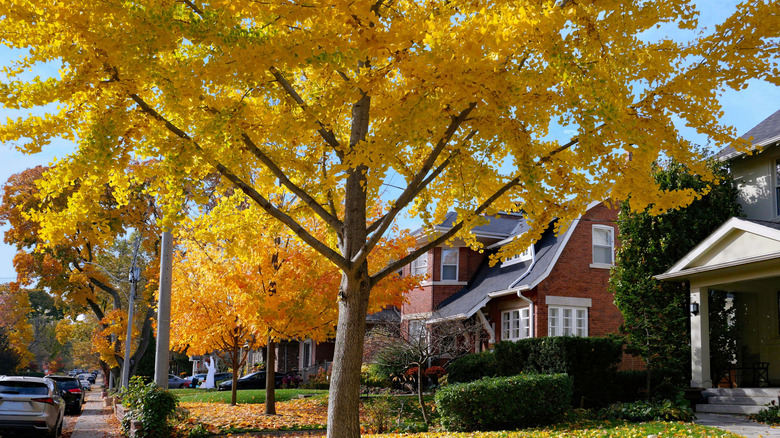
The Norway maple (Acer platanoides) is the beautiful tree that is too exuberant in sharing its beauty. It's a European transplant that's now invasive throughout much of the Northeast, Upper Midwest, and parts of the Pacific Northwest. The Norway maple's shallow roots prevent other plants from taking root, and its prolific propeller seeds helicopter their way to sprout offspring in any bare ground. A close relative is the Sycamore maple (Acer pseudoplatanus), another European invader with similar growing habits. Avoid years of regret: take a pass on growing these all-too-popular trees.
A native alternative that will keep the tree cops from your doorsteps is the classic sugar maple (Acer saccharum), a towering North American giant that can grow 50 to 100 feet tall (or more!) in USDA hardiness zones 3 to 8. The national tree of Canada, the sugar maple's leaves turn shades of red in the fall, much like the misbehaving Norway maple. The sugar maple's sweet sap is the source of maple syrup, though it can decades before they produce enough of it to be made into syrup.
Don't plant Autumn olives or Russian olives
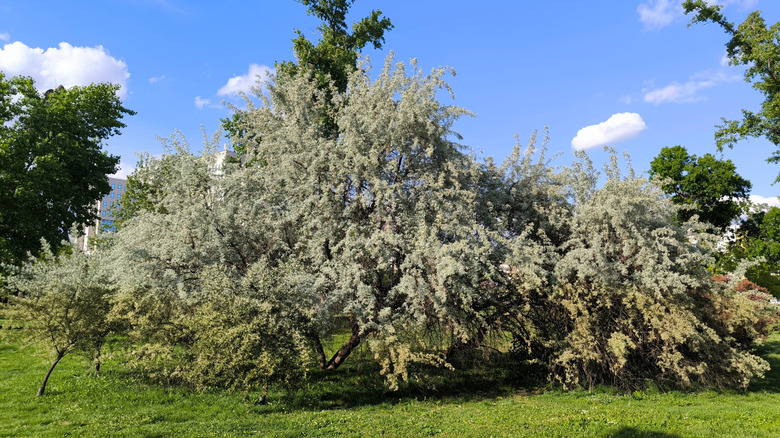
The common olive (Olea europaea) is one of the oldest and most widely cultivated trees in the world, long grown for its oily fruit. Those olives are less of a worry in North America than the autumn olive (Elaeagnus umbellata) and the Russian olive (Elaeagnus angustifolia), as both species are nuisances prohibited in much of the eastern United States, from Massachusetts to Illinois. (Confusingly, both species are sometimes called Russian olives.) Autumn olives are East Asian natives, and Russian olives are native to eastern Europe. Both can grow up to 30 feet tall and can survive in poor soils and drought conditions where other trees fail to grow. Their abundant fruits are easily disseminated by birds, making the trees aggressive spreaders.
An often recommended alternative to invasive olive trees is the dogwood, another small, shrub-like tree genus. This includes the silky dogwood (Cornus amomum), pagoda dogwood (Cornus alternifolia), and the flowering dogwood (Cornus florida). Unlike Asian dogwoods, all these species are native to the eastern United States. They can grow 10 to 25 feet wide and are hardy in zones 3 to 9, depending on the species.
Don't plant the Tree of Heaven
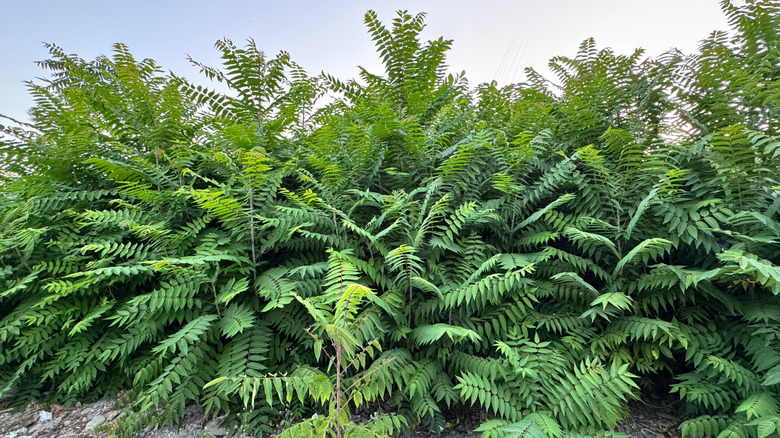
Whoever gave Ailanthus altissima the common name Tree of Heaven probably didn't realize what a devil of a plant it would become in the United States, where it is considered invasive in over 30 states. It can grow most anywhere — disturbed areas, cracks in pavement — and spreads by suckers and winged fruits to create dense colonies that crowd out native species and attract invasive insects.
Native alternatives to Tree of Heaven with growing habits and similar appearance include smooth sumac (Rhus glabra) or winged sumac (Rhus copallinum). Both are also dense colonizers that aren't great plants for small gardens, but, being natives, they support local wildlife with their fruit. Plant them in disturbed areas on slopes to prevent erosion or as a natural privacy hedge. Sumac likes a wide variety of soil types, as long as they are neutral to acidic in pH. Their flowers and fruits attract pollinators, songbirds, and small mammals. Smooth sumac is hardy in zones 3 to 9; the winged variety in zones 4 to 9.
Don't plant Princess trees
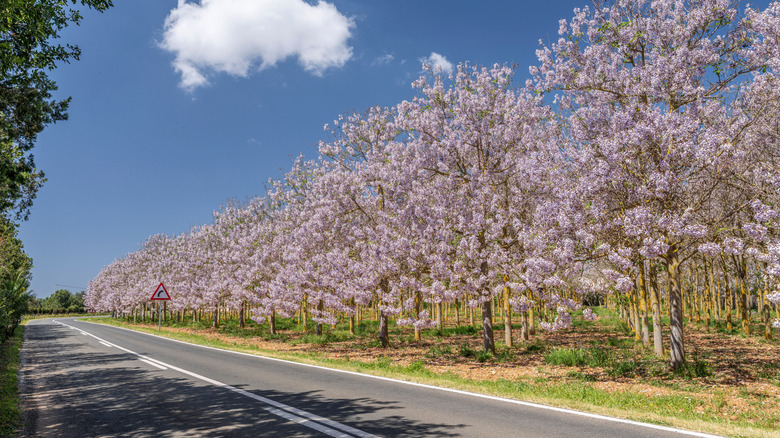
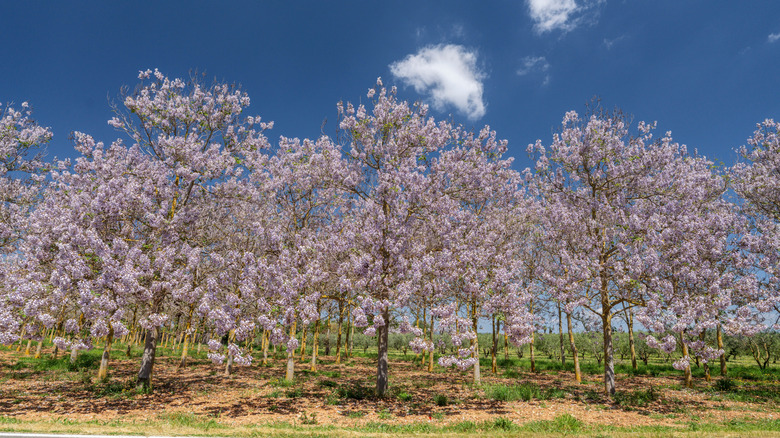
Paulownia tomentosa goes by various regal names: Princess tree, Royal Empress, Royal Paulownia, and Empress tree. But don't let its many titles lure you into planting it. It's a native of China named after a Russian princess and is capable of wreaking havoc in the United States. Once it reaches its 50-foot mature height, its big leaves will shade out competitors. It easily spreads its winged seeds throughout an area, and even if you cut it down, it'll re-sprout from roots somewhere else in your yard. It's considered invasive throughout the United States, and a number of states ban it.
Instead of this royal pain, consider a North American native magnolia tree. The southern magnolia (Magnolia grandiflora) is the most common, prized for its large, sweet-smelling flowers. It can grow up to 80 feet tall and 40 feet wide in zones 6 to 10, so give it room. Capable of growing further north is the sweet bay magnolia (Magnolia virginiana), which can grow up to 35 feet high in zones 5 to 10. In northern climates, it is more shrub-like, but in the South it can grow up to 100 feet tall. Or try the cucumber magnolia (Magnolia acuminata), which can grow up to 80 feet tall in zones 4 to 8. No, it won't produce cucumbers, but its cuke-shaped fruits provide food for a number of native birds and small mammals.
Don't plant Amur cork trees
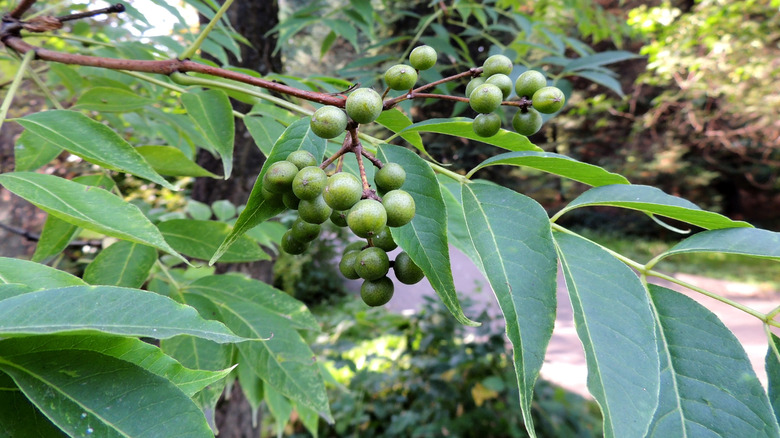
The Amur cork tree (Phellodendron amurense) is considered an invasive weed in the Northeast and Midwest, where numerous states have banned it. A native of East Asia, it was introduced to the United States as a shade tree, as it can grow up to 40 feet tall and 50 feet wide, leaving little room for anything else. Like many landscape trees to avoid, the Amur cork tree's roots spread shallow and widely, making it hard for competitors to take root. And even if its thousands of seeds land on solid rock and you cut the tree down, it can reproduce by re-sprouting from its roots.
A number of North American oak trees are great alternatives to the Amur cork tree. While the root systems of oak trees can cause problems for septic systems and foundations, they make excellent shade trees. The white oak (Quercus alba) can grow up to over 100 feet tall and 80 feet wide in zones 3 to 9. It's found mostly in the eastern United States, while the California black oak (Quercus kelloggii) grows up to 80 feet tall in zones 6 to 9, is native to the western U.S., and is a common site gracing California's golden hills. As its botanical name suggests, the live oak (Quercus virginiana) thrives in the South, can grow up to 50 feet tall and double the width in zones 8 to 10, and is often seen with Spanish moss hanging off its branches.