

Why You Might Regret Buying A Top-Load Washer
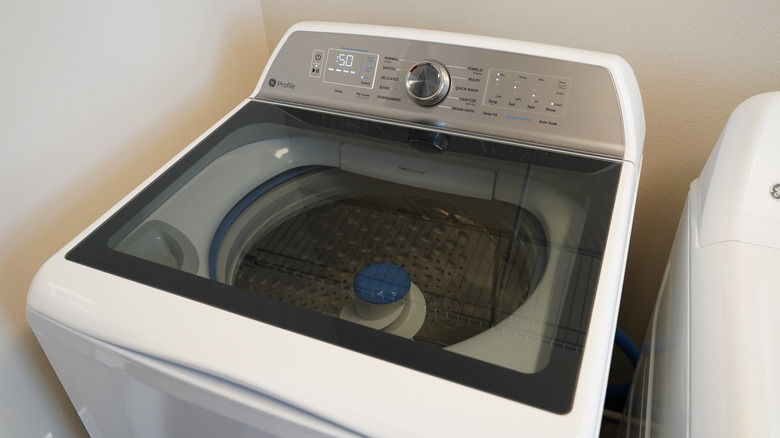
Bucking the received wisdom about appliances might be harder than switching sports team alliances, but it is possible. You've probably been told all your life a few pieces of information about washing machines, for example, and those things haven't necessarily been true since the 1990s: Top-loading washers get clothes cleaner, they say, but front-loaders make your clothes last longer. But while both front- and top-loading washers are being continuously improved to address such shortcomings, there are a few negatives about top-loading washing machines that you might want to consider carefully.
Although they tend to win these debates, front-loading washers have issues that might give you pause, and many of the previous problems of top-loaders have been addressed. For example, newer agitator-free top-loading washers (or those with removable agitators) are now, like front-loaders, gentle on fabrics. But top-loading machines have unavoidable structural issues that can't be (or at least haven't yet been) engineered around: They're awkward to unload, take up more space, and use more energy and water than their front-loading cousins, and so far there's not much that can be done about it.
But remember that you're probably not an average user, and you should shop for your own particular needs. For example, if you have the height and wingspan of a pro basketball player, reaching into a top-loader might not be a big deal. But for most of us, the trouble with top-loaders is real.
The challenges of using a top-loading washing machine
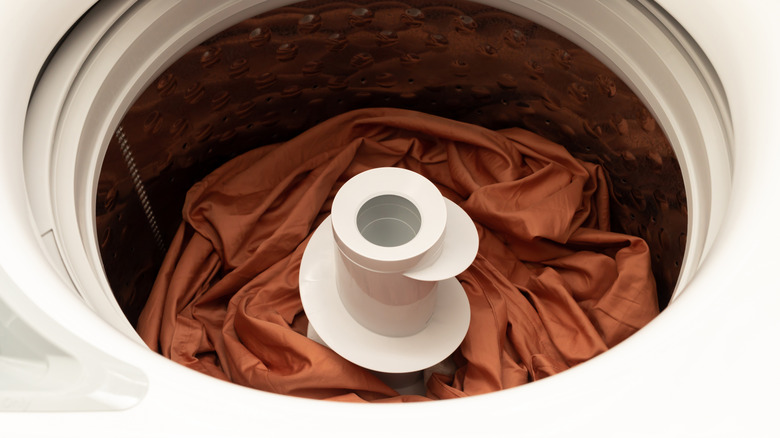
Unlike the ceaseless bending required by front-loaders, which is often and effectively remedied by optional pedestals, there's no easy way to address the problem some people have unloading clothes from the bottom of a top-loader. This is a particular problem for larger-capacity top-loading machines. And the in-stock top-loaders at Lowes averaged 4.44 cubic feet of capacity, while the in-stock front-loaders averaged 4.3 cubic feet. So top-loaders might enjoy a slight lead in the tub size arms race, it only makes them fall behind in the arm size tub race. There's no way to lower the floor and raising the top would be counter-productive, so top-loading machines are somewhat hemmed in by their design.
Similarly, top-loading washers are unavoidably less friendly for small spaces because you can't stack them. Washers are never stacked on top of dryers because of the weight of washing machines, and even if they were the height of the washer door would be unmanageably high. This means that a top-loading washer user is stuck with side-by-side machines that take up twice as much floor space.
And then here's the somewhat obvious problem of transparency. It is, unsurprisingly, a little harder to keep an eye on the washer's progress without the clear door in front. And if that seems like picking nits, don't forget the problem of picking knits. Picking, abrasion, and other forms of damage are still a little worse for top-loader users.
Comparing the costs
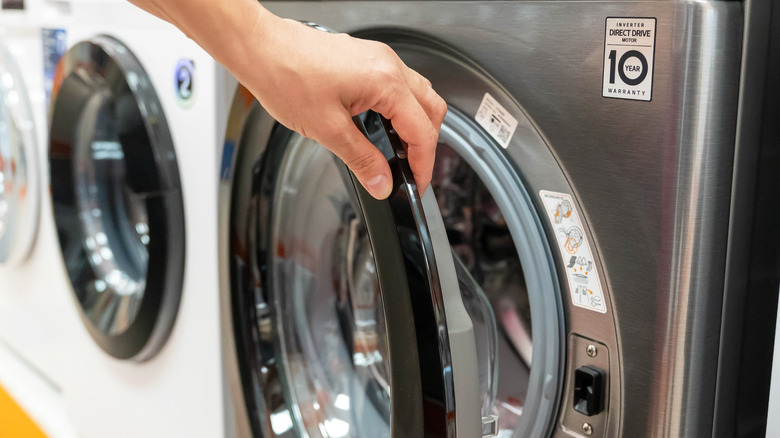
Things get a bit more definite and concrete when you start looking at the costs involved with top- and front-loading washing machines. When we looked at those in-stock machines at Lowe's the front-loaders averaged $918 and the top-loaders averaged $623.67. (Surprisingly, there were more top-loaders in stock ... nine, versus only four front-loaders.) And pedestals add even more cost to front-loaders.
Some argue that the higher cost of front-loading machines is offset by utility savings. Considering only electricity, given the average annual savings of $13.78 and the average price difference of $294.33, you'd break even in 21.58 years. On average, a new washer can be expected to last 10-15 years. But note that using a natural gas water heater levels out the energy use differences, reducing the energy cost of top-loaders by an average of 45.6%, but top-loaders by only 20.18%.
But the bigger deal in terms of cost is actually water usage. Per the U.S. Environmental Protection Agency (EPA), based on the national average cost per 1,000 gallons of water and wastewater and the Energy Guide's cost basis (six wash loads per week), a high-efficiency front-loader costs around $40.34 per year, on average, while a high-efficiency top-loader costs $83.05. So an HE front-loader breaks even in 5.21 years, considering both water and energy use. But a traditional top-loader costs $106.74 more to use annually than a traditional front-loader, so you'd break even in 2.44 years by using the front-loading machine. And if you're more concerned with the machines' environmental impact than its cost to operate, the extra water and power use make it hard to argue in favor of current-generation top-loaders.