

Adding Water To Paint: What It's For And Whether It's Recommended
We may receive a commission on purchases made from links.
You may have heard a rumor floating around that adding water to paint is a good way to stretch it out and make it last longer, to improve its flow so it applies more easily, or to extend its drying time. To find out how much of that rumor is fact and how much is fiction — and if adding water to paint is ever a good idea — Hunker reached out to Scott Paskewitz, the owner of Scott's Painting & Staining Inc., in Omaha, NE. Speaking exclusively to Hunker, Paskewitz set the record straight.
"Professional painters do not typically add water to paint as a routine practice," he said. "At Scott's Painting, we use paint as supplied by the manufacturer and do not add water simply to make it easier to apply or to stretch the product." While there may be instances when it's okay to add water to paint, such as to improve its flow, there are typically better options out there. And, Paskewitz cautioned, there are instances when you absolutely should not add water to paint.
"You can only add water to latex or water-based paint — you can never add water to an oil-based paint," Paskewitz warned. The same is true for exterior paint. "We would not recommend adding water to exterior paint. Exterior coatings need to maintain the proper film thickness so they can perform as designed and flex with the surface without cracking or failing prematurely." And, perhaps most importantly, "paint should never be diluted simply to make it go farther or reduce the amount of paint being used," Paskewitz said. Instead, to stretch small amounts of paint, rely on paint rollers and sprayers.
Is adding water to paint ever recommended?
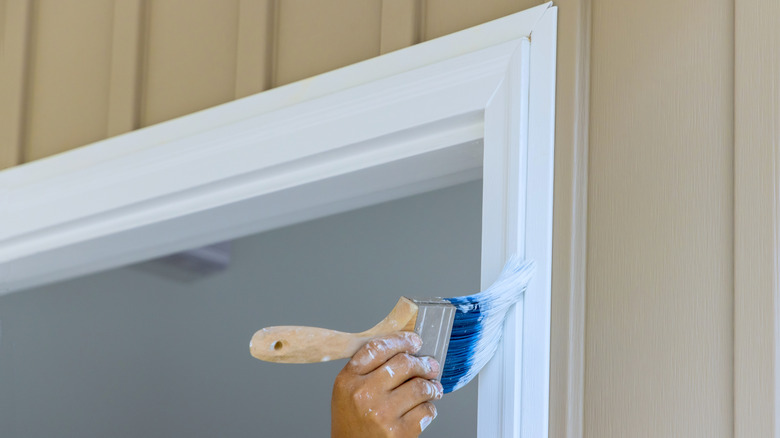
Painting the trim is one way to transform a room with a single bucket of paint. It's also one of the only times when adding water to paint is okay. Adding water to latex paint can give you a smoother, glossier finish. But even then, it's not the best option. "We would recommend products like Floetrol, as opposed to just adding water," Paskewitz said. Oil-based paint will also have a better flow than latex and is "going to give you a smoother finish," said Paskewitz.
The good news is that if you're working on a project where you can't skip primer, water may be able to help, according to Paskewitz. "We have used [water] in limited capacity on some primers, especially as they start to get too thick," he noted. The longer a can of primer sits around, the more likely it is for the water in the paint to evaporate out, and adding water may restore it.
Whether you want to improve flow or thin out a viscous primer, Paskewitz recommends always checking the paint can's label before adding anything. "If thinning is permitted for a particular [paint], the manufacturer's directions should be followed, rather than a general rule," he said. "But, in most cases, water is not recommended."