

Don't Toss Dull Lawn Mower Blades: Reuse Them To DIY Wire Cutters
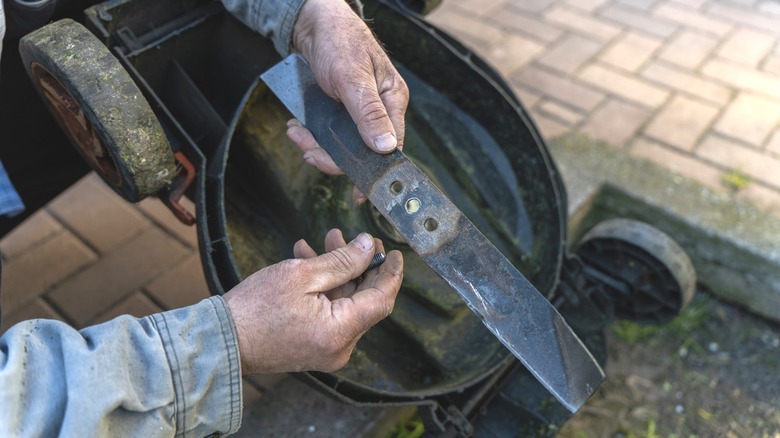
There's no shortage of ways to sharpen lawn mower blades to keep them in workable shape, but there comes a time for every blade when you can't restore the edge and have to throw it away. Or do you? In a clever hack on YouTube, GP DIY demonstrates a way to turn an old blade into a homemade wire cutter for the shop. It's a great tool to have when you need to cut multiple pieces of heavy wire, and you won't find anything quite like it at a hardware store.
The procedure calls for cutting metal with an angle grinder, drilling into it to add a pivot point, and welding a metal handle onto the blade. If you don't own a welding machine, or you're squeamish about using one, you can also attach the handle by drilling holes and using nuts and bolts. The creator behind GP DIY had a stationary drill press at his disposal, but if you don't have one, you could use a handheld drill with the proper type of drill bit (such as a titanium or cobalt bit made for metal), because none of the drilling procedures are precision ones.
A punch will be handy to create a starting spot for your drill bit, and some cutting oil will keep the bit cool and lubricated as it digs away at the material. You'll also need a combination square or a speed square, a Sharpie or piece of chalk, and of course, safety equipment. Safety glasses or goggles are essential whenever you use the angle grinder, and when welding, you should have filter goggles rated for the job at hand and insulating gloves.
Cutting and creating a stationary or portable wire cutter
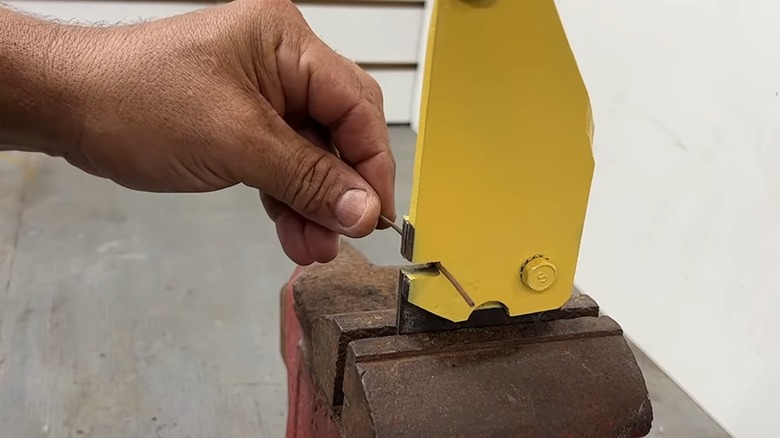
GP DIY's procedure was simple. The designer cleaned rust off the old blade with an angle grinder and used a cut-off disc to cut it into two pieces of unequal length. After drilling holes through the centers of both pieces and connecting them with a nut and bolt, he ground a 1-inch notch into the sides of the blade with the grinder so that, when you insert a wire into the slot and pivot the blades, the wire gets cut. He finished off by spot welding a metal pipe on one end to act as a handle. The handle is easy to customize — even a long piece of metal wrapped in tape for grip and bolted to the tool will work if you don't feel comfortable with welding.
Because there is only one handle, you have to use this tool with a vise or bolt the piece to the side of a work bench. But as one video commenter pointed out, you could easily attach a second handle to make the tool portable and useful for cutting wire fencing, for example. The tool might potentially even cut thin bolts if you increase the width of the slot and use longer pipes for the handles.
At the point at which the two pieces of blade are joined together, there's potential for significant frictional resistance. When making the tool, it's important to clean all the rust off the parts of the metal that touch each other, but that likely won't be enough. They'll also need lubrication, so you'll probably also have to separate the blades periodically and spray them with a silicone or graphite lubricant.