

Use PVC Pipes To Create Industrial-Style Shelves With An Impressive DIY
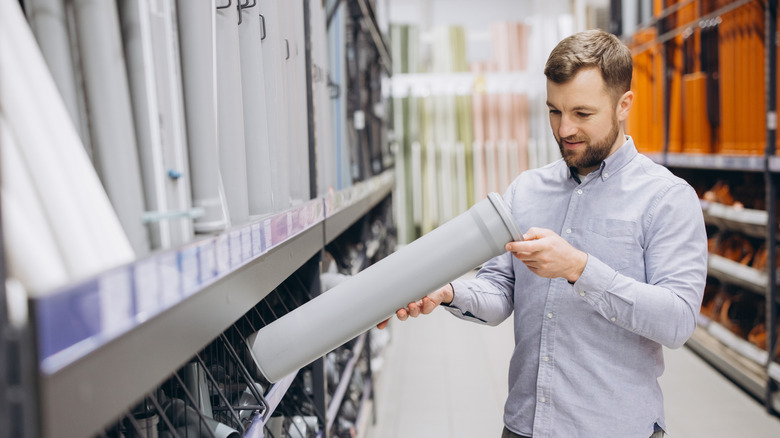
Unless you're devoted to the art of minimal living, stuff probably piles up in your house or apartment, and if there's an extra room for storage, that's where it usually ends up. When you keep adding stuff, items that are already there become harder and harder to access. You can alleviate this problem by adding shelving, and while it doesn't have to be fancy, it does have to be strong.
TikTok user Emily Shaw was in such a situation, but she was on a low budget. She could afford wood for the shelves themselves, but she couldn't afford wood framing. In her search for something as strong as wood, she landed on PVC pipe. It costs about one-fifth as much as steel pipe, and she could paint it black to make it look like steel. Also, unlike steel pipes, PVC is very easy to cut and assemble, and you can slip PVC pipes into fittings and glue them with inexpensive PVC cement instead of screwing them together.
To get the strength and rigidity needed to support a lot of weight, Emily Shaw used 1-inch pipe. She bought it at Lowe's, where a 10-foot length costs $5.91. She also needed multiple tees and elbows to make perpendicular joints, and she bought flanges that could be secured to the floor to support the structure. She came up with an innovative idea to hold the structure to the wall, and she needed 1-inch slip caps for that.
Assembling Emily Shaw's heavy-duty PVC shelves
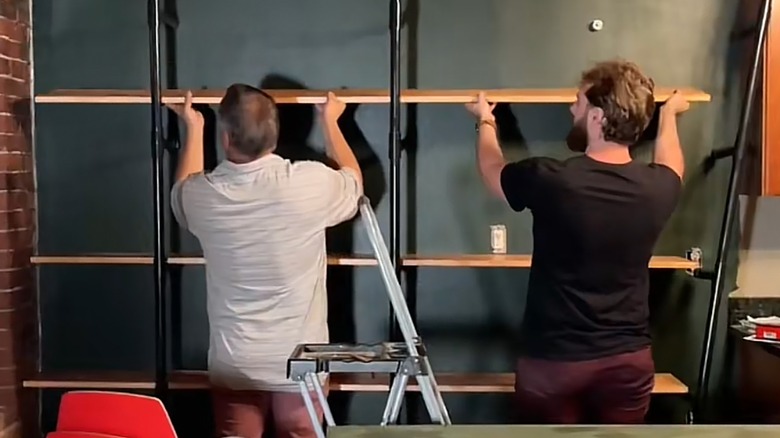
Emily Shaw's design calls for three upright sections secured to the floor, with horizontal supports for the shelving that extend to the wall and are anchored there. She used PVC tees to connect the uprights to the supports, and elbows for the top of the unit. She cut all the pieces of pipe to length on a table saw, but if you decide to copy her design, a PVC pipe cutter is more efficient. It makes a clean cut that fits easily into the fittings without the need to sand off burrs. After cutting the pipes, she painted them black with Rust-Oleum enamel.
She held each upright section in position after assembling it while a helper marked the positions of the bottom on the floor and each support pipe on the wall. She screwed a metal flange into the floor at each mark, then screwed a PVC bushing into each flange, into which she could slip the pipe.
To secure the support brackets to the wall, she drilled holes in the bases of 1-inch caps and fastened them to the wall with drywall screws. She could then easily slip a support into each cap and glue it. She doesn't mention drywall anchors, but these are essential if you don't want the screws to pull out when you put weight on the shelves. Moreover, it would have been better to hold off on painting until after completing assembly, because paint interferes with PVC glue adhesion.