

Build Durable, Budget-Friendly Stairs Using Reclaimed 6x6s

If you live on a mountain or in a hilly neighborhood, or even if your landscape grading is a bit adventurous, you'll eventually notice that you need stairs outdoors somewhere. There are many ways to build such stairs, including a traditional method from "This Old House" using sturdy old landscape timbers. And if you scout around for reclaimed timber, there's a good chance you can find 6x6s at little or no cost.
The "This Old House" episode is old enough to be standard definition (when you've been on the air for 47 years, "old" is increasingly relative) and involves a predictably carpenterish maximized for strength and durability in which wood is joined to other wood rather than just nestled in soil, and everything rests on a carefully leveled foundation. The result is sturdy and attractive.
This build requires a few tools and materials, including gravel, a wood preservative, circular and handsaws, rebar, a shovel, a level, long timber screws, a drill/driver capable of driving those screws, and a sledgehammer. You'll also need a 2-by-2-inch stake and your pressure-treated 6x6 timbers. Pressure treatment is important for any wood used outdoors, unless it has substantial anti-rot properties. Sealing with a wood preservative like "This Old House" suggests is a good idea as well, but it's not practical to fully treat wood with much ground contact. And remember that you're never going to permanently prevent rot in any wood making contact with the ground, so plan to replace the wood in 10 to 15 years. But first, you'll need to source the wood.
Where to find free 6x6 landscaping timbers
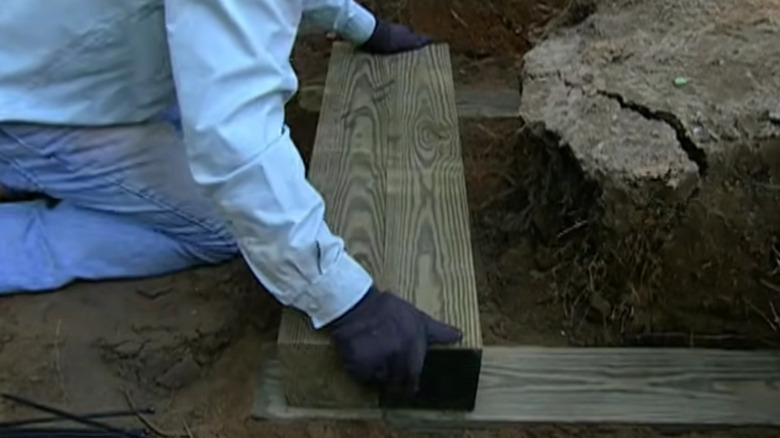
Since a single 8-foot 6x6 currently runs around $36 at Home Depot, it might be a good idea to start looking around for cheap or free lumber. You can try Facebook Marketplace and Craigslist, of course, and it might be a good idea to befriend (or at least get scrap-pile privileges from) someone at a residential construction site or perhaps a fencing or deck-building company, who typically use a lot of 6x6s. Any company that regularly builds wide gates or freestanding structures like carports, pergolas, or gazebos might also be worthwhile.
You might find one unexpected source of free 6x6 timbers in children's playsets. Anyone selling these online might very well let you take them for free if you're willing to do the demolition work. People discard these playsets regularly and they are often made of rot- and insect-resistant wood and have relatively little damage that tends to be limited to ground contact. But please note that demolition work, as well as unearthing fence posts, for 6x6 projects can be surprisingly time-consuming and sometimes difficult.
Pay close attention to the length of timbers available to you. In this design, you'll need 6x6s for sleepers and steps. We'll explain sleepers below, but for the steps you'll likely need timbers at least 36 inches long ... the minimum width of most outdoor steps ... and likely you'll want something close to the 48-60-inch range, or even more for a stairway that makes a statement. It's often easier to collect timbers that are sufficiently long from the demolition of playscapes, fences, and the like, rather than looking for cutoffs from new construction.
How to build the landscape steps
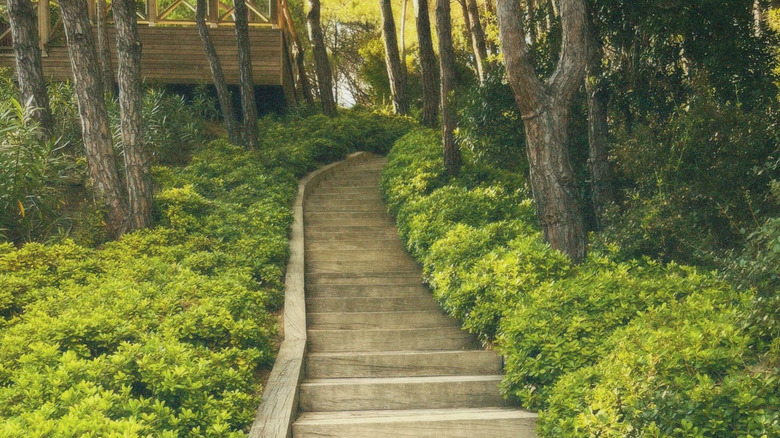
There's a lot to consider when building yard or garden steps, but uniformity is critical. The rise and run of stairs of landscape staircases aren't always regulated, but they're a good guide. Stair risers usually fall at the high end of a 4- to 7 ¾-inch range, and stair tread depth is a minimum of 10 to 11 inches. "This Old House's" steps rest on a foundation of sleepers that support the stair treads. Each step has a 5 ½-inch rise (the average height of a stair step) ... in this case, the thickness of the timbers, which are nominally 6x6s. The run (or tread, the depth of each step from front to back) is 11 inches. Unlike interior staircases, you don't need to worry about how much a stair should overhang the riser.
After measuring the bottom and top landing positions, dig trenches at the base of the steps so that the bottom, longest sleeper can be placed perfectly horizontally, even with the bottom landing. Two treated timbers can then be pinned in place, then another sleeper 11 inches shorter than the last is put in place behind them to form the foundation for the next step up. Constantly check everything for level.
An uneven natural grade can make regularly spaced steps difficult. As you near the top of a hill, for example, the slope gets less steep, so add a landing where necessary. Follow the Landscape Architectural Graphic Standards (LAGS) convention of adding a 36-inch landing wherever it's necessary to have a tread deeper than 18 inches to stretch the steps horizontally without resorting to irregularity and tripping hazards.