

How To Take Apart Pallets Without Destroying The Wood
We may receive a commission on purchases made from links.
Old pallets are the starting point of many cool DIYs — provided you can get the boards off in one piece, that is. From indoor projects that add storage to outdoor projects that cleverly hide your trash cans, pallets are a genius way to source a bunch of quality wood in bulk. But nothing's worse than scoring a perfect pallet only to snap it in half during disassembly. Pallets are built to be extremely sturdy since they usually handle large loads and use specially designed nails that are difficult to remove. When you pry up one end of a board with a crowbar while the other is still nailed down, the wood can split in two — which obviously isn't ideal if you need full-length boards for your project.
Thankfully, there are some good tips out there on how to separate pallet boards carefully. One common method is to cut through the nails with a reciprocating saw, as the blade slips into the seam between the surface boards and the thicker supports underneath. Cutting the fasteners lets you lift the boards away without having to bend them against nails that are still holding tight, leaving less room for error and more usable wood for your project.
For this method, all you need are your pallets, a reciprocating saw, a demolition blade designed for nail-embedded wood, safety glasses, and work gloves. A Diablo Bi-Metal Saw Blade is one option, or you could opt for a slightly pricier Diablo Carbide-Tipped Blade, which offers greater durability when cutting through metal screws. Both are available in longer sizes, which can help you reach fasteners farther in from the edge.
Cut through the nails to free the boards
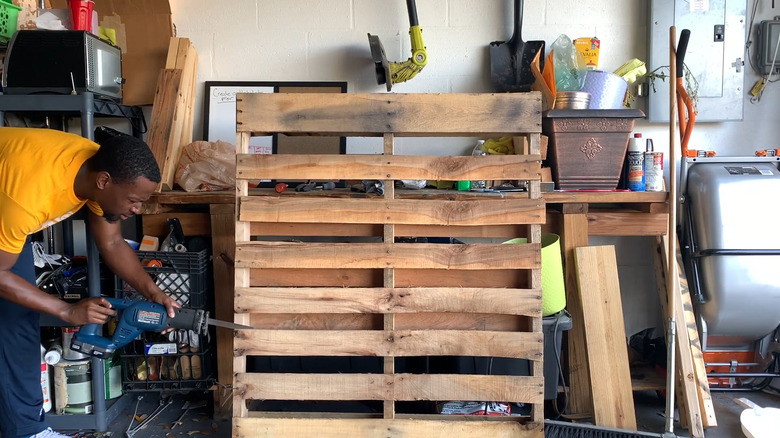
Success with using recycled pallets is all in how you disassemble the wood. Put on your safety gear and make sure the pallet won't budge while being cut. Then, you can fit your reciprocating saw with a suitable demolition blade and look for the seam where a top board meets one of the thicker supports underneath. The blade should be inserted into the gap between the board and its support; this way, it can cut through the nails without biting into the wood.
Slide the blade into the gap from the side and let it cut through the nails, keeping the saw's shoe supported against the workpiece and avoiding excessive pressure. Once the top boards are free, flip the pallet over and repeat everything on the other side. As far as the old nail heads go, many folks prefer to leave them in the wood for a more rustic look. If that's not your style, try using a nail punch and hammer to drive the leftover metal through the board, and then pull out any exposed pieces with pliers.
Don't have a reciprocating saw? A pallet buster is another option, as its forked head straddles the support underneath a board, distributing the lifting force more evenly than a crowbar. A pry bar and hammer can also work, as long as you work carefully near each nail rather than forcing one end of the board upward. Both methods will take more of a physical toll and require a lot of patience.