

They Transform An Old Trampoline Into A Stunning Backyard Retreat With An Impressive DIY
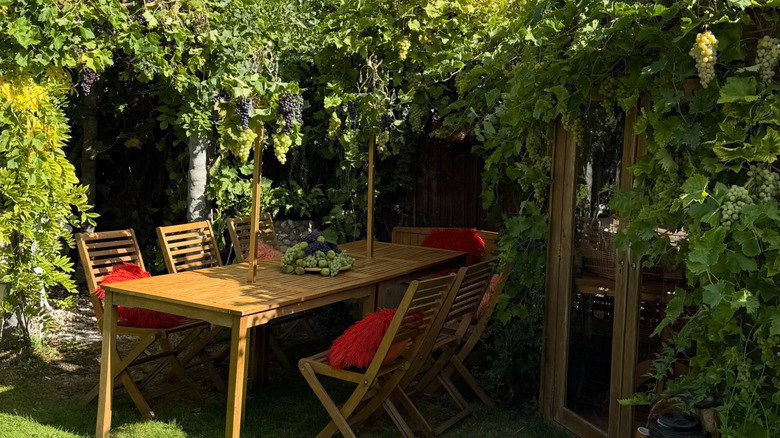
At some point, trampolines outstay their welcome. Sure, at one time it was a key part of tricking out your backyard into the ultimate outdoor game spot. But kids outgrow it, it deteriorates and becomes unsafe, and at some point you decide it has to go. London artist and floral designer Doloresa Medne decided to turn her old trampoline into a backyard retreat. She created a hidden-away nook and grew some grapes on it, too.
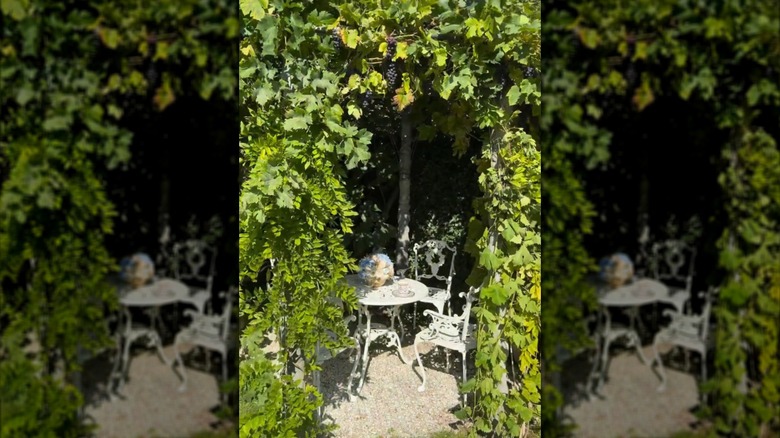
Medne turned the support poles into leg extensions, moving them from the top of the circular frame to the bottom. She affixed them to the frame and extended the legs. This turns the circular mat frame into a roof, and effectively creates a space underneath that can be repurposed into a hideaway. She wrapped all of the vertical poles in cement-soaked bedsheets, then used cord to hold the fabric in place while the cement cured. She removed the jump mat and springs, added a wire frame to the top, and two years ago, planted white and Midnight Beauty grapes beside the trampoline poles. They grew to cover the entire structure, and now she has a beautiful grapevine-covered bower instead of an ugly old trampoline.
How she might have done it, and how you might too
There's not a lot of detail in her videos about how Medne pulled off this project, so it's worth taking a moment to think through how to safely construct a trampoline hideaway. We're following her lead whenever possible, and filling in the details when necessary. The most critical part of the project is, of course, turning the net support poles into legs. Since most large trampolines have U-shaped legs, this requires cutting away the horizontal parts of the legs and leaving the vertical remainder all one length. There are lots of ways to make this cut; we'd use an angle grinder with a cut-off wheel. Cementing the poles in the ground and sticking the frame on top would work because the thinner poles would overlap the thicker ones fully. We suggest finding a plastic pipe, PVC or similar, that fits snugly between the thinner and thicker poles and acts as a sort of coupling sleeve. Then, you can run self-drilling metal screws through all three layers in several places to secure it.
It appears that Medne wrapped the new legs in something like plastic pipe or perhaps pipe insulation to give them a uniform thickness. This is a good idea and probably makes wrapping them in the cement-coated sheets easier.
Turning it into an arbor

You'll also probably want to remove the jump mat itself, which is best done with a spring removal tool. These usually look like metal hooks with a T-handle. You can also use an automotive exhaust spring tool. Once you have this done, you've removed the potential structure that grapes (or the vine of your choice) might use to spread across the top of your retreat. Medne added what looks like a sunburst of thick galvanized wire to the top of the frame, and also a few strands running between each leg to encourage the vines to climb and fill in the gaps.
The wire connecting the legs appears to be simply tucked into the cement sheet wrapping, but the spoke-like top structure will need to be secured to the frame. You could simply extend the top spokes all the way down to the sides, or you could (probably with some effort) wrap them around the round mat frame. If you have the patience, it might be worthwhile to drill holes in the hoop and simply run each spoke into one. The future weight of your vines should hold the wire in place.
There are lots of ways to build a DIY garden arbor and some interesting ways to reuse an old trampoline, but this might be one of the best for both. The upcycling helps turn trash into treasure, and the end result is truly special.