

Woman Turns Bags Of Quikrete Into Stepping Stones For An Upgrade On A Budget
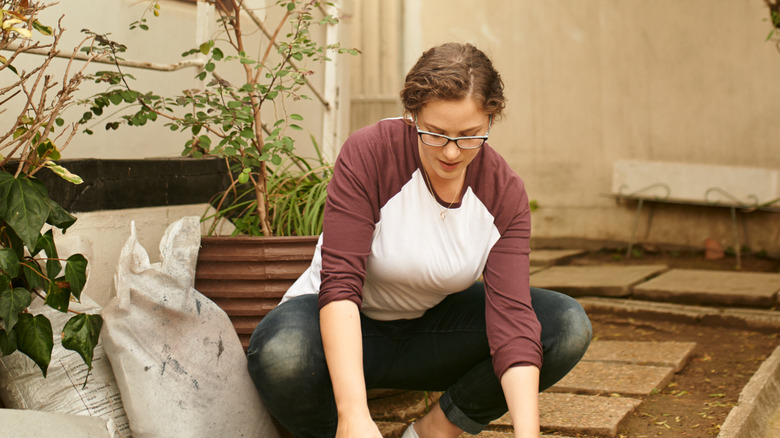
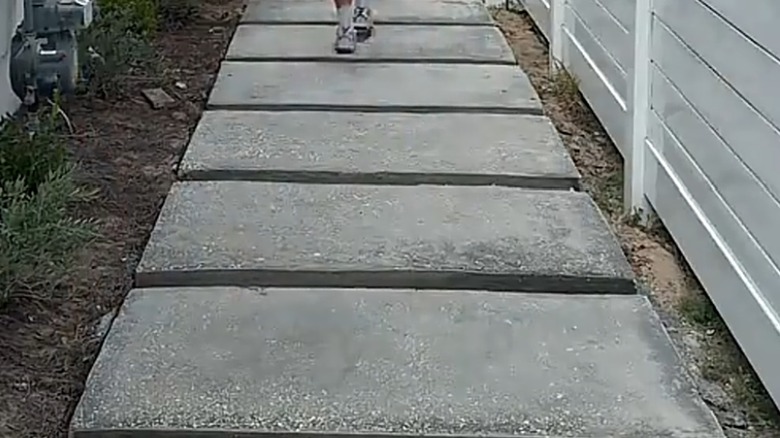
TikTok user Alaina Kathleen Ford wanted concrete stepping stones in her side yard, and because she was on a budget, she decided to make them herself. She undoubtedly saved time and money by not hiring a pro, and her finished stepping stones look impressive. Here's a quick rundown of what she did: Using 1x4 lumber, she formed up each "stone," which is actually a fairly large (maybe 2- by 4-foot) section of concrete. She poured sand into the bottom of each section, but it isn't clear how much sand she used or whether she dug out any dirt before adding it. She covered the sand with what appears to be a plastic film, then poured dry Quikrete on top of that, bringing it to the top of the form and rounding out the edges with a trowel. After having made all the "stones" in this way, she thoroughly watered all the concrete with a garden hose. The concrete dried and hardened to make a solid walkway.
Commenters pointed out problems with this approach. For example, one person said that failing to mix the concrete before application probably made it weak and prone to cracks. Another commented that dry-poured concrete leaves a grainy surface that's impossible to smooth out, and she proved this with an experiment of her own. Graininess may actually be a feature, though, because a rough, grainy surface is slip-resistant.
Making your own concrete walkway on a budget
Any homeowner can incorporate Alaina Kathleen Ford's approach to make their own garden stepping stones with Quikrete, and even improve on her ideas. Forming the stones in place is an efficient alternative to buying them, hauling them in, and placing them, and you don't necessarily have to make the forms out of wood. You can use pie tins or pizza boxes to make stones that are smaller than Ford's, or if you want large, irregularly shaped ones, you can make the forms from a flexible material like rubber landscape edging.
A rough texture on the stones can definitely prevent slipping in the winter, but dry-pouring the Quikrete isn't the best way to achieve it. When you dry-pour concrete and wet it down in place, you can't be sure that the water reaches all of it uniformly. The concrete that's insufficiently wet will remain weak, and since that's usually at the bottom, the stone may appear hard at the top but crumble and crack after a short time. It's safer to pre-mix the concrete, pour it, and then roughen the surface with a broom while it's wet to create a texture.
Some of the most important comments generated by Ford's post were the frequent warnings to wear a mask while working with dry concrete. Breathing in large amounts of the dust can cause silicosis, a dangerous lung disease. It's also important to wear gloves when handling concrete to prevent skin burns.