

Keep Kitchen Knives Sharp With One Of Costco's Smartest Finds Of 2026
We may receive a commission on purchases made from links.
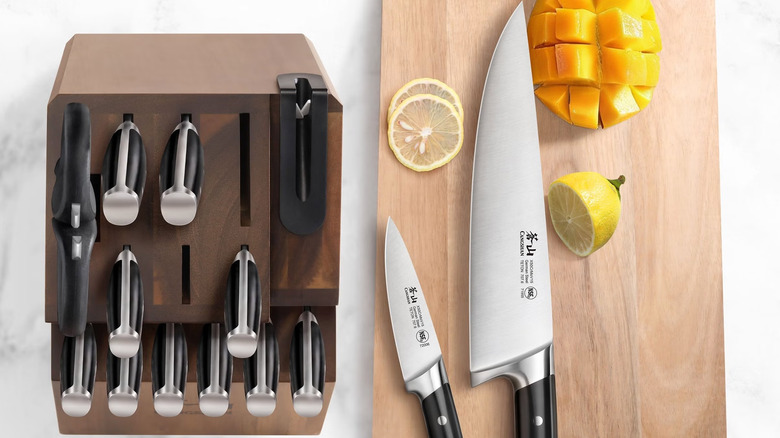
You expect to find smart deals on sharp products at Costco, and you definitely don't want to overlook this one. It's easy to imagine shoppers losing sight of the Cangshan Teton Series 14-Piece Knife Block set amid the standing desks, caffeinated bottled water, and crates of croissants. One major selling point of the set is the block's built-in sharpener. While this bonus feature has plenty of appeal, the best thing about the Teton Series is the knives themselves.
The set covers most culinary bases and includes the three knives Wüsthof's CEO says everyone needs in their kitchens. The stars are an 8-inch chef's knife and a 7-inch santoku, and the set also includes an 8-inch bread knife, 5-inch serrated utility knife, 3.5-inch paring knife, and a 2.75-inch peeling knife, 6 steak knives, heavy-duty kitchen shears, and, of course, an acacia knife block with a built-in sharpener. This provides an easy way to sharpen kitchen knives and makes this set especially appealing for households with limited counter and storage space.
Skeptics of made-in-China products will find no confirmation of their biases in Cangshan knives. This is a company, after all, with an award-winning knife series bearing the name of world-class chef and proprietor of The French Laundry, Thomas Keller. The $179.99 Teton set is a collection of high-quality knives using German steel. The full-tang handles are secured with three rivets (mosaic rivets, according to the description, but the photos don't bear this out). The sharpener is made from the same steel as the knives and is preset to a 16-degree angle.
The quality of the steel matters
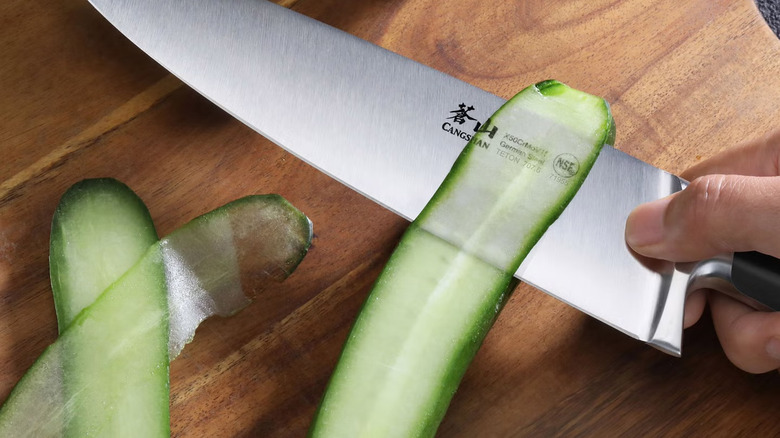
Ask any chef, knife-maker, or RPG player with more than one real sword in their collection, and they'll tell you not to skip over what's most important about any knife — the steel used in its blade. The steel is, in fact, what gives a good knife its most important qualities, assuming it's properly forged. And in the case of the Cangshan Teton series, that steel is X50CrMoV15 stainless steel. Hold on, hold on, remember what the sword guy said: This is important.
X50CrMoV15, also known as 1.4116, is a German-origin steel used by brands like Wüsthof, Zwilling, and Victorinox. It falls in the 54 to 58 range on the Rockwell Hardness Scale, and the Teton series comes in at the top of that range. The impossible-to-pronounce name, X50CrMoV15, indicates that the most notable parts of the steel's composition are 0.50% carbon, 15% chromium, plus some molybdenum and vanadium, and a bunch of other elements that only guys with at least four swords care about.
In practice, all this means that the Teton series scores high on corrosion resistance and a decent job of edge retention (staying sharp). Knifeworks, an online knife retailer, says that X50CrMoV15 steel has been "the workhorse of European professional culinary and outdoor knife production for decades." It sharpens easily, requiring no diamond abrasives like some other steels. Due to its medium-level carbon content, edge retention may be a concern, but the Teton set has been heat-treated to ensure hardness and durability. Plus, there are pros and cons to high-carbon steel kitchen knives as well.
What makes this a great home chef set
As of this writing, the Teton set only has a few reviews on the Costco site, but currently holds a 4.5-star average rating. Other Cangshan sets available at Costco also have a weighted 4.5+ star rating from over 1,500 reviews. If you find yourself balking at the set's price tag, consider this: Of the 13 Cangshan sets Costco currently offers, the average price per knife is $23.56. The average price per knife for the Teton set is $15, the second lowest among the 13 sets.
But is that because it's an inferior set? Most signs point to very high-quality knives within the set, but there are a few nits we could pick. The stated Rockwell hardness of 58 +/-2 suggests that the steel is sometimes out of spec for X50CrMoV15. The sharpener is set to a 16-degree angle, but some sources claim the ideal blade edge geometry for this steel is 8 to 12 degrees per side. And what's up with the polyoxymethylene handles ... shouldn't these be steel or some kind of endangered tropical wood? It turns out that polyoxymethylene is an extremely durable, dimensionally stable, water-resistant plastic often used for mechanical parts and medical devices.
From the blades, you can expect hardness, corrosion resistance, and durability imparted by the use of carbon, chromium, molybdenum, and vanadium. Its somewhat limited sharpness and moderate edge retention mean X50CrMoV15 steel will likely need to be sharpened frequently, so it was a brilliant move to include a sharpener in the set's knife block. It should also be noted that the Teton knives are hand-wash-only, like all high-quality chef knives.