

Quartz Vs. Marble Countertops: Which Will Last Longer?

Renovating your kitchen or bathroom? You might find it difficult to determine which is better: marble or quartz. While the former has gained approval from homeowners due to its elegant appearance and natural veining, the latter wins in terms of low maintenance, making it challenging to pick one. Plus, they're mostly comparable cost-wise, unless you go for bespoke finishes or pick an uber-luxurious marble (think Calacatta gold variants). However, they don't have the same lifespan. Opening up about which material is more durable, Lauren Lerner, the founder and principal designer of Living with Lolo, reveals to Hunker in her exclusive interview, "Marble technically lasts longer. It's natural stone, and some marble counters in Europe are centuries old. But quartz comes out ahead for how most families actually live, because it's nonporous and doesn't stain or etch, so it looks close to new after 15 or 20 years."
But this doesn't mean that marble counters won't survive a decade or two in your household. Our expert clarifies, "Marble doesn't fail, it changes. You have to be the kind of homeowner who's okay with that." Basically, it develops patina over time — a few scratches and etchings here and there (but you can get ahead of them with proper care) — that adds to its natural beauty and lends it a rich character. So, while both have their charm, you must decide whether you value aesthetic appeal or practicality more when it comes to counters. Lerner agrees, "The question I ask clients isn't which one lasts longer. It's which version of 'aged' they can live with."
Consider the pros and cons of both quartz and marble countertops before finalizing
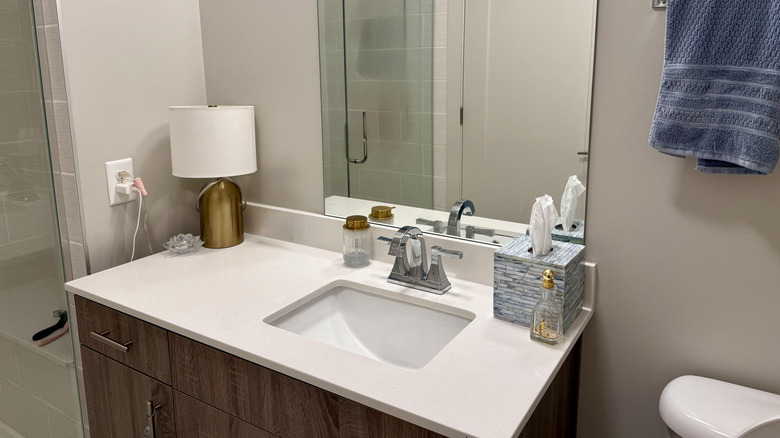
Since you'll have to live with your decision, it's best to know both materials well. Listing all the ways quartz is a kitchen countertop material that's equal parts durable and beautiful, Lerner tells us, "Quartz is nonporous, so it doesn't need sealing and resists stains from wine, coffee, and oil. It's consistent in color and pattern, which makes it easy to match across a large kitchen or multiple bathrooms. It's also very durable against everyday chips and scratches." Moreover, it rates 7 on Mohs scale of mineral hardness, so it can perform well in heavy-duty areas.
That being said, there are certain problems with quartz countertops. Our design expert notes, "Quartz is held together with resin, so a hot pan can scorch or discolor it, and those marks are usually permanent." As such, it can't handle heat beyond 300 degrees Fahrenheit without developing permanent marks. She also mentions that they can't handle direct exposure to sunlight since UV rays can yellow or fade the surface with time. Worse, regulators aren't a fan of this material. Lerner elaborates, "California regulators are moving toward banning engineered stone with high silica content because of silicosis cases among the fabricators who cut it, so we're already showing clients alternatives like quartzite, large-format porcelain, and newer low-silica engineered surfaces."
In comparison, "Marble is a natural stone, and no two slabs are alike, so it gives a kitchen a depth quartz can only imitate. It handles heat well and stays cool to the touch," she states. It can handle UV rays well, too. She also adds that it's a timeless material. Sadly, it scores 3 to 4 on Mohs scale and is porous, making spills a no-go. Plus, it requires regular sealing.
Tips to help your quartz and marble countertops last longer
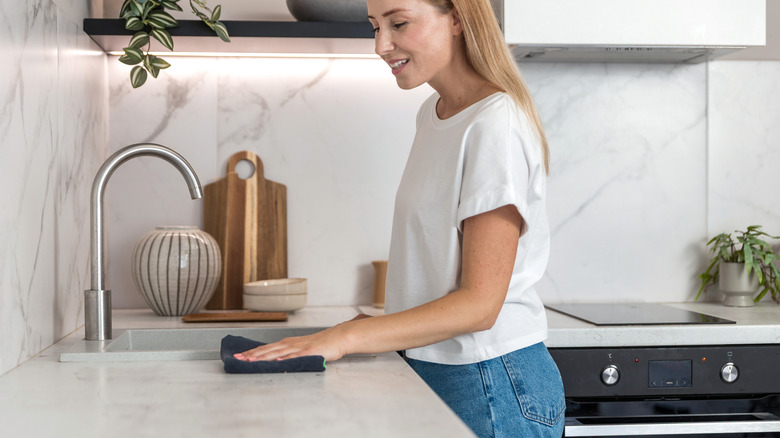
If you've already installed either material, our expert has a few easy-to-follow tips to help you elongate your counter's lifespan. When it comes to quartz, she shares, "Always use a trivet. Quartz can take everyday wear, but the resin can't take a pan straight off the stove." This is non-negotiable, or else the resin binders in your countertop will get discolored and may crack with repeated use. And though it's low-maintenance, "Clean it with mild soap and water and skip bleach, abrasive pads, and harsh degreasers, which break down the finish over time," directs our expert.
With marble counters, Lerner recommends, "Seal it every six months to a year, and test it by dropping water on the surface. If it darkens instead of beading, it's time." And despite regular sealing, don't let acidic substances, such as lemon juice, vinegar, or tomato sauce, sit on the surface. The same goes for any oil spills and upturned bottle of red wine. Clean them immediately to avoid etching and risk your counters losing their inherent shine. Also, "Use a pH-neutral stone cleaner only," she emphasizes. To prevent permanent etching, she further cautions against using cleaning vinegar or chemical descalers, even if you're dealing with mineral spots. And if you want your counters to look good as new year after year, our expert advises, "There are new products available that are films that can be applied directly over natural surface countertops to make them more durable. Choose a honed finish over polished. Etching still happens, but it blends in instead of showing up as a shiny-dull patch."