

The Unique Fridge Feature From The '50s We'd Love To See In Kitchens Again
We may receive a commission on purchases made from links.
Most people take the setup of the interior of a fridge for granted: a few shelves, a produce drawer, and a bin or two for specialty items. However, when you're digging through the back of the fridge for a jar of sauce, only to knock over three other containers, the inside setup becomes a lot more important. Shelves that are deep, crowded, and hard to see into are a big reason food gets forgotten and wasted.
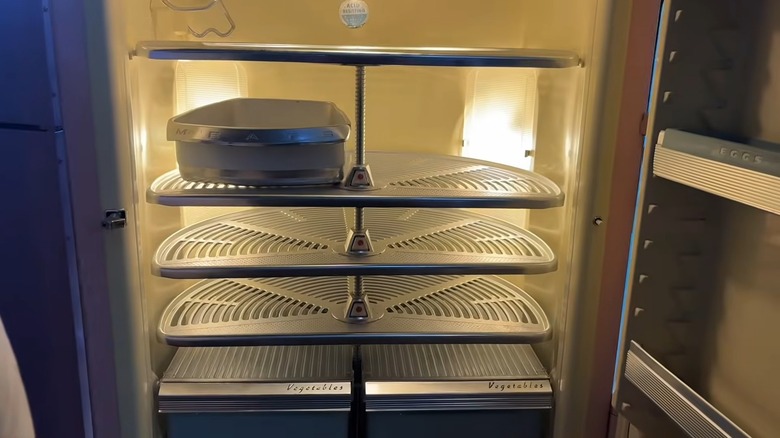
Fridge designers in the 1950s had a clever fix for this: lazy Susan shelving. It is a turntable-style, rotating shelf that lets you spin the contents toward you instead of you reaching blindly into the back. It keeps condiments, leftovers, and produce within easy reach. That can mean less clutter, less food lost to the back corners, and a lot less hassle finding everything. It also makes shopping for new produce simpler, as you can quickly see what's going bad and what can last you another week.
Today's refrigerators are packed with touchscreens and smart sensors, but few of them solve the simplest problem: being able to see and reach everything. When an appliance like the '50s fridge adds to organizing a kitchen, it makes you wonder why it disappeared. There's no single reason, but the most likely reason is that refrigerators grew larger over the years, and as new designs flooded the market, the interior features were updated, too. Since a half-circle or round shelf didn't use all the interior space, a rectangular shelf makes more sense. But if you want this feature in your fridge, you don't have to wait for manufacturers to bring it back; you can add a lazy Susan to your existing fridge for a few bucks.
How to add lazy Susan shelving to your fridge
If you can't swap out your whole fridge, you can borrow the idea from '50s models. A simple rotating turntable, like the Lamu Lazy Susan Turntable Organizer, can store as many as 20 jars for a fraction of the price of a new appliance. It comes in different sizes; to make sure it rotates easily, your fridge should be roughly one inch larger than the length of lazy Susan. For example, Lamu's 14.56-inch lazy Susan needs a length of 15 ½ inches and a width of 12 inches within the fridge to be able to turn. As for how it works, the Lamu consists of two parts: a rotating platform and a base. The former allows it to spin on the base, and the latter has two suction cups that keep the lazy Susan attached to the shelf.
For placement, you can align the lazy Susan's long edge with the front edge of the shelf to make full use of space. And if you find that one is not enough, you can get one for each shelf of your fridge. In case the size of the lazy Susan is an issue, you can go for round ones such as this 11-inch YouCopia FridgeView Fridge Turntable, which fits a standard size refrigerator. But it comes with a trade-off as you can lose the corners of the fridge shelves and anything pushed into them would become harder to spot. Plus, you may not be able to see items in the center of the turntable. Either way, even with that trade-off, a lazy Susan or two is a small change that puts most of what's stored at the back of your fridge reachable again.