

What Does That Little Flapper On Your Toilet Actually Do?
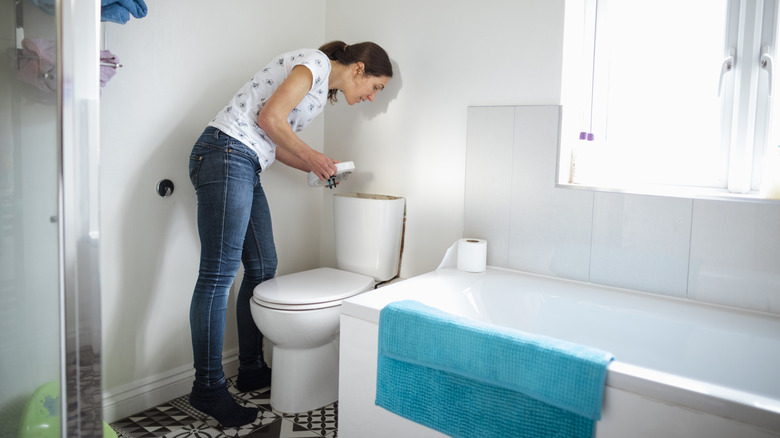
It's easy to take a toilet for granted, but if you stop to think about them for a moment you realize just how important they are. Toilets have been a huge improvement for sanitation and hygiene, and they do it with a relatively simple design. However, while most parts of a toilet are fairly straightforward, there are some that might be a bit more puzzling. If you know how a toilet works but are still confused about what the flapper in your toilet's tank does, you aren't alone. The short answer is that it controls the flow of water exiting the tank. Different types of toilets may have flapper valves that look a little different. You may have one that is a different shape, but they all serve roughly the same purpose.
In many toilets, the flapper valve is a disc-shaped piece of rubber or plastic, typically with a protrusion on the underside. The top is attached by a chain to a long, narrow piece of plastic called the trip lever. The trip lever is attached to the flush lever, so that when you push down on it to flush the toilet, the trip lever pulls the flapper valve up by the chain. This unblocks the pipe, allowing water to flow through it. Then it settles back into place, stopping the drain and allowing the tank to refill. You can think of it as being similar to the drain stopper in your bathtub, controlling how much water fills up your tub and when it drains out of it.
What happens if the flapper valve stops working?
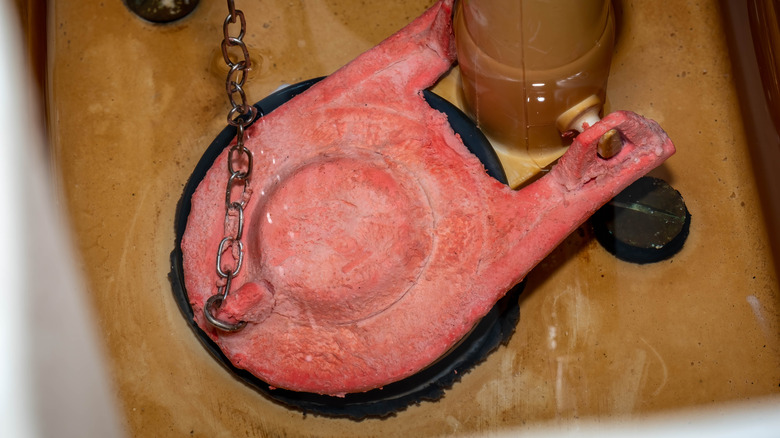
Since the flapper valve controls the flow of water in your toilet, a broken flapper valve can be a real problem. A faulty flapper won't be able to properly manage how much water drains, leading to your toilet bowl receiving too much or not enough water. If the toilet flapper won't close, is cracked, or has a faulty seal, it can't stop water from draining out of the tank. The toilet will constantly run as some amount of water, depending on the size of the leak, runs from the tank to your toilet bowl. If the leak is small, this may only be an annoyance, but it can waste water and drive your bill up. Luckily, flapper valves are fairly quick and easy to replace. That's pretty good news, considering how important of a job they do.
A flapper valve stuck in the shut position is somewhat less common, but arguably a bigger problem. If the valve can't raise, water can't leave the tank. Likewise, if it will rise but falls back into position too quickly, some water may be able to flow out but not enough. This can make it much more difficult to flush your toilet. Unlike a leaky valve, you may need to check more parts to completely fix the problem. It may be that the valve dried out and is simply stuck, but there could be an issue with the flush lever itself or the chain connecting the valve to it.