

Smart DIYers Use A Stock Tank For An Off-Grid Hot Tub

What do you do with the water tank when the cows have gone? If you're YouTube user MadisonClysdalee, you turn it into a hot tub. Turning watering or feeding troughs into a stock tank into a swimming pool is an idea that was popularized a few years ago. In actuality, stock tanks are too small to be more than wading pools, but if you could add heat, they'd be just the right size for soaking away the cold weather chills.
This particular DIY uses a large, galvanized steel stock tank for the tub. MadisonClysdalee's idea is to generate heat with a wood fire. She formed a coil from what appears to ⅝ inch copper tubing, then she connected both ends of the tubing to the stock tank using lengths of plastic tubing and plastic couplers. When she filled the stock tank with water, the tube also filled, and because the coil was large enough for her to fit firewood inside it, she could light a fire to heat the water. The fire heats the copper, which in turn, heats the water inside the tube. The water circulates by natural convection, so she didn't need a pump. Just level the ground, set up the stock tank, fill it with water, and add the copper coil. Heat, and voila — instant hot tub.
The idea seems simple and elegant, but it's bound to come with problems. The most obvious is the danger of scalding when the temperature of the tank water exceeds safe levels. You must monitor the water temperature with a thermometer to avoid getting burned. Unlike a swimming pool heater, you can't control the heat output of a fire. If the tank gets too hot, the best you can do is put the fire out and go indoors until the water cools down.
A great idea if you do it right
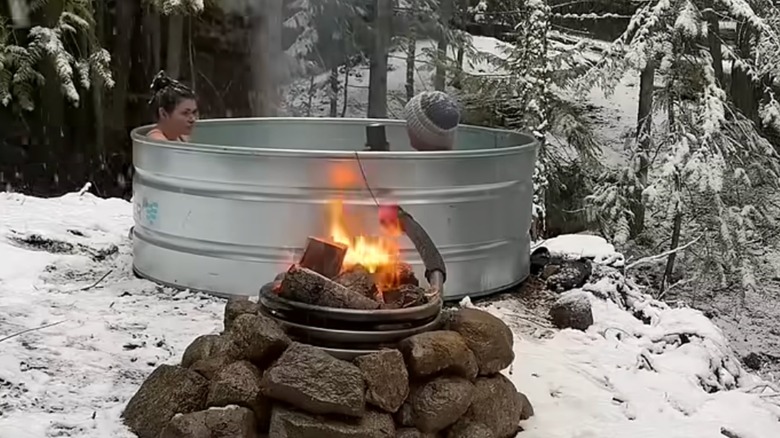
Stock tanks come in various sizes, and while manufacturers have traditionally made them from galvanized steel, some of the larger ones, like the Rubbermaid Brute 300 gal. Structural Foam Stock Tank (available from Tractor Supply for $349.99), are made of structural foam. This material retains heat better than galvanized steel — which has negligible insulation value — and would keep the tub warm for a longer period of time. Moreover, it doesn't rust.
Anyone undertaking this project will have to deal with several ongoing issues once the tub is up and running. One is the problem of keeping the water clean, which is usually the job of a filtration system that includes a circulation pump. Because this project does not use any filtration system, you may have to change the water frequently. If so, don't forget to install a drain spigot that allows you to empty the tank.
Even with a pump, a stock tank hot tub is a magnet for mosquitoes and algae during periods of warm weather. You might be able to keep both at bay if you cover the tank when you aren't using it. To control mosquitoes, set buckets of water around the tub and place mosquito dunks in them. Mosquito dunks kill larvae (not adults), and can help prevent the area around your tub from becoming a breeding ground, but they aren't meant for hot tubs; please don't put them directly in the tub water.