

Replace Gazebos With A Durable And Adjustable Alternative
We may receive a commission on purchases made from links.
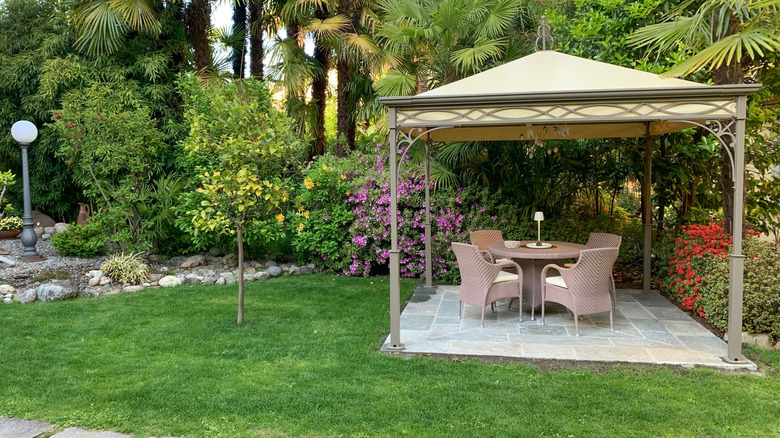
For a long time, gazebos have offered luxury along with protection and comfort. But many haven't adapted to today's homeowners' needs, where flexibility, weather responsiveness, and year-round usability matter just as much as shelter. Fabric-roofed gazebos tend to rip, develop mildew, and need to be pulled down before every storm. Meanwhile, hardtop gazebos solve these problems, but their roofs are fixed and fully covered, so you can't adjust them to let sunlight in. That's where a louvered pergola, such as the Sailary Outdoor Aluminum Pergola, stands out, as it features a rigid, weather-resistant roof of rotating slats.
You can open the slats to let in sunlight and work on your tan, or close them to shield the space below from rain or UV rays during the intense summer heat. This can be especially advantageous when the weather turns, since you just need to tilt the slats shut (or open) instead of dismantling anything. Plus, they can be set at an angle to cope with snow and strong winds as well. Do note, though, that not all pergolas are louvered. Pergolas traditionally have a roof made of beams and rafters, but they also come in several roof styles, such as fixed solid roofs and retractable fabric roofs. A pergola with a fixed solid roof is no more adjustable than a hardtop gazebo, and a fabric roof brings back the tearing and mildew problem.
Comparing a louvered pergola to a gazebo
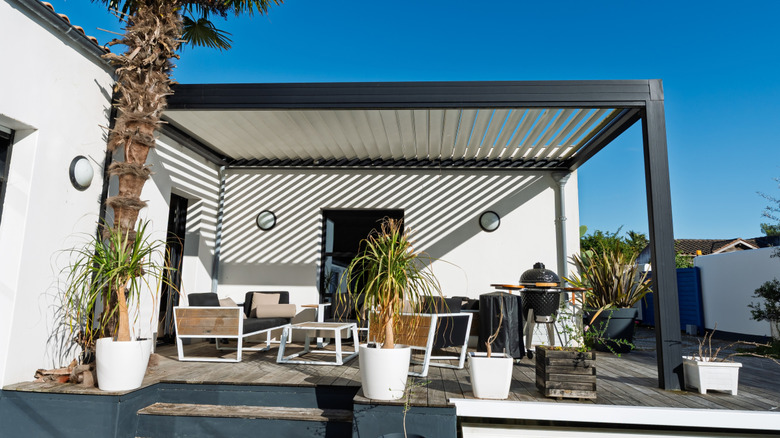
Louvered pergolas and gazebos share several similarities. For instance, both are available in a variety of materials, including wood, vinyl, and aluminum, with the latter being the most popular option as it resists rust. These outdoor structures are often freestanding and can go anywhere in your yard – although you can also attach a wall-mounted louvered pergola to your house to create a porch-like outdoor space.
Of all the parts of a pergola, the roof is what sets it apart from a gazebo. Louvered ones, in particular, can be operated manually with a crank or electrically using a motorized system. Some advanced models can even connect to your smartphone and automatically open or close the slats according to the weather. Regardless, their major draw is ventilation (where gazebos often lose), which keeps the space livable during warm weather.
Entertaining is simpler under louvered pergolas, too, as they offer greater flexibility than gazebos. You can grill under a pergola in fair weather, and the open space allows smoke to escape naturally, whereas a gazebo's closed roof tends to trap it. Outdoor furniture and decor layouts become easier as well, since you get to bring your old (or brand-new) L-shaped couch or rectangular dining table into the space. Traditional hexagonal and octagonal gazebos, on the other hand, can make it difficult to fit these pieces. Of course, it's worth noting that these benefits come at a higher price, with louvered pergolas usually costing between $1,000 and $10,000.