

Swap Your Curtain Rod For This More Minimalistic Alternative

We may receive a commission on purchases made from links.
When choosing drapery, you might put a lot of thought into the coverings themselves, but not much into what's holding them. Curtain rods are often the go-to, but if you're after subtlety, a curtain wire is a minimalist alternative. A curtain wire consists of a thin, taut wire that holds the curtain between two mounts. They're amongst the most minimalist ways to hang a curtain (outmatched by a ceiling curtain track system), offering a low profile way to hang window treatments.
A key benefit of a curtain wire is its ability to blend into the background. The wire itself is visible, but much thinner than a curtain rod, and the mounts tend to be sleek, small, and unadorned. If the length is short enough, there's no need for a center support bracket, which can be a clunky and obtrusive part of using curtain rods. Sans center bracket, there's less visual interruption, plus the ability to run a single curtain along the length. In particular, the inconspicuous look suits ultra-minimalist spaces and anywhere you don't want heavy curtain hardware. It can be ideal for small rooms where rods can look heavy and overbearing, or in spaces where you want the curtain to be the main focus.
Aside from the understated appearance, curtain wires can also be very affordable. For example, the UrbanRed Curtain Wire Rod Set includes just over 16 feet of wire and costs around $22 on Amazon. IKEA sells the DIGNITET Curtain Wire, which also includes around 16 feet of wire but without mounting accessories, for $16. That's an economical price for curtain hardware that looks more sleek and high-end than bulky rods.
What are the downsides of curtain wire?
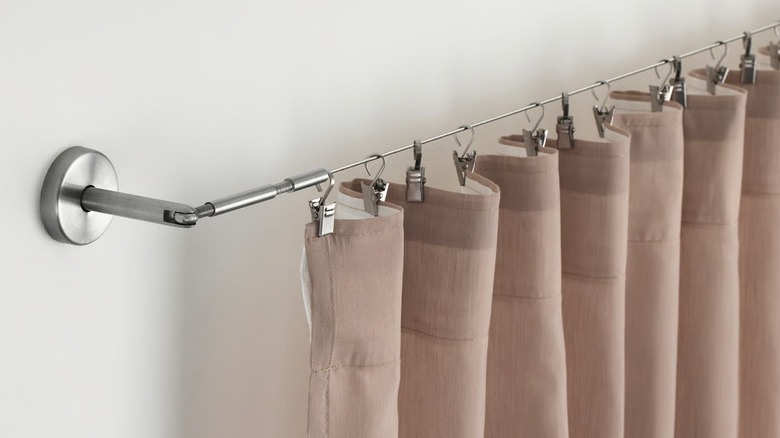
Curtain wire systems aren't the perfect hanging solution. Metal wire is very durable, but its flexibility can pose a problem: To look nice, the system requires good tension. In an ideal world, a curtain wire needs to be tight enough not to sag yet suitable for home-mounting and DIY installation. Available products tend to work best with very lightweight curtains, like sheer curtains.
For example, the DIGNITET Curtain Wire advertises a maximum weight capacity of 11 pounds. This product also recommends using extra support fittings for lengths longer than 55 inches. Depending on the system, your space, and the curtain weight, you might have to use middle supports, though they will often look subtler than those for rods. These metrics will vary between products and what type of curtains you choose to hang. Even with proper installation, curtain wire can sag over time, which can lead to a bowed appearance where the curtains droop in the middle. To be fair, this can happen with some metal curtain rods as well. Depending on the installation process, you can go back and adjust the tension on some wire systems, a feature to look for if you want to maintain a picture-perfect appearance.
However, with these cons in mind, you still might love the idea of curtain wire for your bedroom, kitchen, or living room curtains. If you want a super airy look, mount your curtain wire to the ceiling to really make flowy floor-to-ceiling curtains a focal point. Or, if you're layering sheer curtains under another window treatment, a curtain wire is less bulky than a double-rod setup. So while they're not the best choice to hold up heavy velvet drapes, they absolutely have their uses and can be a worthwhile curtain rod alternative for lightweight treatments.