

Forget Drywall: An Affordable And More Durable Alternative To Consider

For a lot of people, a plywood wall just sounds wrong, like freezer burn, old news, or gluten-free bread. In fact, interior walls made of anything other than gypsum board seem odd in 21st-century America. One pictures the unfinished exterior sheathing of new construction or the look of OSB or plywood garage walls. But it turns out that plywood has some distinct benefits and certain charms you simply can't replicate with drywall.
Plywood is made by bonding together multiple plies of wood veneer, with each ply rotated so that its grain is 90 degrees to the previous layer. This makes for a strong and stable sheet good that resists expanding, contracting, and warping. When used to sheathe the exterior of a home, plywood adds rigidity to a structure.
In addition to those standard advantages and disadvantages of plywood, it has aesthetic value as well. If you stop picturing the coarse-grained, sometimes knotty look of pine plywood and think instead about the refined, subtle grain of Baltic birch or white oak, things get clearer. The effect of plywood walls depends on the installation method and the face veneer. Plywood sheets butted against each other might create a more cabin-y feel, while sheets installed with a uniform "shadow gap" between them evoke a more contemporary look. (Mounting systems are available that make this easier than it sounds.) Hardwood veneers have different qualities based on their grain: Birch, maple, and white oak can create a modern, Scandi, or midcentury feel, while oak brings traditional warmth and walnut, mahogany, teak, and cherry bring the richness (and often require the riches).
Pros and cons of plywood walls
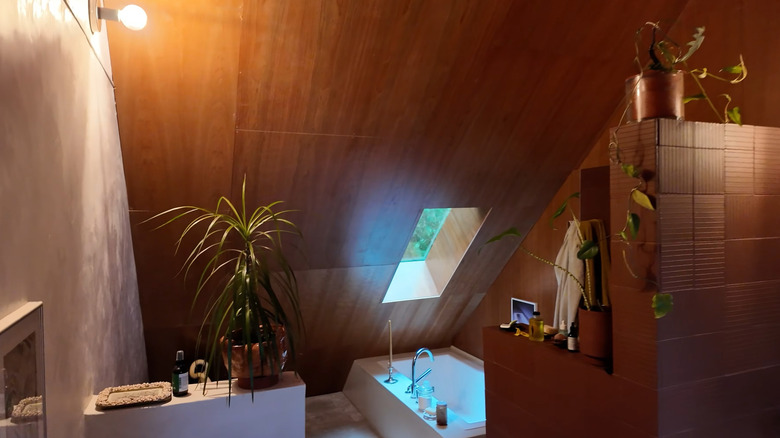
The advantages of finished plywood over sheetrock are well-defined and might drive whether and where you might choose to use it as a wall material, and where you might stick with drywall. In addition to its strength, plywood is more impact-resistant than drywall. It's easier to install, easier to mount heavy things to, and easier to replace when you damage a sheet. Plywood offers better thermal insulation and, when treated, handles moisture far better than paper-covered gypsum board. The downsides are higher materials costs and slightly worse acoustics. Plywood can also be somewhat more demanding of your carpentry skills, depending on your installation, since you won't have seam tape and mud to disguise the joints between boards, like you do with drywall. And in some states and municipalities, building codes require that wall materials are fire-rated, as Type X drywall is.
But the biggest stumbling block to installing plywood walls might, at first glance, be the expense involved. Both plywood and drywall have increased in price dramatically over the past decade (plywood by 51.4% and drywall by 60.2%), and when we priced ½-inch drywall and appearance-grade plywood at a national big-box DIY retailer we found that drywall averages $22.24 per 4-by-8 sheet, while plywood costs $57.11 on average. (Sanded plywoods are available at lower prices, but be careful to read reviews. Some are prone to chipping when cut, and must be cut with extreme care to avoid an unacceptable finished look.) But we have a suggestion that just might get you around the price difference, or at least make plywood competitive.
Making plywood walls work
YouTuber and builder Derek Dollahite is decidedly critical of drywall's fragility, and attributes a lot of the hesitation about wood walls to "the trauma that people feel from the wood paneling that was popular in the '50s, '60s, [and] '70s." Dollahite says that plywood is more sustainable because of how easy the material is to reuse — not drywall's strong suit — and advocates for installing it using hidden fasteners or screws rather than construction adhesive to preserve the material better. Dollahite recommends 1/2- and 3/4-inch plywood and says you can save money by buying from a lumberyard that specializes in plywood and specifying shop-grade rather than A or B face grade plywood that has one good side with occasional minor imperfections in its veneer, but is usually indistinguishable from better grades.
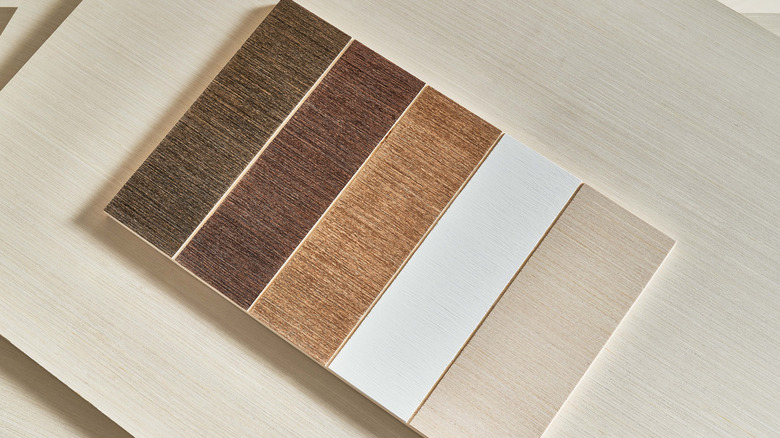
Another effective, and somewhat opposite, approach is to go with a thinner (and much cheaper) version of plywood, more akin to Lauan or old-school paneling. A Patriot Timber Products 1/4-inch plywood called SurePly is actually intended as a flooring underlayment. SurePly costs $23.00 for a 4-by-8 sheet, versus more than $37 for another brand of sanded plywood and over $48 for a sheet of 1/4-inch birch plywood. SurePly has a lot going for it: NGBS Green certification, a smooth surface, a delamination-free core, and score-and-snap installation. But the real wow factor comes from its engineered veneer "grain," a sort of striated pattern on the side not marked for subfloor installation, which resembles its thicker sibling, RevolutionPly. The surface can be left natural or painted, but it looks remarkable when stained, offering a sort of very flexible MCM-like vibe.