

The Best Mulch To Smooth & Level A Bumpy Lawn With Exposed Tree Roots
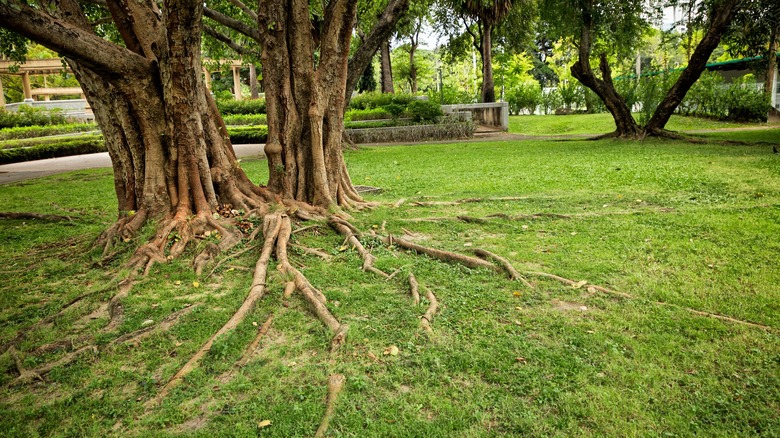
If your lawn looks a little uneven or bumpy, tree roots might be the cause, and they aren't easy to manage. Tree roots create obstacles for people walking on the lawn or mowing. You can't level the bumps the way you can with those caused by dirt, nor can you simply chop up the roots without harming the tree. If you spread enough sand or topsoil around the tree to cover the roots, you could end up depriving the tree of water and oxygen and killing it. The best solution is to make a ring around the tree with hardwood mulch (per Purdue University Extension).
Unlike other types of mulch, particularly inorganic ones like stone, rubber, and gravel, hardwood mulch is breathable and allows water to drain. It builds up the soil as it decomposes, and because it breaks down more slowly than other organic materials, it lasts longer. Yet, not all hardwood mulch is equally good for your lawn.
The best hardwood mulch comes directly from the wood chipper. Many people, however, find their local home center, where it's available in bags, a more convenient source. You can't be sure what's in bagged mulch; it often contains lower-quality wood materials, like old pallets, that don't nourish the soil. What's more, it's compacted to fit in the bag, and compacted mulch doesn't allow air or water to reach the soil and tree roots.
Proper mulching for a healthy tree
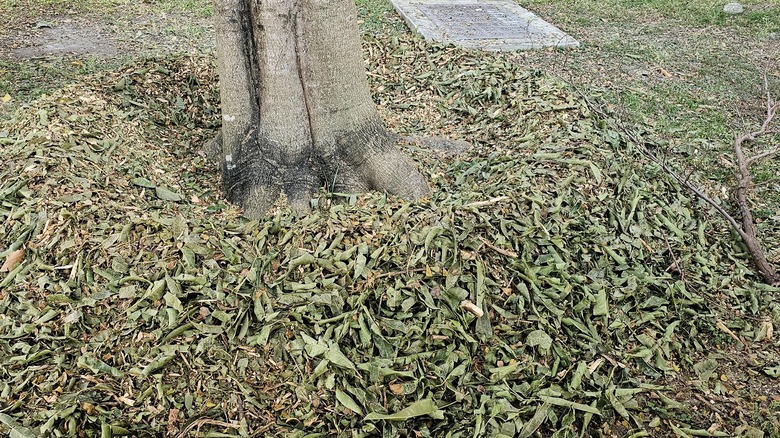
Mulching affects the ability of the roots to absorb moisture, nutrients, and oxygen. While properly applied mulch is usually beneficial, piling it on too thickly can potentially harm the tree. It might make sense to pile the mulch progressively higher as you get closer to the trunk to match the height of the roots, but the best way to do it is to leave a few inches of ground next to the trunk uncovered. This way, the roots can breathe, and it won't affect the bumpiness of your lawn. Grass growing that close to the tree is more part of the tree than the lawn.
The purpose of mulching is to cover the roots, but be careful not to apply a layer thicker than 2 to 3 inches. The donut-shaped ring can extend as far as the roots go, but it usually only needs to reach the tree's drip line (the line beyond which the ground is unprotected by the tree's foliage and gets wet during a light rain).
If mulching isn't an option, depending on the type of tree and the height and extent of its roots, another option is planting shade-tolerant groundcover over the roots. You can also try building up 1/2-inch layers of topsoil and new grass over several seasons.