

Make DIY Electrical Work Safer With The Help Of This Pocket-Sized Tool
We may receive a commission on purchases made from links.
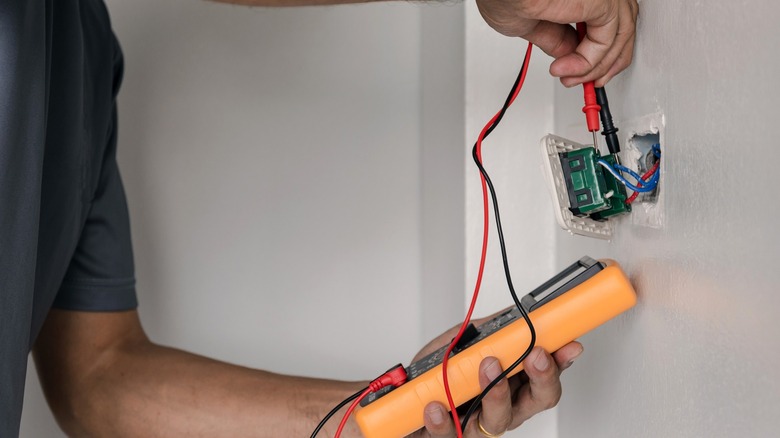
Whether you're a homeowner doing a minor wiring repair, a general contractor working on a remodel, or an electrician doing a new electrical installation, you need a way to test wires before you work on them. The old-school method is to touch the two leads of a voltage tester or multimeter to the wires you're testing, and note whether you get a light or a positive reading. However, if you have a non-contact voltage (NCV) tester like the Fluke 1AC II VoltAlert non-contact voltage tester, you can do a voltage test more safely, without touching any wires.
How is that possible? An NCV tester detects the presence of electricity in a wire by capacitive coupling. Without getting too technical, capacitors are devices with two conducting plates separated by insulating material used for storing electrical charge, and an NCV tester needs two of them to work. One is formed by the tester, the wire, and the air as an insulator, and the other by the person holding the tester, the ground, and the insulating layer (shoes, carpets, etc.) between them. An NVC tester won't work if no one is holding it. Using it involves simply bringing it close to or up against an insulated wire or outlet you want to check.
The Fluke tester costs just $44.99 on Amazon (currently discounted at $36.21) and is about the size of a highlighter. It needs two AAA batteries, and it only works with AC current. Fortunately, that includes all residential grid-supplied electrical circuits and systems, as well as battery systems equipped with inverters. While you can detect a live wire with this device, you need to be cautious, because it can give false readings in certain circumstances.
Using an NCV tester safely
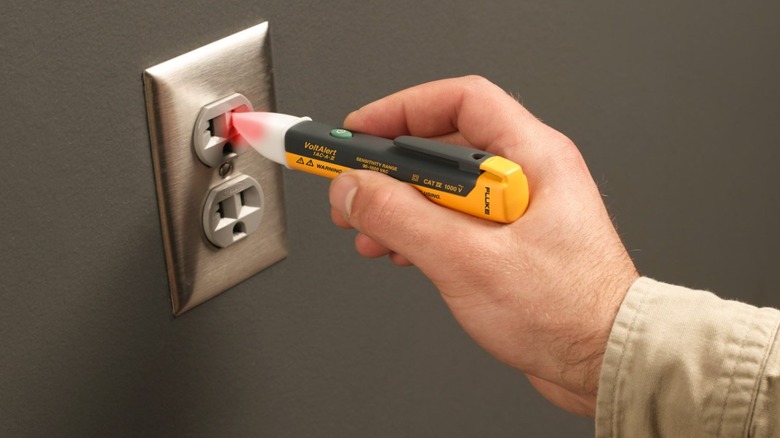
While an NCV tester is a handy tool, it is no substitute for a multimeter. It is used to detect the presence of electricity and voltage, but it can't measure the voltage, nor can it tell which wire in a bundle of wires is live. Moreover, an NCV tester can malfunction for a number of reasons, including a weak battery, excessive wire insulation or too much insulation between the user and ground (for instance, working on a fiberglass or wooden ladder), and too much distance between the tester and the voltage source. The manufacturer warns that using the tester in wet conditions can adversely affect its performance and can even be dangerous.
Taking these limitations into account, the Fluke NCV tester does come in handy when you use it properly and don't expect too much of it. Before use, you should always verify that it's actually working by bringing it close to a wire you know is live and making sure the light comes on and/or the device beeps (if it's so equipped). If, during testing, you get a positive reading from a wire you think is dead, make sure no other wires are close by. One of them could be generating the signal.
Although the Fluke NCV tester is very practical and convenient, allowing you to quickly identify a live hot wire without having to touch it, Electrical Contractor Magazine cautions against relying on it as the sole testing method. For safety, it recommends verifying with a multimeter or conventional voltage tester.