

Not Curtains Or Blinds: Add Privacy Indoors While Allowing Natural Light In

Our homes should be secure sanctuaries, which is why traditional window treatments like curtains and blinds are the go-to for supplying privacy. And yet, as much as you don't want passersby looking into your home during the day, you still want plenty of natural light in your home, so closing your curtains or blinds isn't always an option. To get the privacy you deserve without sacrificing too much sunlight, there's a clever solution, and it comes in the form of DIY plant shelves in your windows.
Windowsills are a great home for houseplants that can handle lots of sun, but no matter how many you display there, they won't provide privacy on their own. Why? Well, because outsiders can still see into your home. Multiply the amount of shelving vertically, however, and you have a way to obscure the view while also maximizing space for your houseplant collection and creating a neat mini-oasis in the room. The idea comes courtesy of YouTube channel Ugly Duckling House with Sarah Fogle. This practical and attractive alternative to add privacy to your windows does require some handy DIY work and a collection of dimensional lumber and wood cutting tools, including a jigsaw, a Kreg jig, and a drill. But if you're up to the challenge, it's a great weekend project to upgrade windows that face a busy street or nosy neighbors.
How to install DIY plant shelves for added privacy
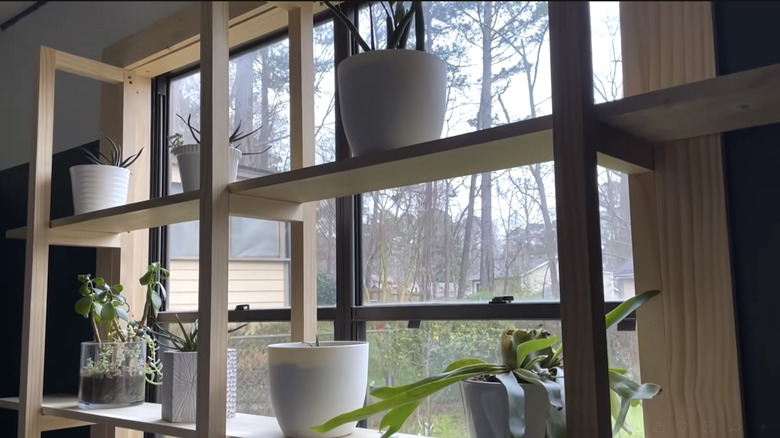
The exact measurements of the final build will depend on the size of your window, and you'll need to be wary of where the shelves sit so that you can still access the window to open it. The frames will consist of 2-by-2 lumber, while the actual shelves will be 1-by-8 or 1-by-10 boards cut to length to span the window. To begin, make three identical rectangular frames to support your shelves (you may need more if you have a particularly long window). These frames are constructed with two vertical 2-by-2 pieces and four horizontal pieces, which are joined together using wood glue and screws in pocket holes.
To make each rectangular frame, measure the height of the window frame (the distance between the sill and the head), and cut the vertical 2-by-2 pieces to fit it. Install the four horizontal cross-pieces (cut to length to equal the width of the shelf boards) between the two vertical pieces, spacing them equidistantly from top to bottom. This allows for three shelves across your window, although you may add more horizontal pieces if you have a tall window that requires extra shelving.
If needed, you could also drill a box frame inside the perimeter of your window with 1-by-4 boards before assembling your frames and shelves. The three shelf support frames can then be fixed to this window box frame, with one at either vertical edge and one in the center running vertically across the middle of your window. Once the frames are fitted, the shelf boards simply rest on each frame's horizontal supports. It's a good idea to keep the plant shelves long so they extend past the window.
Decorating your plant shelves for low-maintenance privacy
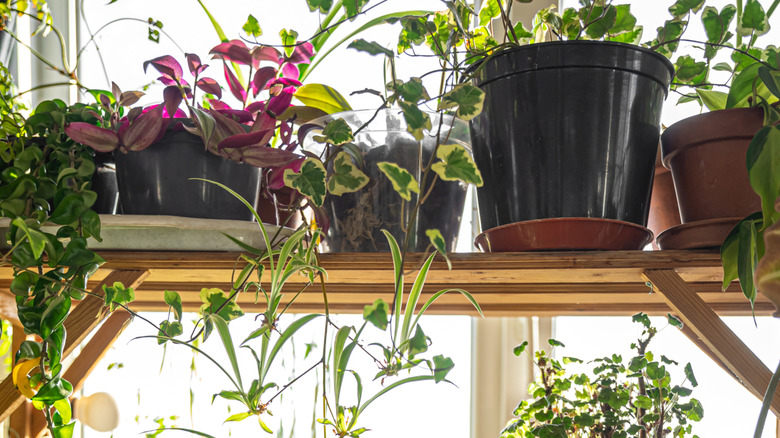
After completing the shelves, you can start decorating them with different types of houseplants. You'll want to choose privacy plants with plenty of foliage to obscure the view inside your home. Varieties like snake plants, golden pothos, and Blue Star ferns are all great options because they have dense foliage and do well in bright light. That said, you should be wary of placing houseplants in south-facing windows where direct light could scorch leaves. Reserve these windows for sun-loving plants like cacti, succulents, and tropical plants like bird of paradise.
The more plants you use, the more privacy you'll have in your window. Be sure to include a mixture of tall varieties for height, bushy types to fill in the spaces between your plants, and trailing plants that bridge the gaps between the individual shelves. You'll also need to turn your houseplants occasionally to make sure the leaves all receive plenty of light and ensure growth is even. There you have it — a beautiful alternative to curtains and blinds that offers privacy in the home, gently filtered natural light, and even a more enjoyable view for any passersby who happen to sneak a glance through your window.