

Forget Tile Backsplashes: The Mid-Century Modern Alternative For Your Kitchen
We may receive a commission on purchases made from links.
Tile backsplashes are the default for several reasons. They're easy to clean, unobtrusive, and long-lasting. However, they're certainly not the only option on the market. If you're looking for retro-inspired kitchen decor ideas, you might want to consider a mid-century modern classic: teak. This warm golden wood was highly popular in the '50s and '60s when it was used for cabinetry, furniture, and even wall paneling. A particularly hard wood, teak is renowned for its durability and is often used in outdoor furniture due to its natural weather resistance. The wood contains a high amount of oil, making it resistant to water, another great feature in a kitchen backsplash.
Incorporating teak as a backsplash can allow you to retain an element of continuity within your kitchen. If you already have warm wooden cabinets, the backsplash can feel more like an extension of your cabinetry than a standalone element. However, to prevent the kitchen from feeling overly dated, you'll want to ensure that you pair the wood with contemporary touches that complement its warmth without overburdening the space. Think brass fixtures, quartz countertops, and light-colored walls. This will allow the wood to create a strong, retro focal point without it making the space feel dark or dated.
Important considerations when choosing teak
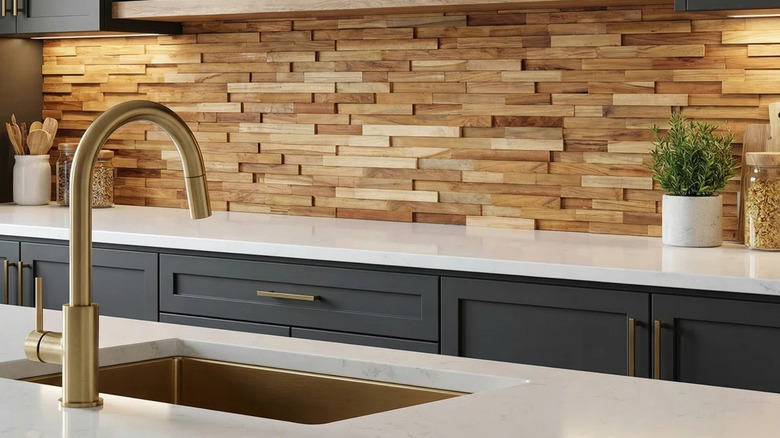
There are a few things to consider before installing a teak backsplash. First of all, although teak is naturally water-resistant, it still should be sealed to maximize its endurance and lock in that signature warm golden color. A natural finish, like tung oil or Danish oil, is a good option for preserving color and showcasing the wood grain. It needs reapplying every six to twelve months to prevent the wood from gradually weathering to a silvery gray.
Alternatively, if you're looking for something a bit more low-maintenance, an oil-based polyurethane holds up better against daily moisture contact and needs far less upkeep once it's fully cured. It's also important to remember that, since it's wood, teak is obviously flammable in a way that a tile backsplash is not. So, make sure to check your local building code for the required clearance between a wood backsplash and your stovetop before you finalize your layout.
If you're looking to implement a teak backsplash, you don't necessarily need to shell out for solid wood. Instead, you can use teak veneer sheets like these from Oakwood Veneer Company. Veneer has the same mid-century modern warmth, without the weight or installation expense. If you'd like more texture, panels like Stone Ten's Backsplash Boards, can also be a DIY-friendly option.