

The Centuries-Old Home Decor Trend That's Taking Over In 2026
We may receive a commission on purchases made from links.
Can something really be called an interior design trend if it's existed for centuries? Well, one of 2026's hottest decor trends is the tapestry, a stylish wall hanging that was popular during the medieval period. The golden age of European tapestry is considered to have taken place between the 14th and 17th centuries across France, Belgium, and England, and the creations from this period have had the most enduring impact on our conception of the art form — think the famous Unicorn Tapestries. And, while it may seem implausible that such an antiquated art form would be sweeping across design boards in 2026, Steve Larkin, co-founder of Lark & Larks, told Homes & Gardens, "Tapestries are trending again because they are a way to incorporate historical motifs and styles into modern homes." You don't have to purchase a house that looks just like a medieval castle to enjoy this aesthetic.
Tapestries were originally used for practical as well as artistic purposes, designed to offer insulation in drafty stone palaces, as well as to provide visual documentation of historic battles or other significant events which glorified the families who owned them. Generally commissioned by nobility, the only people who could afford such luxuries, tapestries took years to complete and were woven on such a scale that they could cover entire walls in castles and churches. However, they were also highly practical, easily rolled up and transported between stately homes in a way paintings could not be. As the art form progressed, tapestries came to depict mythological, biblical, and pastoral scenes, often with subtle political messaging woven in.
Why tapestries still work today
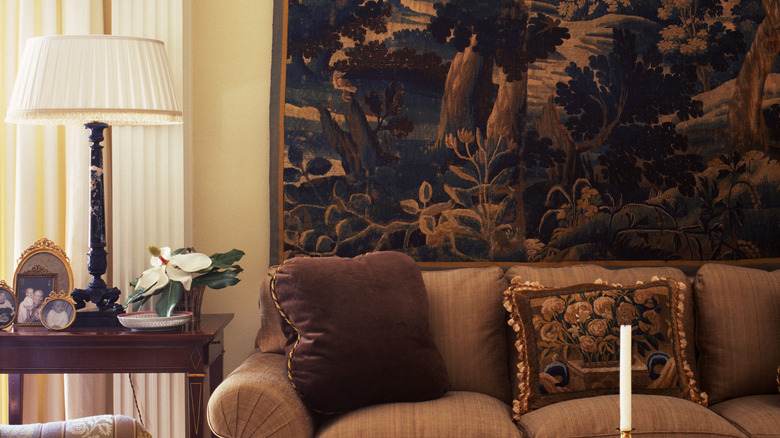
Today, tapestries still feel luxurious, indulgent, and decadent, instantly elevating a space with timeless elegance and an intellectual aplomb. "To us, tapestries are such an unexpected, eye-catching way to fill a wall," founder Bella Valeniza and creative director India Holmes of Pelican House told Country Living. "They instantly bring warmth and texture, and a sense of depth and layering we love." Plus, modern-day tapestries are every bit as functional as their historical antecedents. Tapestries can add insulation to your space, as well as offer an element of sound absorption if you're looking to block out noisy neighbors. Their size is another benefit, as they can easily cover any unsightly cracks or stains on a wall, providing a dramatic focal point for the room with one, bold statement piece.
Fortunately, you don't need to scour antique markets or haunt auction houses to acquire your own tapestry if you're craving the medieval aesthetic, as lots of contemporary alternatives at a wide range of price points are available from places like Wayfair, Anthropologie, and of course Etsy. To really get creative with your tapestry, try using it as a stand-in for your headboard, layering it behind other artwork, or even overlapping multiple tapestries to really play with texture. Tapestries also make a low-effort alternative to a gallery wall, as they generally only require one nail or hook from which to hang, making them a great choice for renters fearful of making any permanent holes in their walls.